


Manas Dasgupta
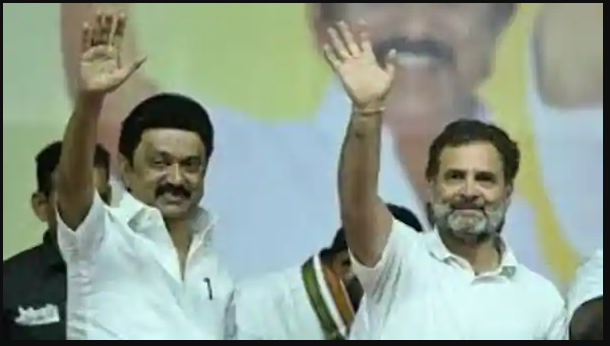
NEW DELHI, Jan 18: Amidst speculations of the Congress shifting to the Tamilaga Vettri Kazhagam (TVK) camp launched by the actor-turned-politician Vijay, the party high command taking a long-term view on Sunday has decisively shut down all talks about exiting the DMK-led alliance in Tamil Nadu and directing the state leaders to refrain from airing any dissenting views in the public.
The decision was taken after a marathon closed-door meeting keeping in focus that the party cannot afford a rupture, politically or electorally, at this stage with the DMK as it looks ahead to the 2029 Lok Sabha elections.
The meeting, attended by 42 leaders from the state, not only reaffirmed the centrality of the DMK alliance to the Congress’s national strategy but also saw the Tamil Nadu leadership formally place before the high command a detailed report cataloguing what it described as a pattern of public dissent and contrarian positioning by the party’s research cell head Praveen Chakravarty, a move that underscored the leadership’s resolve to restore discipline and draw a line under internal drift.
The discussion, led by Congress president Mallikarjun Kharge and attended by Leader of Opposition Rahul Gandhi, made two things clear: the alliance with the DMK will not be disturbed, and internal dissent about the alliance should no longer be aired in public. The overwhelming sentiment, participants said, was in favour of remaining firmly within the DMK alliance, but on stronger terms.
Sources said Kharge pointedly asked why leaders were speaking out of turn. “What is the need for a high command then?” he is learnt to have asked.
Behind that clarity lay a blunt political assessment. For the Congress, Tamil Nadu remains one of the few states that has consistently delivered near-total electoral success through alliance politics — the 2019 and 2024 Lok Sabha elections, and the 2021 Assembly polls — at a time when the party’s national footprint has shrunk. Walking away from that arrangement, senior leaders concluded, would jeopardise not just the 2026 Assembly arithmetic but the party’s ability to maximise MPs in 2029, when coalition strength in Parliament will again be decisive.
At the outset, Kharge is said to have taken a firm tone, questioning why internal differences had spilled into the public domain and warning that such conduct was detrimental to the Congress-DMK alliance. Leaders were told in unambiguous terms that decisions with regard to alliances rest with the high command and that contradictory statements — particularly on social media — would no longer be tolerated. Small grievances, Kharge said, could be addressed internally. Public posturing could not.
While rejecting the idea of a break-up, leaders from Tamil Nadu laid out a detailed case for why the Congress must assert itself more strongly within the alliance. Several leaders said while power-sharing in the form of two or three Cabinet berths was desirable, what mattered more for rebuilding the party at the grassroots was decentralised representation: better accommodation in local body elections, cooperative institutions, welfare boards and even in government advocate appointments.
“This is what strengthens the party on the ground,” one leader said. Without such participation, they argued, morale of the cadre suffers and organisational decline accelerates. The meeting also took stock of the Congress’s shrinking footprint in the Assembly over the past decade: from contesting 63 seats in 2011, down to 41 in 2016, and further down to 25 in 2021, of which it won 18.
The consensus that emerged was that “more seat share means more opportunity,” and that the party should seek not less than 39 to 40 seats for the upcoming Assembly polls. Several leaders pointed out that the Congress’s representation in local bodies and allied institutions had diminished even as the alliance delivered electoral victories. Cadres, they warned, were increasingly unhappy with the perception of decline.
The most sustained criticism of the DMK alliance came from Tagore and Chakravarty, who argued that the DMK was not giving the Congress its due and that the party was being treated unfairly within the alliance. Those arguments, however, were sharply countered inside the room.
Former Union minister P Chidambaram, MPs Jothimani and Sasikanth Senthil, and several MLAs spoke strongly in favour of the alliance, underscoring its electoral significance. Chidambaram reminded the meeting that the DMK alliance had delivered “80 to 100% success” for the Congress in recent elections and that the last Lok Sabha election saw the alliance secure around 46% of the votes. He along with some other leaders also noted the absence of major anti-incumbency factors against the DMK government: no severe law and order issues, no drought or flood crisis, and no visible erosion of public support.
Karti Chidambaram added a political caution of his own. The Tamilaga Vettri Kazhagam (TVK), Karti is learnt to have said, remains untested, unproven, and inexperienced, adding that the fledgling outfit had not yet demonstrated independent strength. Actor Vijay, the leaders pointed out, had not even begun full-time politics or articulated a coherent political programme. A leader said the TVK chief was not even fighting his own cause.