








NEW DELHI, Dec 24: Amidst the controversy over alleged destruction of the Aravalli hills following new rules on the definition of the hill range, the Centre on Tuesday ordered a complete ban on new mining leases in the Aravallis.
The order came days after the Supreme Court imposed a freeze on new mining leases until a comprehensive management plan for sustainable mining is prepared. “In a major step towards conservation and protection of the entire Aravalli range stretching from Delhi to Gujarat from illegal mining, the Union Ministry of Environment, Forest and Climate Change (MoEF&CC) has issued directions to the states for a complete ban on the grant of any new mining leases in the Aravallis,” MoEF&CC said in a statement.
This prohibition applies uniformly across the entire Aravalli landscape and is intended to preserve the integrity of the range, the government said. The directions are aimed at safeguarding the Aravallis as a continuous geological ridge extending from Gujarat to the National Capital Region (NCR), and at stopping all unregulated mining activities.
The government told the Indian Council of Forestry Research and Education (ICFRE) to identify additional areas and zones in the entire Aravallis, where mining should be prohibited, over and above the areas already prohibited for mining by the centre, based on ecological, geological and landscape-level considerations. For the mines already in operation, the Centre said state governments must ensure strict compliance with all environmental safeguards and in conformity with the Supreme Court’s order.
The instructions stem directly from the Supreme Court’s November 20 judgment in the ongoing TN Godavarman Thirumulpad vs Union of India case. The court accepted a uniform scientific definition of the Aravalli hills and ranges proposed by a MoEF&CC-led committee, while explicitly directing, “Till the MPSM [Management Plan for Sustainable Mining] is finalised by the MoEF&CC through Indian Council of Forestry Research and Education (ICFRE), no new mining leases should be granted.”
The court emphasised the Aravallis’ role as a “green barrier” against the eastward spread of the Thar Desert, highlighting its biodiversity and climate significance. It rejected calls for a blanket mining ban across the range, noting that such a measure could foster illegal activities, but mandated a comprehensive, science-based MPSM modelled on plans for other fragile ecosystems like Saranda in Jharkhand.
For existing mines, the court and subsequent MoEF&CC directive require “strict compliance with all environmental safeguards” and “stringent regulation” to ensure sustainability.
The announcement comes amid intense public debate and social media campaigns alleging that the court’s acceptance of a height-based definition (hills rising 100 metres or more above local terrain, clustered within 500 metres) would “open up” over 90 per cent of the Aravallis to mining. Environmentalists and Opposition parties have criticised the criterion, warning it excludes lower hillocks critical for ecological connectivity.
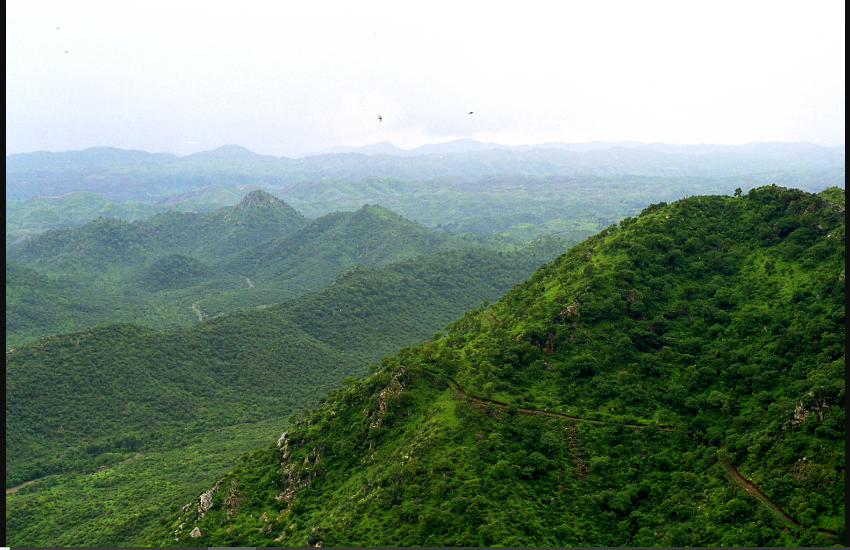
The Aravallis, one of the world’s oldest mountain systems, span Delhi, Haryana, Rajasthan, and Gujarat, serving as a vital shield against desertification and supporting groundwater recharge in the National Capital Region.
(Manas Dasgupta)