


Virendra Pandit
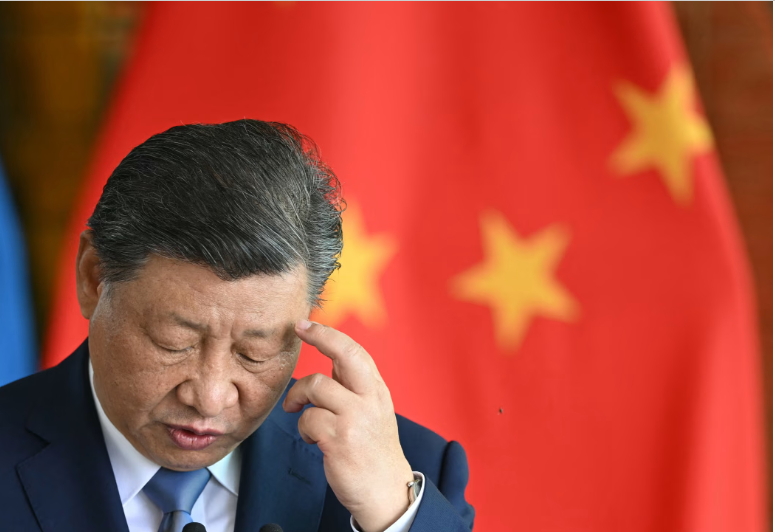
New Delhi: President Xi Jinping, who has helmed China since 2014, was ‘elected for life’ in 2023, and has been ‘missing’ for weeks, may step down by the end of 2025, the media reported on Monday, after weeks of social media speculation that he is ready to share power, or may have even been sidelined.
His reported move to share power, his health issues, his absence from the just-concluded BRICS Summit in Brazil (July 6-7, 2025), and from Chinese official media for days, have fueled rumors about his political future
Xi’s move sparked speculation that he may be laying the groundwork for an orderly power transition or scaling back his role in preparation for possible retirement. However, some China-watchers said he was busier in domestic affairs than attending international events.
Speculation about his power transition was rife after state-run Xinhua news agency recently reported that the powerful 24-member Political Bureau of the ruling Communist Party of China (CPC) in its meeting on June 30 reviewed a set of new regulations on the work of the party’s institutions.
The meeting, presided over by President Xi himself, stressed that the regulations will further standardize the establishment, responsibilities, and operations of the CPC Central Committee’s decision-making, deliberative, and coordinating institutions.
Such institutions should exercise more effective leadership and coordination over major tasks and focus on planning, discussing, and overseeing major tasks, the Xinhua report said.
While the overseas Chinese dissident community in recent months was abuzz with speculation of a power struggle within the secretive and tightly controlled CPC, an unnamed China-based political analyst said the regulations on these party bodies could hint at preparations for Xi’s retirement.
“The rules may be set up to regulate the bodies because it’s a key time for power transition,” the Hong Kong-based South China Morning Post (SCMP) on Sunday quoted the analyst as saying.
Other experts, however, averred that Xi, regarded as the most powerful leader after CPC founder Mao Zedong, may be delegating some powers to focus on larger issues.
“It does seem that Xi might pay less attention to day-to-day details, which necessitates a policing mechanism to ensure that his policy priorities are still being carried out by lower-level officials,” Victor Shih, a specialist in Chinese elite politics and finance at the University of California San Diego, told the SCMP.
His move of delegating power comes amid US President Donald Trump’s tariff war disrupting China’s USD 440 billion exports to America, besides major headwinds faced by the Chinese economy, with growth falling because of continued slowdown, and the collapse of the housing market, the mainstay of China’s economic growth.
The crisis was exacerbated by Beijing’s attempts to rein in the corporate sector, led by Alibaba’ Jack Ma, and the unsuccessful zero COVID policy of shutting down Chinese cities during the height of the pandemic in 2020-21, resulting in the industry and business coming to a grinding halt. The decline has continued.
Since he took over power, becoming the General Secretary of the CPC in 2012, Xi, who was earlier the Vice President, rapidly consolidated his power hold in the key power centres — the party, the presidency, and the powerful military as the Chairman of the Central Military Commission (CMC) — the overall high command of Chinese armed forces. He is currently the President, the CPC General Secretary, and Chairman of the CMC, among others.
As he firmed up his grip over power structures, carrying out China’s biggest anti-corruption campaign in which over a million officials were punished and dozens of top generals, ministers, and diplomats purged, Xi was declared as “core leader” of the party, a designation that was conferred only on party founder Mao Zedong. Like Mao’s “teachings”, Xi’s “thoughts” are also taught in educational institutions.
Later, the key rule of the President’s tenure of two five-year terms was amended by the legislature, paving the way for him to get elected for an unprecedented third five-year term as the General Secretary of the Party in 2022 and as President of the country in the following year.
All of Xi’s predecessors retired after two five-year terms, while he continued in power with no term limits, earning him the label of ‘President for life.’
Analysts say his plan to remain in power or share power was expected to unravel before or during the next five-year congress of the CPC to be held in 2027, by which time his third term will end.