



Manas Dasgupta
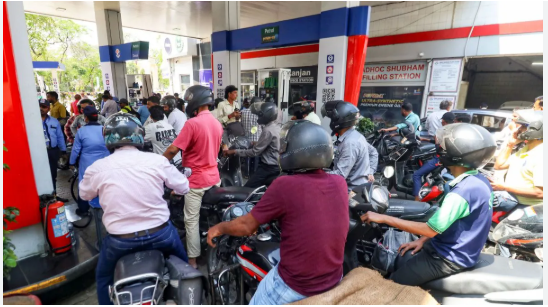
NEW DELHI, Mar 26: Amid reports of LPG shortage and long queues at some petrol pumps, the Ministry of Petroleum and Natural Gas categorically said on Thursday that India has 74 days of total reserve capacity, and actual stock cover was around 60 days right now.
According to the government, India is completely secure for the next few months, even as the country is on the 27th day of the West Asia crisis. “Nearly two months of steady supply is available for every Indian citizen, regardless of what happens globally. The next 2 months of crude procurement have also been secured,” the ministry said.
According to the ministry, the domestic refinery production has been ramped up by 40 per cent, bringing daily LPG output to 50 TMT against a total daily requirement of around 80 TMT.
The net daily import requirement has consequently come down to only 30 TMT – meaning India is now producing much more than it needs to import. Over and above domestic production, 800 TMT of assured inbound LPG cargoes are already secured and en route from the United States, Russia, Australia, and other countries, arriving across India’s 22 LPG import terminals – double the 11 terminals that existed in 2014.
According to the government, demand for cylinders has fallen after reaching a peak of up to 89 lakh cylinders due to panic ordering by consumers. Oil companies are successfully delivering over 50 lakh cylinders every day, and commercial cylinder allocations have been raised to 50% in consultation with state governments to avoid hoarding or black marketing.
The government also clarified that the claim that PNG is being pushed because LPG is running out was misinformation. It said that PNG was simply a better, more affordable and highly convenient fuel for India’s households. It, however, mandated that the LPG supply would be discontinued if consumers fail to switch to piped natural gas where such connectivity was available, under a new order aimed at accelerating gas network expansion and reducing reliance on a single fuel.
The Central Consumer Protection Authority has also directed the hotels and restaurants not to levy additional charges on the consumers such as ‘LPG charges’ and ‘fuel cost recovery’ as these tantamount to unfair trade practices and strict action would be taken in case of violation.
Stating that there was no shortage of petrol, diesel or LPG, the government urged the citizens not to believe rumours circulating on social media or resort to panic buying. Sujata Sharma, Joint Secretary in the Ministry of Petroleum and Natural Gas, said all refineries were operating at high capacity with “adequate crude inventories”, while “sufficient stocks of petrol and diesel are being maintained” and retail outlets are functioning normally nationwide.
The Delhi Public Works Department (PWD), to ensure faster laying of PNG pipelines, has decided to approve road-cutting permission within 24 hours from receiving the request, an official order said on Thursday. The PWD, which is the main road owning agency in the national capital, has also waived off road restoration charges for three months.
In a fresh order issued on Thursday, it said, “It is further directed that permission for road cutting for laying of Indraprastha Gas Limited (IGL) pipelines shall be accorded within 24 hours of receipt of a complete request, along with directions to commence the work immediately,” the order said. “The road restoration charges applicable for laying of IGL pipelines for PNG connections are hereby waived for a period of three months – up to June 30, 2026,” it added.
Meanwhile, Sri Lanka and Russia began talks on Thursday aimed at buying Russian oil to strengthen bilateral energy cooperation, authorities said. The talks were headed by the visiting Russian Deputy Energy Minister Roman Marshavin, the Russian Embassy said in Colombo.
The officials of the State oil entity were hopeful that Sri Lanka would be able to buy refined petroleum from Russia. Earlier, the Sri Lankan government said talks would be held with India on oil purchases in view of the volatile situation in West Asia due to U.S. military action.
Asian countries , including Vietnam, Thailand, the Philippines, Indonesia and Sri Lanka, are lining up to buy Russian oil as the Iran war blocks supplies, raising the possibility that demand may exceed supply, several sources, including Russia, said.
Since the war in Ukraine prompted European customers — once the biggest buyers of Russian oil and gas — to shun Moscow, India and China have accounted for around 80% of Russian oil exports. Turkey has also been a significant buyer.
But in recent weeks, a host of Asian countries have been lining up to buy Russian oil. “Demand is high, particularly for alternative destinations. As a result, a point may come when it becomes difficult to meet additional demand,” Kremlin spokesman Dmitry Peskov said.