CBI Challenges in Delhi High Court Lower Court’s Order Discharging Kejriwal and Others in Delhi Liquor Policy Case




Manas Dasgupta
NEW DELHI, Feb 27: The Central Bureau of Investigation (CBI) has challenged in the Delhi High Court the verdict of the special court in the alleged Delhi liquor policy case in which the curt not only discharged all the 23 accused including the former Delhi chief minister Arvind Kejriwal but also rapped the CBI for lapses in the investigation.
Sources said the federal agency has flagged several points that were ignored and not considered at the framing-of-the-charge level by the special court. “The Central Bureau of Investigation (CBI) has decided to appeal in the high court against the judgment of the trial court immediately since several aspects of the investigation have either been ignored or not considered adequately,” a spokesperson of the agency said in a statement earlier in the day.
The special court on Friday discharged Mr Kejriwal, his former deputy Manish Sisodia and 21 others including the Telangana Jagruthi president and former Telangana chief minister’s daughter K Kavitha, in the liquor-policy case by refusing to take cognisance of the CBI chargesheet against them.
“There was no overarching conspiracy or criminal intent in the excise policy,” the court said. In a setback for the CBI, the court said it would seek a departmental inquiry against its officials for making a public servant, Kuldeep Singh, the accused number one in the case. The CBI’s method of investigation that primarily relied on pardoning suspects and making them approver came under fire from the court. The matter which later came to be known as the Delhi liquor policy case had given a lot of trouble to the Aam Aadmi Party (AAP) chief and his aide when they were in power in Delhi.
Special Judge Jitendra Singh rapped the CBI for lapses in the investigation, saying there was no cogent evidence against Mr Kejriwal and no prima-facie case against Mr Sisodia and the other accused. The CBI has been probing alleged corruption in the formulation and execution of the previous Aam Aadmi Party (AAP) government’s now-scrapped excise policy for the national capital.
Coming down heavily on the CBI, special judge Jitendra Singh refused to take cognisance of the CBI chargesheet against the 21 people. It also observed that the federal agency’s case did not withstand judicial scrutiny, especially when the CBI sought to construct a narrative of conspiracy on mere conjecture.
The CBI tried to build a conspiracy narrative, but one founded on only conjecture instead of solid proof, the court of special judge Jitender Singh of Rouse Avenue Court said in the case filed under the Prevention of Corruption Act. The judge said not a single prima facie case can be reliably established against any of the 23 accused.
The method of investigation that mainly used approver statements came under the court’s scrutiny. The court said the heavy reliance on pardoning an accused, turning the person into an approver, and using their statements to mend holes in the case or get more suspects, was an improper method. The judge said allowing such a conduct would be a violation of constitutional principles.
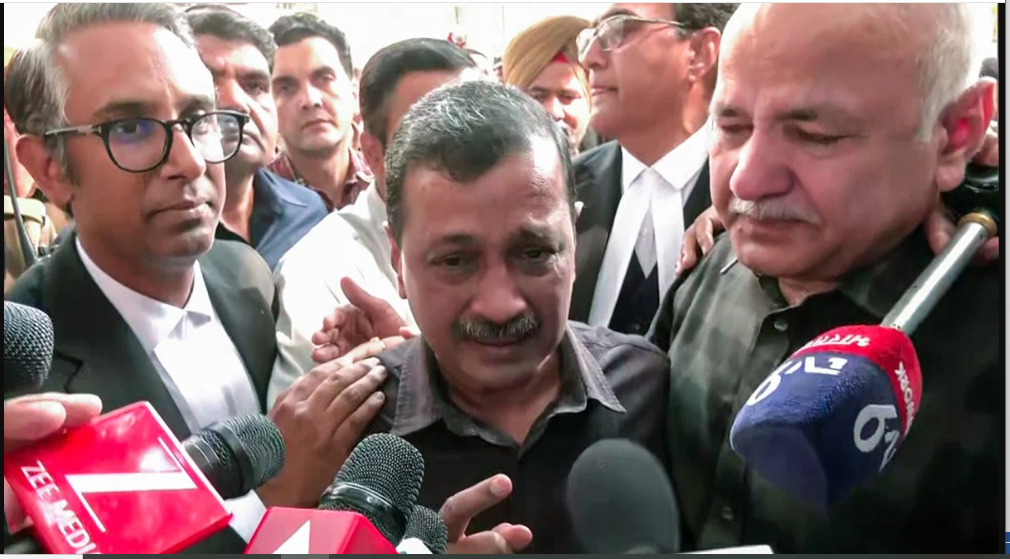
The CBI has been probing alleged corruption in the formulation and execution of the erstwhile AAP government’s now scrapped excise policy. As the news came in of the clean chit in the case that helped bring the AAP Government down, Mr Kejriwal broke down and said the corruption case against him was the “biggest political conspiracy” in the history of Independent India.
The case dates back to a liquor policy launched by the AAP government in 2021-22, which the then Kejriwal government had claimed would bring a lot more revenue than the model that existed before that. The Delhi government later scrapped it. “We always said that truth ultimately wins. I always used to say that the truth is with us. A sitting chief minister was dragged out of his home and thrown into jail. Mud was flung at us,” Kejriwal told reporters outside the court in central Delhi. The AAP’s defeat in the last assembly election was to a large extent attributed to the troubles its top leaders ran into linked to the excise policy.
The conspiracy theory was such that it “cannot survive against one constitutional authority.” Special Judge Jitendra Singh also asked searching questions of the Central Bureau of Investigation, the federal agency tasked with building the corruption case against Kejriwal. And the biggest question was the use of the term “South Group” or ‘South Lobby’, flagging it as an arbitrary and regionally prejudicial phrase. “Where did this come from?” the court demanded.
“I was concerned that terms like ‘South Group’ were used. This is not correct. If the CBI had filed the same chargesheet in Chennai, would they have used the ‘South Group’? the judge began. The court even placed its comments on record. “… the Court considers it necessary to place on record its concern with the repeated and deliberate use of the expression ‘South Group’ by the investigating agency to describe a set of accused persons, ostensibly on the basis of their regional origin or place of residence.”
“Such a nomenclature finds no foundation in law, does not correspond to any legally cognisable classification, and is wholly alien to the statutory framework governing criminal liability.” “… in a constitutional order founded upon equality before law and the unity and integrity of the nation, descriptors rooted in regional identity serve no legitimate investigative or prosecutorial purpose and are manifestly inappropriate,” Special Judge Singh reasoned.
The CBI argued the term was a useful catch-all for several accused but the claim was shot down. The agency was referred to a 2000 landmark verdict from a United States appeals court that set aside a drug dealer’s conviction because the prosecution used racial/ethnic terms. The judge pointed out that the significant case in the US was dismissed because a term was used to refer to a Dominican group. “I believe the term South Group should not have been used,” the judge said.
The case stemmed from allegations of corruption in the now-scrapped Delhi Excise Policy 2021-22 introduced by the Aam Aadmi Party (AAP) government. When the case began, the CBI had alleged that the policy looked to favour some private entities by reducing licence fees and fixing profit margins, leading to kickbacks and financial losses to the Delhi government. The CBI filed a first information report (FIR) in August 2022, based on a complaint by the then Delhi Lieutenant Governor VK Saxena.
An emotional Arvind Kejriwal on Friday asserted that the corruption case against him was the “biggest political conspiracy” in the history of Independent India. “The court has proved that Kejriwal, Manish Sisodia and AAP are ‘Kattar Imaandar’,” he said. Mr Kejriwal alleged that the “conspiracy” of the excise case was hatched to finish off AAP. It was entirely a fake case with the roles of the Prime Minister Narendra Modi and the Union Home Minister Amit Shah behind its fabrication, the fresh-off-the-hook leader alleged.
Addressing a press conference after getting a clean chit in the case, the AAP chief said they would file an application in a court for discharge in connection with cases registered by Enforcement Directorate. “BJP has thrown Delhi into chaos with problems like pollution, polluted Yamuna, damaged roads… I challenge PM Modi to hold fresh polls in Delhi and if BJP wins over 10 seats, I will quit politics,” he asserted.
Sunita Kejriwal, his wife, thanked the court and the judge for “bravery.” “Arvind Kejriwal led his entire life with honesty and for the progress of the country. But these people, in their greed for power, levelled fake charges, jailed his aides… But I had faith in God,” she said. Before the court vindication, the multi-crore-rupee corruption allegations led to the jailing of Mr Kejriwal and Mr Sisodia for an extended period of time.
After he went to prison, Mr Kejriwal resigned from the post of Delhi Chief Minister, vowing to return to the post only when he was proven innocent. Mr Kejriwal became the first sitting Delhi Chief Minister to be arrested on March 21, 2024. He got bail from the Supreme Court on September 13 of the same year. Mr Sisodia had served around 17 months in jail before being released on bail.
On the discharge, the Congress said it was a “predictable script” from the BJP and proceedings against its convenient “allies” in the AAP, and others will quietly vanish in light of the Gujarat and Punjab elections. The Congress termed the BJP a “shape-shifter, a wishful serpent — Icchadhari Naag.”
Reacting to the development, Congress’ media and publicity department head Pawan Khera said, “The BJP is not a political party. It is a shape-shifter, a wishful serpent – Icchadhari Naag. It will stoop to any level for one obsessive goal: defeat Congress – Congress Mukt Bharat.” “For 12 years, they spewed venom at the TMC. And now? Narendra Modi himself is showering it with praise – not out of respect, but to land a cheap blow at Congress,” Mr Khera said in a post in Hindi on X.
“Elections are coming. So the script is predictable. Cases against Congress leaders will suddenly accelerate – P. Chidambaram has already been dragged back into the spotlight because Tamil Nadu is going for polls. Meanwhile, proceedings against their convenient ‘allies’ in the AAP and others will quietly vanish in light of the Gujarat and Punjab elections,” the Congress leader said. “This is the BJP playbook – vendetta as governance and agencies as campaign tools,” Mr Khera said.