


Virendra Pandit
New Delhi: They have done it with India in recent weeks, with zero results.
Now, they are doing it with China as well—hoping for a different response from an equally old and living civilization.
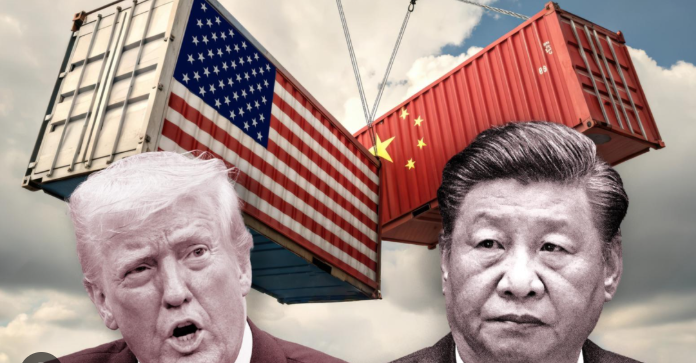
Using the age-old carrot-and-stick policy, US President Donald Trump said on Wednesday that America is already locked in a trade war with China, reinforcing his hardline stance—even as his Treasury Secretary Scott Bessent suggested a longer pause on high tariffs to resolve tensions over critical minerals, the media reported.
“Well, you’re in one now,” Trump said when a reporter asked if the world’s two largest economies are in for a sustained trade war if they cannot reach a trade deal. “We have a 100 percent tariff. If we didn’t have tariffs, we would be exposed as being nothing.”
The US President’s remarks came just hours after Bessent dangled a carrot, the possibility of extending a pause of import duties on Chinese goods for longer than three months if Beijing halts its plan for strict new export controls on rare-earth elements. The US and China agreed to a series of 90-day truces this year, with the next deadline looming in November.
“Is it possible that we could go to a longer roll in return? Perhaps. But all that’s going to be negotiated in the coming weeks,” Bessent told reporters.
Because of this policy tactic, investors remained confused. US equities extended gains after Bessent’s comments, while Trump’s remarks came after trading closed in New York.
US Trade Representative Jamieson Greer cast doubt that Beijing would go ahead with the plan, which he said would choke off trade in a wide variety of consumer products that contain even a trace of rare earths.
“The scope and the scale are just unimaginable, and it cannot be implemented,” Greer said.
Meanwhile, Bessent predicted a coordinated response from the US and several allies to China’s move, according to media reports.
“We’re going to have a fulsome, group response to this, because bureaucrats in China cannot manage the supply chain or the manufacturing process for the rest of the world,” he said at a CNBC-hosted forum in Washington.
Pointing out that “all my counterparts” are in Washington for the annual gathering of the International Monetary Fund (IMF) and World Bank this week, he said, “We’re going to be speaking with our European allies, with Australia, with Canada, with India, and the Asian democracies.”
An escalating tit-for-tat between Washington and Beijing has renewed investors’ fears that world’s two largest economies could soon be locked in a full-blown trade war.
China’s new rules, announced last week, require overseas firms to obtain Chinese government’s approval before exporting products containing even trace amounts of certain rare earths that originated in China—to ensure they are not ‘misused’ in defence-related industries.
Trump responded by threatening to impose an additional 100 percent tariff on Chinese goods by November 1, even hinting at scrapping a planned meeting with President Xi Jinping, and warned the US could cut off trade in cooking oil, a key input in biofuels.
Bessent, however, hinted that Trump might meet Xi later this month in South Korea. He might also travel to Asia before Trump to meet his Chinese counterpart, Vice Premier He Lifeng.
The Treasury chief said he expected trade announcements to be made during Trump’s Asia tour. The US President may attend a summit with the Association of South-East Asian Nations (ASEAN) in Malaysia before visiting Japan and then South Korea, which will be hosting the annual Asia-Pacific Economic Cooperation (APEC) leaders meeting.
The US is “about to finish up” negotiations with South Korea, Bessent said, adding those talks have lately revolved around the contours of a giant investment program.
The US-Canada talks are also “back on track,” he said, and indicated progress with India.
Bessent rejected the idea that stock market losses would force the Trump administration into a negotiating position with Beijing. The US won’t negotiate with China “because the stock market is going down,” he said.
He singled out a Chinese vice commerce minister, Li Chenggang, for particular criticism, referencing comments he made during an August visit to Washington. He said Li had shown up “uninvited.”
“Perhaps the vice minister who showed up here with very incendiary language on August 28 has gone rogue,” Bessent told reporters. “This individual was very disrespectful,” he said, after earlier calling him “unhinged” in the CNBC event.
Li had warned China would “cause global chaos” if the US went ahead with plans for port fees for Chinese ships, Bessent said. “Maybe he thinks he’s a wolf warrior,” he said, referring to a term used for aggressive Chinese diplomats.
Bessent said that China had initially ascribed a slowdown in the supply of rare earth magnets to a holiday — an argument that suggested “they can’t be trusted with the global supply chain.”
“If China wants to be an unreliable partner to the world, then the world will have to decouple,” he said. “The world does not want to decouple,” he said. “We want to de-risk. But signals like this are signs of decoupling, which we don’t believe China wants.”