





Manas Dasgupta
NEW DELHI, Apr 2: Heated exchanges between the treasury and the opposition benches were witnessed in the Lok Sabha on Wednesday as the House took up for debate the Waqf Amendment Bill, which seeks to amend the 1995 law governing Waqf properties to decide how the Muslim charitable properties will be administered.
While the BJP and the Centre maintained that the bill aimed at improving the management of the Waqf properties in India and have accused the Opposition of playing vote bank politics, the Congress and other Opposition parties have opposed the legislation. They have said the Joint Parliamentary Committee set up to examine the Bill did not consider Opposition MPs’ suggestions. They have alleged that the government was rushing ahead with the Bill and that was an attempt to target the minorities to gain electorally from polarisation.
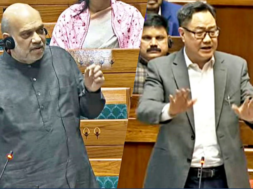
Introducing the bill, the minority affairs minister Kiren Rijiju began with jabs at the Congress, claiming the party had made “questionable” changes to Waqf laws when in power, including the denotification of “123 major buildings… given to the Waqf.” The Congress-led UPA government, he said, would have given even the Parliament to the Waqf if not stopped.
His introductory speech was rebutted by the Congress’ Gaurav Gogoi, who first accused Mr Rijiju of making “misleading statements” and labelled the Waqf amendments “an assault on the Constitution.” Mr Gogoi also asked why the Minority Affairs Ministry did not mention this bill in any of the four meetings of its parliamentary committee in 2023, a year before the amendments were presented.
“If we had not introduced this amendment today, even the building we are sitting in could have been claimed as Waqf property. If Prime Minister Narendra Modi’s government did not come to power… several other properties would also have been de-notified,” the Union Minister said.
Mr Rijiju criticised the opposition for standing against changes, insisting there would be no alterations to the management of mosques and that the amendments were “a property management issue.” “The government has nothing to do with religious sentiments,” he said, pointing out, “The role of Waqf boards is to supervise management of Waqf properties… this (the proposed law) is purely a provision for governance and supervision. It is simply a matter of property management.”
“If someone fails to understand this basic distinction… or chooses not to… I have no answer.” Mr Rijiju also pointed out the government had removed a “draconian provision” in the existing Waqf laws – a provision, he said, that allowed “any land to be declared as Waqf property.” “… previously any land could be declared as Waqf property. But we have removed that provision. This provision was misused to such an extent the number of properties increased to lakhs,” he claimed.
To emphasise his point, Mr Rijiju said temples and gurdwaras had been claimed as Waqf land despite no records of mosques in those areas. “Surendereshwar Temple in Tamil Nadu was declared Waqf… in Karnataka, thousands of acres of land… in Haryana, a Sikh gurudwara was also declared Waqf…”
“Waqf boards control the third largest pool of properties in the country, after the Railways and Defence, but those belong to the nation. Waqf properties are private…” he said, stressing also the proposed changes to the law would not be retrospective, as some opposition MPs had warned they would be.
“We have come with a very clear brief… we want the Waqf to be secular, inclusive,” Mr Rijiju said, outlining several of the proposed changes, including a contentious rule requiring two-non Muslims to be part of each state Waqf Board and the central Waqf Council. The Minority Affairs Minister also questioned the lack of female representation on these boards, declaring the government had written in provisions to guarantee at least two women members.
Speaking in favour of the Bill, the Union Home Minister Amit Shah said the Waqf (Amendment) Bill would not interfere with Muslim religious matters and properties donated by them. He said any suggestion otherwise was “fear-mongering for vote bank” and appeasement politics.” Mr Shah said the Waqf council and board came into existence in 1995, and non-Muslims would have no role in running of religious affairs.
“The opposition is trying to spread misconceptions about the Bill. The Waqf bill is not going to interfere with Muslim religious practice…appeasement politics is going on, opposition is doing vote bank politics. You…will break the nation with your myths,” he said, hitting out at the opposition.
He further said there was no provision in the Waqf bill that non-Muslims would be included in the Waqf board. “This Bill is to curb corruption going on in the Waqf board. The Waqf law was made ‘extreme’ in 2013 for appeasement; if it was not done then this bill might not have been needed. The Waqf board is not a religious body but administrative,” he added.
In his rebuttal, Congress MP Gogoi referred to a new provision that says donations to Waqf boards can only be made by Muslims who have been practicing for at least five years. “Problematic clauses are in the Waqf Amendment Bill… it is sad that the government is now giving ‘religious certificates’. Will they seek statements from other religions also? What kind of justice is this?” Mr Gogoi accused the BJP-led government of trying to defame minority communities.