


Virendra Pandit
New Delhi: An active Chinese vessel was found “hiding” in the Bay of Bengal for several days in June near Indian waters and tried to stay concealed by switching off its Automatic Identification System (AIS), a French maritime intelligence company has revealed.
According to media reports on Friday, the French company, Unseenlabs which uses satellites to track ships in the high seas, said that a 16-day-long survey of the Bay of Bengal tracked radio frequencies that showed nearly 10 percent of ships operating in the region had turned off AIS, ticking off security concerns in India amid enhanced China-Bangladesh ties.
The company tracked 1,897 vessels during the period, with most transmitting legitimate AIS signals. However, 9.6 percent showed no AIS activity, suggesting attempts to hide their locations.
It flagged a particular Chinese research vessel in close proximity to Indian waters and was constantly present in the Indian Ocean.
The report said, “While not broadcasting AIS, its radio frequency (RF) signature was consistent and traceable, enabling our systems to monitor its movement over several days… We suspect that this prominent Chinese research vessel was likely operating with strategic intent.”
The French company revealed that the Chinese vessel’s mission likely involved seafloor mapping, acoustic environment analysis, and identifying submarine transit corridors, activities that support surveillance operations and anti-submarine warfare preparedness. These activities are not uncommon in oceanographic research but defence officials say such data can be dual-use supporting both civilian and military operations.
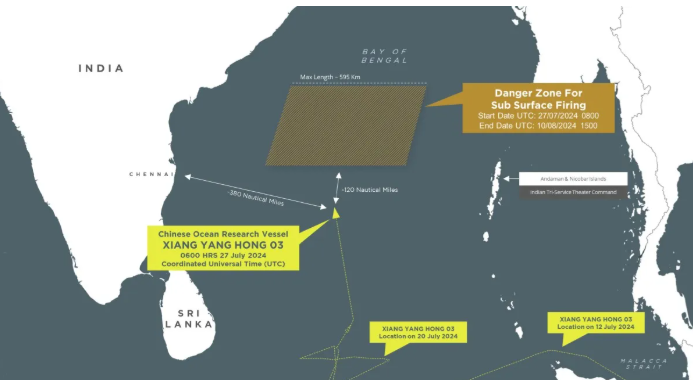
The Chinese ship was operating in international waters off India’s eastern coast, about 120 nautical miles from designated military zones.
While Chinese warships and submarines are already active in the Indian Ocean, naval planners believe it is only a matter of time before Beijing deploys its aircraft carriers to the region.
The media reported that the Chinese ‘research’ vessel raised fresh concerns about Beijing’s growing strategic presence in the region.
Found operating around 120 nautical miles off India’s east coast, outside the Exclusive Economic Zone (EEZ), was close enough to monitor naval operations and submarine activity.
In particular, seafloor data and acoustic profiling are crucial inputs for anti-submarine warfare (ASW), allowing navies to locate, track and hide submarines more effectively. The location near Indian missile testing ranges and the Eastern Naval Command base in Visakhapatnam has added to the suspicion.
The media reported that this is not the first time a Chinese ‘research’ vessel has raised concerns in Indian maritime zones:
- In March 2024, its vessel Xiang Yang Hong 01 was detected off the east coast during an Indian Agni-5 missile test.
- In mid-2024, Xiang Yang Hong 03 was observed near a Navy submarine warfare drill.
- In early 2025, Xiang Yang Hong 01 returned to the region and remained anchored for nearly three months near the Andaman and Nicobar Islands, reportedly testing autonomous underwater vehicles (AUVs).
While Beijing claims that such deployments are part of legitimate marine research, New Delhi increasingly views them as components of a broader intelligence and military mapping campaign across the Indian Ocean Region (IOR).
AIS is a globally mandated safety protocol under the International Maritime Organization (IMO) for all ships over 300 tonnes. It allows vessels to broadcast their identity, position and navigation status to others nearby. Disabling AIS near another country’s maritime zones is widely seen as suspicious and while not illegal in international waters, violates transparency norms and can be treated as a security risk.
Although the said Chinese ‘research’ vessel did not enter India’s EEZ, its location just 120 nautical miles from Indian shores gives it line-of-sight access to undersea and acoustic data valuable for both surveillance and combat deployment planning.
Indian defence officials confirmed that the ship was being monitored throughout its time in the region. The Indian Navy and Coast Guard maintain continuous surveillance of vessels around India’s maritime borders and may take up the issue through diplomatic or security channels.
Vice Admiral Rajesh Pendharkar, who heads the Eastern Naval Command, had earlier stated that Chinese research ships are denied access to the EEZ without prior clearance and are under ‘continuous observation’ when they enter the wider Indian Ocean Region.
India is also scaling up its maritime domain awareness infrastructure including seabed surveillance networks, coastal radar chains and quad-lateral intelligence sharing with partner countries such as the United States, Japan and Australia.