


Virendra Pandit
New Delhi: The February 12 parliamentary elections in Bangladesh will not only decide the fate of the multiple competitive Islamist parties—and the hapless Hindu minorities—in the South Asian country but may also impact the Vidhan Sabha elections due in West Bengal and Assam, in March-April 2026, which are fighting the menace of intruders from across the border.
In the ongoing Islamist frenzy, which has claimed the lives of over two dozen Hindus and destroyed their properties and temples worth crores, this will be the first election since the fall of the Sheikh Hasina Wajed government in August 2024. Its outcome could shape political stability and ties with India.
Nearly 12.8 crore voters are eligible to elect their representatives to the national parliament, Jatiya Sangsad. The polling is scheduled to begin at 7:30 am (local time) on Thursday, while election campaigning will end at 7:30 pm on Tuesday.
The Bangladesh Parliament consists of 300 directly elected single-member constituencies. These territorial constituencies, known as Nirbachani Elaka, are distributed based on population size across the country’s administrative districts. Additionally, 50 seats reserved for women, bringing the total number of parliamentary seats to 350.
Main players
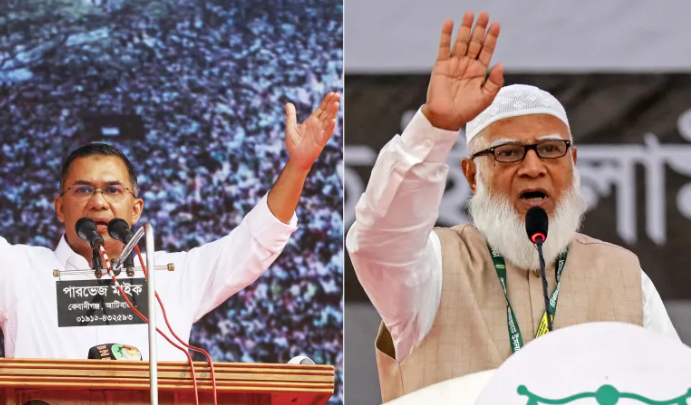
The contest, the media reported on Tuesday, is largely centred around two major political alliances. The Bangladesh Nationalist Party (BNP) is leading a coalition of 10 parties, while Jamaat-e-Islami (JIB) heads an 11-party alliance, including the National Citizen Party, formed by students who played a key role in the 2024 anti-Hasina movement.
Her party, Awami League, which dominated Bangladeshi politics for decades, has been barred from contesting the elections.
Besides, Islami Andolan Bangladesh, which split from the JIB-led bloc and the Jatiya Party, a long-time ally of the Awami League, is also contesting independently.
Alongside these elections, Bangladesh will also hold a referendum on the July National Charter, signed on October 17, 2025, more than a year after the protests that brought down the Hasina government.
Impact on India
For India, the election carries major strategic and security implications. Until Sheikh Hasina’s removal, New Delhi viewed Dhaka as a close and reliable partner in South Asia.
India was Bangladesh’s largest trading partner in Asia. Between April 2023 and March 2024, New Delhi exported goods worth USD 11.1 billion to Dhaka, including textiles, tea, auto parts, electricity, agricultural products, iron and steel, and plastics, and imported goods worth USD 1.8 billion, mainly readymade garments and leather products.
Their bilateral relations worsened after the Awami League government was toppled on August 5, 2024, and the minority Hindus, their properties, and shrines were targeted with little official action taken against the perpetrators.
Sheikh Hasina has since been sentenced to 10 years in jail in two separate corruption cases linked to alleged irregularities in land allocation under a government housing project. Her other relatives and party officials have also been targeted. She fled Bangladesh on August 5, 2024 and has since been living in India. Earlier, a Bangladeshi court had declared her a fugitive.
Responding to the deteriorating situation, India restricted tourist visas in 2025 for Bangladeshi citizens and withdrew families of Indian diplomats from Dhaka, citing security concerns ahead of the elections. In April 2025, New Delhi also ended a transshipment facility that allowed Bangladeshi export cargo to pass through Indian land customs stations to ports and airports, the media reported.
Violence
Ahead of the polls, India has again asked families of its officials posted in Bangladesh to return home, pointing to the prevailing security situation.
Media houses have also been targeted. Bangladesh’s leading daily Prothom Alo was vandalised and set on fire, forcing journalists to flee and suspending both its print and online operations.
India has repeatedly voiced concerns over attacks on minorities. Last month, Ministry of External Affairs spokesperson Randhir Jaiswal said, “We continue to witness a disturbing pattern of recurring attacks on minorities as well as their homes and businesses by extremists.”
Signs of strain have also appeared in other areas. Last month, the Bangladesh Cricket Board requested that all of its ICC Men’s T20 World Cup matches scheduled in India be shifted to Sri Lanka.
In the Union Budget presented on February 1, Finance Minister Nirmala Sitharaman halved India’s funding allocation for Bangladesh from Rs. 120 crores in 2025-26 to Rs. 60 crores for FY27.
Despite the tensions, diplomatic channels remain open. In early January, External Affairs Minister S. Jaishankar travelled to Dhaka to attend the funeral of former Bangladesh prime minister and BNP leader Khaleda Zia.