


Virendra Pandit
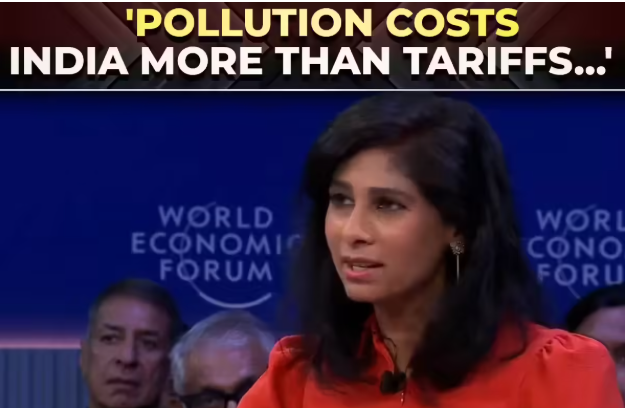
New Delhi: Former International Monetary Fund (IMF) Chief Economist Gita Gopinath on Wednesday warned that pollution poses a much bigger threat to India’s economy than the US trade tariffs.
Speaking at the World Economic Forum (WEF) Annual Summit at Davos, Switzerland, she said pollution is quietly becoming one of the most serious risks to India’s long-term economic growth, the media reported.
“Pollution is a major challenge in India, and its impact on the country’s economy is far more consequential than any impact of tariffs imposed so far.”
She explained that pollution affects much more than the impact of environment on economy. It reduces workers’ productivity, raises healthcare costs and slows overall economic activity, creating a long-term drag on growth.
“The real costs of pollution are not merely environmental… They are deeply intertwined with economic growth, productivity, and the health of citizens,” she pointed out.
Gopinath emphasized that while tariffs often dominate public and political debates, environmental damage deserves greater attention because of its lasting and wide-ranging economic impact.
Investments
Highlighting the global perception of India, Gopinath said that pollution also influences foreign investment decisions. Environmental conditions matter greatly to international companies planning to set up operations in the country.
“From an international investor’s point of view, if you are thinking of setting up operations in India and living there, the environment matters,” she said.
“India has made progress in expanding its economy and improving infrastructure, but pollution remains a persistent challenge, particularly in major urban centres,” she noted.
Impact on health
Citing a 2022 World Bank study, Gopinath said pollution causes nearly 1.7 million deaths in India every year. This accounts for around 18 percent of all deaths in the country, underlining the scale of the crisis.
She urged India to treat pollution as a national emergency and address it with urgency and commitment.
“Tackling pollution must become a top national priority. It needs to be treated as a mission for India,” she said.
Gopinath said that, besides pollution, India must also address key structural challenges such as land acquisition, judicial reforms and skilling of human capital to sustain economic growth.
Gopinath’s assertions came on a day when the Supreme Court directed the Centre and the governments of Delhi, Punjab, Haryana, Uttar Pradesh and Rajasthan to submit clear action plans to contain pollution. The apex court directed them to outline steps to implement long-term measures proposed by the Commission for Air Quality Management (CAQM) to tackle air pollution.
Delhi remained under ‘very poor’ air quality on Thursday morning, although pollution levels showed a marginal improvement. Data from the Central Pollution Control Board (CPCB) showed the Air Quality Index (AQI) was 312 at 8 am.