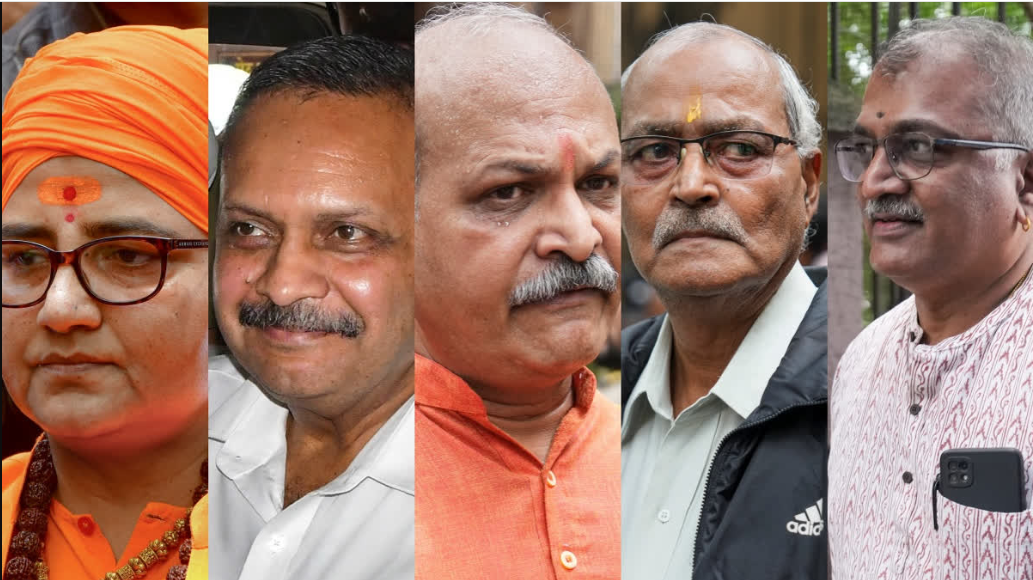
All 7 Accused in Malegaon Blast including Pragya Singh Thakur, Col Purohit Acquitted






Manas Dasgupta
NEW DELHI, July 31: Nearly 17 years after a powerful bomb tore through Muslim-dominated Malegaon town in Maharashtra killing six people and injuring more than hundred others, a special National Investigation Agency (NIA) in Mumbai n Thursday acquitted all the seven accused in the case, including the former BJP Member of Parliament Sadhvi Pragya Singh Thakur and the former army officer Lt Col Prasad Shrikant Purohit.
The NIA court has also ordered the Maharashtra government to award Rs 2 lakh compensation to the families of the victims and Rs 50,000 compensation to the injured.
The blast occurred on the night of September 29 2008, near Bhikku Chowk in the communally tense town, located about 200 km from Mumbai, during the holy month of Ramzan. The court cited lack of evidence and procedural lapses by the investigating agencies as key reasons behind the acquittal.
Special Judge AK Lahoti, presiding over the case assigned to the NIA, while acquitting the accused said the prosecution failed to prove the allegations in the case and that all seven accused deserve the benefit of doubt. Judge Lahoti said the prosecution could not prove that the motorcycle used in the blast belonged to Pragya Thakur, adding that the engine number was unclear, and the chassis number had been wiped out. The court concluded that terrorism has no religion, but it cannot convict on mere perception.
The court held that the charges against the accused were not proven beyond a reasonable doubt, stating that the prosecution failed to establish that the motorcycle used in the blast belonged to Pragya Thakur, and that the investigating agencies were unable to substantiate the case with sufficient evidence.
While reading the observation, the judge said the investigating agencies failed to prove the charges against the accused. Several technical errors were noted during the investigation. It could not be established that the motorcycle alone was used in the blast, nor was there any evidence to show that Prasad Purohit kept RDX at his residence.
The spot panchnama was found to be improper, and while the chassis number on the motorcycle may be similar to that of Sadhvi Pragya Singh Thakur’s bike, this alone did not suffice as conclusive proof. The prosecution could not establish that any secret meetings had taken place, and the voice test was not conducted as per the prescribed rules.
The other accused in the case were Major (retired) Ramesh Upadhyay, Ajay Rahirkar, Sudhakar Dwivedi, Sudhakar Chaturvedi, and Sameer Kulkarni. The case was initially investigated by the Maharashtra Anti-Terrorism Squad (ATS) before being handed over to the National Investigation Agency (NIA) in 2011. The NIA, which took over the probe, sought “commensurate punishment” for all accused based on what it described as “relevant, admissible, cogent, trustworthy, wholly reliable and proved evidence.”
According to the NIA, the blast in Malegaon, a town with a significant Muslim population, was part of a larger conspiracy intended to terrorise a section of the Muslim community, disrupt essential services, incite communal tension, and threaten internal security. The agency contended that the accused were directly involved in orchestrating the attack and played active roles in the conspiracy that led to the explosion.
The prosecution further argued that the timing of the blast, during the holy month of Ramzan and just before the Navratri festival, was deliberate, aimed at spreading fear among Muslims. The trial, which began in 2018 after the framing of charges, concluded on April 19, 2025, and the matter was reserved for judgment.
The accused faced charges under the Unlawful Activities (Prevention) Act (UAPA) and various sections of the Indian Penal Code (IPC), including conspiracy, murder, attempt to murder, promoting enmity, and voluntarily causing hurt.
The investigation was initially led by the Maharashtra Anti-Terrorism Squad (ATS), headed at the time by Hemant Karkare, who would later be killed in the 26/11 Mumbai terror attacks. The ATS made its first arrests in October 2008. The motorcycle allegedly used in the blast was traced to Pragya Thakur. Authorities claimed she had lent it to the conspirators. They alleged she was part of a group which included former military personnel and members of a little-known radical group called Abhinav Bharat.
Pronouncing its verdict, the court said the prosecution successfully proved that the blast did take place, but the National Investigation Agency (NIA) failed to establish that the bomb was fitted in the motorcycle. The court said although there were allegations that RDX was used to cause the explosion, there was no evidence that the RDX was stored at Lt Col Purohit’s residence, and neither was there any proof that he assembled the bomb. It added that there was also no evidence to prove that the bike in question was owned by Pragya Thakur.
The court also noted discrepancies in medical certificates and documentation related to the custody and treatment of some accused, citing “manipulation” in some instances. The court held that “suspicion is not sufficient ground for conviction” and the benefit of the doubt must go to the accused.
All seven accused were present at the court when the verdict was pronounced. The BJP leader Pragya Thakur broke down in court while addressing Judge Lahoti expressing the emotional toll of her years-long legal battle. Reacting to the verdict, she said the case ruined her whole life, and “God will punish” those who are guilty. “I said this from the very beginning that those who are called for investigation, there should be a basis behind that. I was called by them for investigation and was arrested and tortured. This ruined my whole life. I was living a sage’s life, but I was made and accused, and no one was willingly standing beside us. I am alive because I am a Sanyasi,” she said.
“I have endured years of humiliation,” she said, holding back tears. “I had to struggle repeatedly. Despite being innocent, I was branded with the stigma of guilt.” She added, “Today marks a victory for the saffron flag, a victory for Hindutva. The false narrative of ‘saffron terrorism’ has finally been disproven.”
Pragya Thakur’s counsel had stated that the motorcycle had been sold years before the blast and that her arrest was based on “fabricated evidence.” Lt Col Purohit’s defence said he was a military intelligence officer who had infiltrated Abhinav Bharat and was reporting regularly to his superiors. His legal team highlighted contradictions in witness statements and alleged procedural violations.
The other co-accused, including Upadhyay and Kulkarni, accused the ATS of custodial torture and claimed that their statements were obtained under duress. In April 2011, the then UPA-led central government transferred the investigation to the NIA. The agency dropped the Maharashtra Control of Organised Crime Act (MCOCA) charges in 2016 due to insufficient evidence but the UAPA and IPC charges remained in place against the remaining seven.
The NIA’s supplementary charge sheet sought to discharge Pragya Thakur, but the special NIA court declined, observing that there was sufficient evidence to proceed with a trial against her. The trial began formally in 2018. The prosecution examined 323 witnesses, while the defence brought eight witnesses to the stand. Of the prosecution witnesses, nearly 40 turned hostile. The evidence included over 10,800 documents. Written submissions from both sides ran into three volumes, amounting to more than 1,300 pages. The case was heard by five judges over its 7-year trial period. Judge Lahoti took over in 2023 and reserved the final verdict on April 19 after months of final arguments.
The verdict, however, dashed the hopes of the relatives of the victims of getting justice for their loved ones. The hardest hit was 75-year-old Nisar Bilal, who lost his 19-year-old son, Azhar, who was memorising the Quran to become a Hafiz and also worked as a fledgling refrigerator mechanic. On the fateful day, Azhar had decided to take a detour from the local mosque on his way home. That change of route proved fatal, as flying shrapnel from the bomb impaled his body, killing him on the spot. Bilal had been following up the case vigorously all these years.
Another persistent activist pursuing the case was Liyakat Shaikh, 67, the father of the youngest victim of the blast, 10-year-old Farheen Shaikh, who had stepped out to buy snacks. Over the last two decades, Shaikh has made numerous trips to Mumbai and participated in countless sit-ins seeking justice for his daughter. Surrounded by his young granddaughters, Liyakat said the verdict has left him heartbroken. “The news has made us despondent. I am at the fag end of my life. With decisions like these, I sometimes feel I will never find peace,” said Liyakat Shaikh.
While Shaikh and Bilal were deeply invested in the case, other families accepted the loss they had suffered two decades ago as fate and prioritised daily survival. One such person is Rehan Shaikh, 38, whose father, 42-year-old Shaikh Rafiq Brace, was a blast victim. Rehan said that the void left by his father’s absence and his mother’s illness forced him to start working early. Now a bus conductor on the Malegaon-Mumbai-Malegaon route, Rehan says his carefree life was overturned by his father’s death, who was killed while stepping out to eat paan after dinner.
Another affected family was that of 23-year-old Irfan Khan, an auto driver who was also killed in the blast. His uncle, Usman Khan, who runs a power loom, said while Irfan’s loss had devastated the family, survival took precedence. “My nephew died after two days of agony. Of course, we want those responsible to suffer for what they did. We may not have followed the trial every day, but the verdict has left us deeply disheartened,” said Usman Khan.
The same goes for the family of the oldest victim, 60-year-old Harun Shah, who, despite his age, continued working as a labourer. Two decades later, his son and grandsons make a living selling sandwiches outside one of Malegaon’s biggest schools. The need to survive saw then-14-year-old Aamin Shah care for his injured grandfather while his father Hussain worked as a handyman.
“My grandfather died in agony. Except for a small patch covered by his beard, his entire body was burned. I actually fell ill on the 12th day due to the nauseating smell of burned skin while taking care of him. I had hoped those responsible for this would be brought to justice,” said Aamin.