




Manas Dasgupta
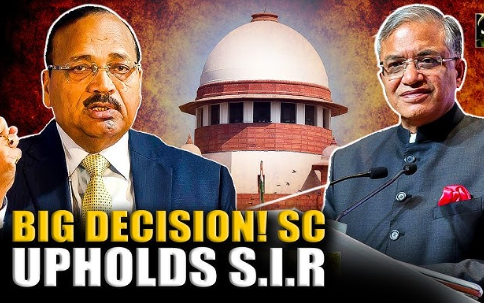
NEW DELHI, May 27: Silencing the critics of the exercise, particularly the opposition parties, the Supreme Court in a big win for the Election Commission of India on Wednesday upheld the “Special Intensive Revision” (SIR) of the electoral rolls holding it as legal and did not violate any constitutional principles.
A bench headed by the Chief Justice of India (CJI) Surya Kant dismissed the petitioners’ view that SIR was a surreptitious, backdoor move to conduct citizenship screening in the name of cleaning up the electoral roll off aliens and held that the excise furthered the constitutional principle of free and fair elections giving answers to several key questions and contentions raised by the critics of the exercise.
The petitions had accused the ECI of arbitrarily assuming powers to “determine citizenship” while overriding limitations clearly prescribed in parliamentary laws, rules and its own manual without providing “any good reason.”
The Supreme Court judgment upholding the constitutionality of the Bihar SIR would have an impact on further rounds of SIR. The ECI went ahead with the second round of SIR covering 51 crore voters in 12 States and Union Territories — including in West Bengal, Tamil Nadu and Assam —even when the Bihar challenge was pending in the Supreme Court.
The judgment pronounced by the Chief Justice in open court on Wednesday said the ECI was empowered under Article 324 of the Constitution to examine citizenship to verify inclusion in the electoral roll. This verification was not the final word on the citizenship of a person. The ECI, if it finds that a person did not have the necessary documents and did not pass the enquiry, could forward the case to the competent authorities in the Central government for adjudication under the Citizenship Act.
The court said SIR, though it stretched the modalities of electoral roll revision under the Representation of the People Act and the Registration of Electors Rules, cannot be invalidated. It was done in an exigency but was not “manifestly excessive”. The procedural safeguards of revision were complied with.
The court rejected the arguments raised by the petitioners, including the Association for Democratic Reforms, represented by advocates Prashant Bhushan and Neha Rathi, that SIR ipso facto reversed the burden of proof of citizenship on the voters.
The court said the variety of indicative documents, including Aadhaar, was a reasonable demand and part of a structured regime devised for verifying voters. The court reiterated that SIR must continue to maintain a calibrated balance in the choice of indicative documents.
The Bihar SIR hearings had seen the Supreme Court effectively intervene to make the massive exercise more inclusive. One of the effective judicial interventions was to include Aadhaar as the 12th in the list of 11 ‘indicative’ documents that voters could file as proof of their identity or residence.
The judgment said any decision taken during the SIR was subject to judicial review. The Bihar SIR hearings had seen the court remind the ECI that “the degree of transparency and access to information form the hallmarks of an open democracy.”
The apex court had pushed the poll body to publish the names and details of voters added to the final electoral roll in the Bihar SIR. The final list in Bihar had shown the total tally of eligible voters in the State as 7.42 crore. The court had directed the Election Commission to publish a district-wise, booth-level searchable list of the nearly 65 lakh voters who were purged from the draft roll along with the exact reasons for their deletion from the list.
Among the questions the apex court verdict has answered on SIR included that it upheld the ECI’s authority to conduct the SIR process under Article 324 of the Constitution and the Representation of the People Act, 1950. It also upheld the ECI’s power to scrutinise citizenship. However, the Bench clarified that the exclusion of a name from the voter roll does not automatically strip an individual of their Indian citizenship. “If a citizen does not appear on electoral roll that does not mean the citizen was unable to prove his citizenship, but shows the inability of the Election Commission to verify citizenship,” the court said. Those excluded from voter list, the court said, should be dealt with in accordance to law.
The ECI also successfully demonstrated that necessary procedural safeguards were in place, the court said. “The procedural safeguards introduced both by the Commission and pursuant to the directions issued by this Court from time to time have sought to strike a balance between the need for electoral integrity and the protection of constitutional rights,” the court said.
The Court also ruled that any deletions made must be open to further adjudication. The ECI and relevant State Legal Services Authorities are mandated to assist citizens in filing appeals for the inclusion of their names if they are excluded.