




Manas Dasgupta
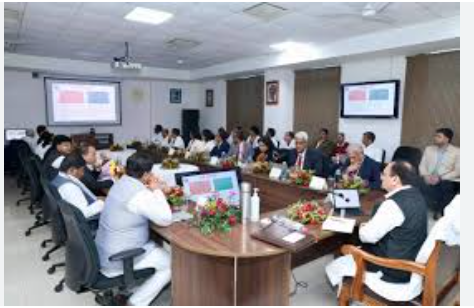
NEW DELHI, May 26: What is normal in most other states has raised eye-brows in West Bengal as concerned Members of Parliament and Members of the State Assembly belonging to the Trinamool Congress (TMC) on Tuesday attended an administrative review meeting for three districts convened by the Chief Minister Suvendu Adhikari at Kalyani, about 100 kilometres from Kolkata.
The state government has decided to ban liquor shops within one kilometre radius of an educational institution and temples, introduce over 400 public canteens to provide subsidised fish-rice meal at Rs five across the state and start distribution of registration form from Wednesday for the BJP’s promised “Annapurna Yojana” of Rs 3,000 monthly assistance to eligible women from June.
After taking over as the first BJP chief minister of West Bengal, Mr Adhikari decided to make a departure from the practice the previous TMC government headed by Mamata Banerjee followed, keeping the opposition MPs and MLAs out of even the administrative meetings. Mr Adhikari decided to follow the practice prevailing in most of the states in the country and invited all the concerned MPs and MLAs irrespective of their political affiliations for the review meeting for North 24 Parganas, Nadia and Hooghly districts held at Kalyani.
Responding positively to the invitation, MP from Barasat Kakoli Ghosh Dastidar and TMC MLAs Anisur Rahaman Biswas of Deganga, Bina Mondal of Swarupnagar, and Mohammad Abdul Matin of Haroa besides three other legislators from the Basirhat region attended the meeting that brought together officials and elected representatives from the three districts together.
For political observers, however, Ms Ghosh Dastidar’s presence carried political significance beyond its stated administrative purpose as the politically telling image is likely to deepen chatter about the churn within the TMC after its Assembly poll defeat. Ms Ghosh Dastidar had only on Sunday resigned her organisational post as the Barasat TMC district president and had been publicly airing disappointment over her treatment in the party.
Earlier, after being removed as the parliamentary party chief whip and replaced by Kalyan Banerjee, she had posted on social media: “Association since 1976, journey began in 1984. Today I have been rewarded for four decades of loyalty.” The post had triggered speculation over simmering discontent within the party, making her appearance at Mr Adhikari’s meeting instantly politically loaded. Ms Ghosh Dastidar, however, sought to play down the buzz. “Administration belongs to everyone,” she said.
The attending Trinamool legislators, too, maintained they were there solely for developmental concerns. “I have come for the development of my constituency. A total six of our MLAs have joined the meeting,” said Ms Mondal. “The State government invited us, so I came as an MLA,” Mr Matin said. Mr Rahaman said his constituency had several backward areas and required government cooperation for overall development.
Addressing reporters later, Mr Adhikari projected the meeting as an indication of departure from West Bengal’s past political culture. “When we were in the Opposition, we were not invited to administrative meetings. We decided lawmakers would be invited. The Barasat MP responded positively. Many opposition MLAs from Basirhat also joined here. We even gave one of them an opportunity to speak,” he said.
“We want people to receive the benefits of the double-engine government. Political exercises should happen only during election time; throughout the year we will work with constructive ideas,” he added.
Interestingly, the development also found support from within the Trinamool. Party MLA Ritabrata Banerjee, who had recently criticised a section of the party leadership, welcomed the participation of Trinamool MPs and MLAs and termed it a healthy democratic practice. “It’s unfortunate that this practice was not followed in the past 15 years,” he said.
During the previous Trinamool regime, BJP leaders had often alleged that Opposition legislators were excluded from such meetings. Soon after assuming office, Mr Adhikari had announced that Opposition MPs and MLAs too would be invited.
Tuesday’s meeting appeared to be more than a routine administrative exercise. In West Bengal’s fiercely polarised politics, the presence of six Trinamool MLAs and a visibly happy Ms Ghosh Dastidar at the BJP government’s official platform carried a message of its own.
Mr Adhikari later announced a series of welfare and regulatory measures in Kalyani, including a ban on liquor shops within one kilometre of educational institutions and temples, a monthly financial assistance scheme for women, and subsidised fish-rice meals across the state.
The Chief Minister said liquor shops would not be permitted within a one-kilometre radius of schools, colleges and temples. In another major announcement, he said the state government would begin issuing application forms from May 27 for the “Annapurna Yojana”, under which eligible women would receive Rs 3,000 per month as financial assistance. The scheme is expected to benefit lakhs of women across the state.
“Annapurna Yojana forms will be issued from the state secretariat from tomorrow. All Indians are eligible to receive benefits under the scheme,” he said. He also announced the launch of subsidised canteens across Bengal where fish-rice meals would be provided for Rs 5. According to him, around 400 dedicated canteens would be set up under the initiative to provide affordable meals to people.
He also said the state government would set up a separate AYUSH department, removing it from the purview of the health department.
The government, he said, would also introduce a new recruitment policy in the next budget session to curb irregularities in public sector hiring. “The state government will launch a fresh recruitment policy in the next budget session. We shall introduce bills in the next Assembly to support the new policy,” he said.