




Manas Dasgupta
NEW DELHI, May 23: Another symbol of the colonial era in Delhi is due to come to an end next month. The Centre has asked the Gymkhana Club, which is one of the oldest clubs in India, in Lutyens’ Delhi to handover the premises by June 5 for “strengthening and securing” of defence infrastructure and other vital public security purposes.
The order, which was issued by the Land and Development Office under the Union Housing and Urban Affairs Ministry, stated that the land was essential to fulfil urgent institutional needs, governance infrastructure and public interest project. “The premises shall be taken over by the Land and Development Office on June 5,” the order stated. The department’s technical section would take possession on behalf of the government and secure the premises accordingly, it said.
“You are directed to hand over peaceful possession of the premises to the representatives of this office on the aforesaid date. In the event of non-compliance, possession shall be taken in accordance with law,” the order read.
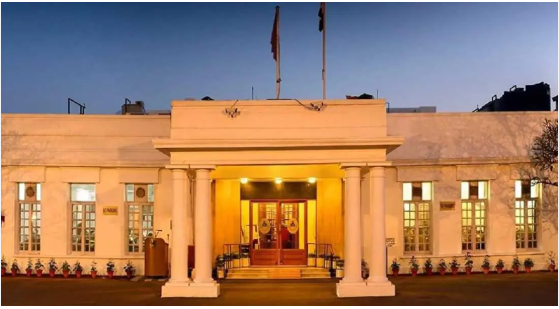
Nestled in the heart of Lutyens’ Delhi, the sprawling Delhi Gymkhana Club stands adjacent to the prime minister’s residence on Lok Kalyan Marg. In its letter to the club’s secretary on May 22, the L&DO said the premises situated at 2, Safdarjung Road, were leased to the Imperial Delhi Gymkhana Club Ltd (now known as Delhi Gymkhana Club Ltd) for the specific purpose of maintaining a social and sporting club.
However, the 27.3-acre plot was now required to fulfil urgent institutional needs, governance infrastructure, and public interest projects, integrated with the resumption of adjoining government lands, the official order stated.
“In exercise of the powers conferred under Clause 4 of the Lease Deed, the President of India, through the Land & Development Office, hereby determines the lease and orders re-entry of the aforesaid premises with immediate effect,” the order read.
“Upon such re-entry, the entire plot of land measuring 27.3 acres, along with all buildings, standing erections, structures, lawns, and fittings thereon, shall vest absolutely in the lessor, i.e., the President of India, through the Land & Development Office,” it added.
The Delhi Gymkhana Club, which started functioning at the site in 1913. Back then, it was called the ‘Imperial Delhi Gymkhana Club’, but the word ‘Imperial’ was dropped after Independence. As per the information available on its website, the Polo Club was seen as a part of Gymkhana Club in the beginning, but it became a separate entity in the 1930s when the Polo Club moved to New Delhi.
Tucked besides the imposing Ashoka trees and the power corridors of the Capital, the Delhi Gymkhana Club has for over a century symbolised power, elitism, exclusivity, access, colonial influence and above all privilege. It has always been more than just a sports or recreation club. Its membership defined people’s status in the Delhi high society.
The institution was created during the British colonial era as a socialising space for imperial officers and the ruling elite. After Independence though the word “Imperial” was dropped, much of the club’s culture, traditions and aura survived. Spread across nearly 27 acres on Safdarjung Road, the club building was designed by famed British architect Robert Tor Russell – who also designed Connaught Place and Teen Murti House.
The club boasts 26 grass tennis courts, which is the most in any club in the country. It has seven clay courts, three squash courts, badminton courts, a billiards room and a covered swimming pool. There are three lounge bars and 43 resident cottages.
High-ranking bureaucrats, military chiefs, diplomats, judges, politicians, industrialists and old business families made up much of its membership making it synonymous with India’s ruling establishment. Its membership carries equal prestige as a high office.
With around 1,200 members, getting into the coveted circle has historically been extraordinarily difficult. The waiting period to get a membership has stretched 20 to 30 years. Just about a 100 memberships are opened every year to fill up for deaths and resignations.
And money alone is no guarantee for entry. It has always been about the “network.” Families with influence — bureaucratic, military or political — spanning generations. Recommendations, social standing, and connections mattered more than the money. It’s a club that has guarded access and maintained its “traditions” like no other. Strict dress codes and etiquette reinforce its reputation for exclusivity.
For over a century, the Delhi Gymkhana has followed the 40-40-20 rule for membership. 40% went to civil servants, 40% to the defence services and 20% to ‘others’ (read commoners). Adult children of members got preferential treatment in grant of membership thus snuffing out chances of the “outsiders”.
Those getting membership attend “at home”, a ritual where club members see if a person is good enough to be one of “them.” This exclusivity has also made Delhi Gymkhana controversial. Critics accused the club of representing colonial mindset in modern democratic India. In 2020, the National Company Law Tribunal sharply criticised the institution, remarking that the club still “reeks of an imperial mindset” and serves privileged elites.
Despite criticism, the charm of Delhi Gymkhana remains intact. Its membership signals that the person has arrived into the top social circles. In more ways than one, Delhi Gymkhana represents a paradox of modern India. It was a heritage institution, a colonial relic, a social power centre and a status symbol all rolled into one. Now it stands at a crossroad, an era in the national capital is staring at sunset.