




Manas Dasgupta
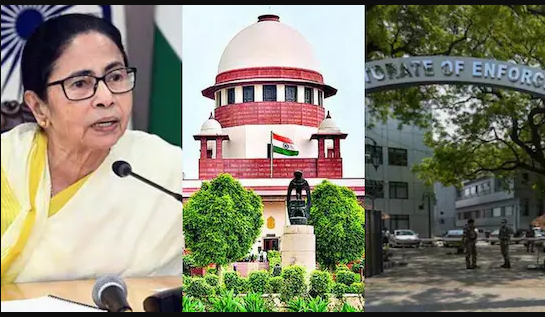
NEW DELHI, Mar 18: The Supreme Court on Wednesday virtually reprimanded the West Bengal chief minister Mamata Banerjee observing that her barging into the ruling Trinamool Congress party’s political consultancy firm I-PAC office in Kolkata interrupting the workings of the Enforcement Directorate was “not a happy situation.”
The court also questioned the state government’s stand that the ED was neither a “body corporate” nor a “legal or natural person” to approach the apex court under Article 32 of the Constitution claiming violation of its “fundamental rights.”
West Bengal, represented by senior advocate Shyam Divan, raised preliminary objections to the maintainability of the ED’s writ petition filed under Article 32, seeking a Central Bureau of Investigation (CBI) probe against Ms Banerjee and the senior police officers who accompanied her.
In January, Ms Banerjee rushed to the house of I-PAC director Pratik Jain’s house as the ED launched a raid into the political consultancy firm. As per the central agency, Banerjee entered key raid locations and interrupted the investigation by taking away “key evidence,” including physical documents and electronic devices. Ms Banerjee has denied the allegations and stated that the central agency is acting on the Centre’s “political vendetta.”
“If a Chief Minister, according to the ED, barges in and obstructs statutory work, is it that the ED cannot move either this court under Article 32 or the High Court under Article 226. So, will the ED be left remediless? This (Ms Banerjee’s alleged actions) is an unusual situation, an unhappy situation. This has not happened before,” said the bench comprising Justices Prashant Kumar Mishra and NV Anjaria, which was hearing a petition by the Enforcement Directorate.
“What if tomorrow some other Chief Minister barges into such a raid? Can the ED be left without remedy?” The agency, which has knocked at the doors of the top court, has called Banerjee’s move — allegedly walking out with a laptop, phone and multiple documents from the house of Pratik Jain, the chief of election consultant I-PAC and their offices — a “gross abuse of power.” It has also demanded that a police case be filed against the Chief Minister and officials who had accompanied her.
Representing the state, senior Advocate Shyam Divan contended that allowing a department of the Central Government to file a petition against a state government will be “dangerous to the federal structure.” Probe agencies like the CBI, Narcotics Control Bureau, Directorate of Revenue Intelligence, and Serious Fraud Investigation Office do not have the right to sue a state government, he added. Even State-level agencies like CID, Vigilance Commissions, and Anti-Corruption Bureaus do not have that power.
“ED is not a juristic entity… it is nothing beyond just a department of the Government. It does not have by itself any personality,” said Advocate Shyam Divan. He added that if central agencies are allowed to use Article 32, it would “completely bypass the checks and balances in the constitutional framework” as it would result in the article being used by one department against the order.
Justice Mishra questioned what if “unusual” situations — such as a Chief Minister obstructing a Central Agency — comes up. “Because in this case, according to them, the Chief Minister barged into some government office controlled by the Central Government… if (Articles) 226 is also not maintainable 32 is also not maintainable, then who will decide? Someday some other Chief Minister may enter some other office…” he said. “There should not be a vacuum,” he added.
Divan said the Constitution does provide a remedy, and suggested that the Centre could initiate appropriate proceedings rather than a department acting independently. Divan responded that the perceived vacuum is precisely why the issue requires authoritative determination by a larger Bench. Allowing departments to invoke writ jurisdiction — which compels courts to take action — could pose “a danger to the federal structure” and lead to unchecked inter-governmental litigation, he said.
Solicitor General Tushar Mehta, for the ED, interjected to point out that the “Chief Minister, who is the head of the government in the State, hindered a lawful ongoing investigation being conducted in the larger public interest.” The ED has maintained that the raids were part of an investigation into a ₹2,742-crore coal smuggling case.
The ED is an instrument of the Centre, a department of the Central government, Mr Divan submitted. The Prevention of Money Laundering Act (PMLA), which governs the ED, did not give the agency the “right to sue.” “There is no question of the civil liberty or rights of the ED which is being trampled upon here. If the ED had a complaint, the Union government can invoke the original jurisdiction of the Supreme Court under Article 131 of the Constitution and approach the Supreme Court directly,” Mr Divan said.
Senior advocate Kapil Sibal, appearing for Ms Banerjee, said an officer of the ED did not have a “fundamental right” to investigate. The power is drawn from the PMLA. Mr Sibal argued that the Centre cannot sue using Article 32 by using the ED as a front. Article 32 was only available to individuals wishing to approach the Supreme Court against encroachments by the state and its agencies on her civil rights.
If central agencies, government departments and one or other instrumentalities of the state were allowed to approach the court under Article 32, they would start filing petitions against each other and private citizens. The Centre and its agencies would use Article 32 to bring States and their entities to court.
“The principle of federalism, a basic feature of the Constitution, would be in tatters. States are not mere appendages to the Centre. Courts must be on guard against the conscious whittling down of power of the States by the Union government,” Mr Divan submitted.
Urging the court to throw out the ED’s petition as unmaintainable, the senior advocate said the ED was a part of the state machinery. It cannot come to court saying that another state had violated its fundamental rights. “If Parliament wants to confer an agency the power to sue, it would confer the power specifically. Investigation agencies are not ‘body corporates’ with a power to sue,” Mr Divan said, requesting the apex court to refer the case to a Constitution Bench.
The statutes and notifications which created other agencies, including the CBI, the Narcotics Control Bureau, the Intelligence Bureau, the Serious Fraud Investigation Office, the Directorate of Revenue Intelligence, or, for that matter, the West Bengal Criminal Investigation Department, etc., were not authorised to sue, Mr Divan said.
The court scheduled the next hearing on March 24.
On January 15, the apex court had stayed the Kolkata Police probe against the officers of the ED who conducted the raids. The State police investigation had been based on allegations that sensitive election records of the State’s ruling Trinamool Congress party, which consults I-PAC on electoral and political strategy, were “stolen” by the Central agency officials during the raids.
The Bench had previously said the case raises “serious” issues relating to the scope of the investigations carried out by Central agencies, including the ED, and interference by State agencies.