




Manas Dasgupta
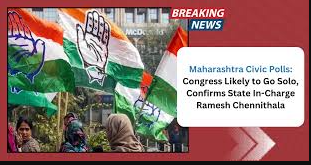
NEW DELHI, Dec 31: The Congress has decided to contest a chunk of seats on its own in the Maharashtra civic body elections to be held on January 15.
The row between the BJP and the Eknath Shinde’s Shiv Sena in the Brihanmumbai Municipal Corporation (BMC) elections has also been settled with BJP taking the Lion’s share of 130 seats and the Sena 97 in the 227-member civic body. Ajit Pawar’s Nationalist Congress Party is out of the Mahayuti alliance in the BMC elections.
According to the Congress sources, the party would contest 528 seats across the Mumbai, Thane, Pune, Chhatrapati Sambhaji Nagar, and Pimpri-Chinchwad municipal corporations in the civic body elections. This will be the most number of civic body seats it has contested solo since 1999.
This will also be sans any alliance or understanding with major allies, including Uddhav Thackeray’s Shiv Sena faction and Sharad Pawar’s Nationalist Congress Party. In addition, it will also fight solo in Nagpur, Akola, Amravati, and Chandrapur, and for 65 of Latur’s 70 seats and 60 of Nanded’s 81; the rest will go to Prakash Ambedkar’s Vanchit Bahujan Angadi.
In Mumbai, the country’s richest municipal corporation valued at Rs 74,000 crore, the Congress will contest 167 of the 227 seats. In Thane the party will contest 101 seats. In Pune and Chhatrapati Sambhaji Nagar it will field candidates in 100 seats. And in Pimpri-Chinchwad the Congress has put up 60 candidates.
The Congress’ lone wolf approach follows an apparent complete breakdown of the Maha Vikas Aghadi (MVA), the alliance formed by it and Uddhav Thackeray and Sharad Pawar. The breakdown was precipitated by the much-publicised Thackeray family reunion; Raj Thackeray, who walked out of the family 20 years ago after a fight with party founder and uncle Bal Thackeray, reunited his Maharashtra Navnirman Sena with his cousin Uddhav last week.
The Congress (and Sharad Pawar’s NCP) was left distinctly unsettled by Thackeray’s onboarding of the MNS, a firebrand regional outfit that it criticised, heavily, during July’s ‘slapgate’ and Marathi language row. It had earlier also criticised Raj Thackeray’s “politics of hatred.” As a result, the Congress had made it clear as early as mid-November that the party would not be a part of the MVA if the MNS joined the alliance. The party’s poll-in-charge, Ramesh Chennithala, and the chief of its Mumbai unit, Varsha Gaikwad, had told reporters of a temporary parting at least for the civic elections.
The Thackeray Sena, though, has called on the Congress to return to the MVA fold, arguing that only a fully united opposition can defeat the BJP-led Mahayuti alliance. The Congress, like Sharad Pawar’s NCP, remains wary of linking its fortunes to a political party that has historically targeted, often with violence, migrant workers in the state.
And over in the Mahayuti camp, the BJP and the Sena faction led by Eknath Shinde have completed their seat-share talks, with the latter having settled for a much lower figure. The BMC’s 227 seats will be divided 130 – 97. Sources told NDTV Shinde had pushed for as many as 125 seats.
But despite the prolonged negotiations, the BJP not only managed to restrict Shiv Sena’s share but also emerged as the unquestioned “big brother” in the BMC alliance. Indeed, the BJP’s move is widely being read as a clear signal that the party is positioning itself for the mayor’s post in Mumbai.
For Shinde, who heads the “real” Shiv Sena, the outcome represents a political setback. The reduced seat share reflects the limits of his negotiating power – particularly in a civic body that has historically been synonymous with the Sena, a dominance the Thackeray brothers will hope to reclaim.