




Manas Dasgupta
NEW DELHI, Dec 30: India on Tuesday underlined that there was “artistic freedom” in the country and filmmakers have the right to make films exercising this freedom, government sources after the Chinese media reacted strongly after actor Salman Khan’s war drama “Battle of Galwan” claiming that the movie “distorted facts.”
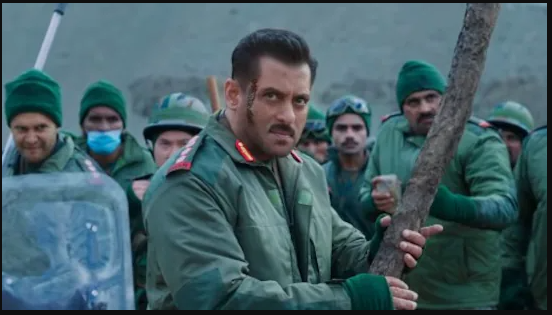
The Salman Khan starrer is based on the 2020 clashes between the soldiers of Indian Army’s 16 Bihar regiment and the Chinese troops in Galwan in eastern Ladakh. The movie is directed by Apoorva Lakhia and also stars Chitrangada Singh as the female lead alongside Zeyn Shaw, Ankur Bhatia, and Vipin Bhardwaj. In the film, Salman Khan plays Colonel Bikkumalla Santosh Babu, the commanding officer of the 16 Bihar Regiment, who died while fighting intruding People’s Liberation Army (PLA) troops. It is based on a story from India’s Most Fearless 3 by Shiv Aroor and Rahul Singh.
In the film, Salman Khan plays Colonel Bikkumalla Santosh Babu, the commanding officer of the 16 Bihar Regiment, who died while fighting intruding People’s Liberation Army (PLA) troops. New Delhi has officially acknowledged that it lost 20 troops in the brutal hand-to-hand combat. On the contrary, Beijing, which earlier denied any casualties in the clash, later claimed it lost four soldiers, gravely underplaying the number.
“India is a country with freedom of expression, and cinematic expression is an integral part of it. Indian filmmakers are free to make films as per this artistic freedom,” the government sources said. “Those who may have concerns on this particular film are free to approach India’s Ministry of Defence for any clarifications. Government has no role to play in this film,” the source added.
Following the clashes, tensions between India and China rose, with the army deploying formations near the Galwan Valley, along the Line of Actual Control (LAC) in Ladakh, and undertaking activities such as surveying border areas to prevent “possible” Chinese aggression. An article in China’s state-run newspaper, Global Times, alleges that the events of the June 2020 clash portrayed in the movie “do not align with the facts.”
“The Bollywood films at most provide an entertainment-driven, emotionally charged portrayal, but no amount of cinematic exaggeration can rewrite the history or shake the PLA’s determination to defend China’s sovereign territory,” read the article. The Global Times article falsely claims that the Galwan Valley is located on the Chinese side of the Line of Actual Control. It places the responsibility of the June 2020 clashes on India, claiming that Indian troops crossed over the LAC and provoked a fight.
The deadly clash at Galwan five years ago is still a sore point that stings from time to time. It all started on June 15, 2020, when a small band of Indian troops moved to remove a Chinese tent in the Galwan river valley — an area 15,000 feet above the sea level on the Karakoram range, located in Ladakh, near the Line of Actual Control. China had agreed to remove the tent after talks that took place on June 6 and create a buffer zone.
But a fight broke out after the Chinese soldiers targeted the Indian Colonel, BL Santosh Babu. Reinforcements were called in by both sides and the clash escalated. By the time it ended — after nearly six hours – around 40 Chinese soldiers were dead. India lost 20 bravehearts. Several Indian and Chinese soldiers had fallen into the Galwan river and the resulting hypothermia proved fatal. China though, said only four soldiers had died and of them, only one, Junior Sergeant Wang Zhuoran- had drowned.
An accurate number was never arrived at. More than two years later, an Australian investigative newspaper “The Klaxon” reported that “at least 38 PLA (People’s Liberation Army) troops along with Wang were washed away and drowned that night… of whom only Wang was declared among the four officially dead soldiers.” Citing “several Weibo users” as its sources, it said the Chinese soldiers had fallen into the river while attempting to cross it in the first minutes of the fight.
What followed was a stern face-off, contradictory statements from China and years of chill that had only recently started thawing. India said the clash arose from “an attempt by the Chinese side to unilaterally change the status quo” on the border. Beijing pointed fingers at the Indian troops.