



Manas Dasgupta
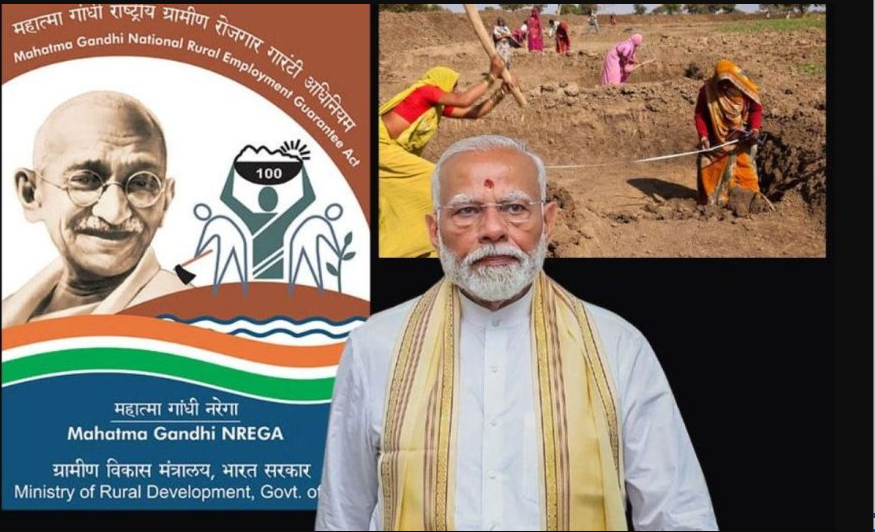
NEW DELHI, Dec 15: Setting the stage for a political face-off during the ongoing Winter Session of Parliament, the Centre on Monday introduced a Bill that will replace the previous UPA government’s flagship project “Mahatma Gandhi National Rural Employment Guarantee Scheme (MGNREGA)” with the new named “The Viksit Bharat Guarantee For Rozgar And Ajeevika Mission (Grameen), shortened as VB G RAM G.
A whip has been issued, and BJP MPs have been asked to attend Parliament to ensure the passage of the Bill. According to the government, the new Bill presents a new framework aimed at fulfilling the Viksit Bharat 2047 vision.
While the Congress leader Priyanka Gandhi said changing the name of a scheme only lead to additional expenditure because of the several administrative alterations were required to be made in offices and stationary, the BJP’s closest ally the Telegu Desam Party (TDP) expressed certain reservations with the bill which would lead to additional burden on the states though it said it would support its passage in Parliament and the party government in Andhra Pradesh would also implement it. The BJP and the TDP are allies at the Centre and in the state.
The proposed legislation seeks to realign rural employment policy with the government’s long-term vision of Viksit Bharat by 2047, while also changing the structure, funding pattern of the existing scheme. The move has triggered reactions from the Congress and other Opposition parties, with leaders questioning the “intention” behind removing Mahatma Gandhi’s name.
According to the draft Bill, the new bill aims to establish a “rural development framework aligned with the national vision of Viksit Bharat @2047,” with a statutory guarantee of 125 days of wage employment per financial year for every rural household whose adult members volunteer for unskilled manual work. The Bill also stresses empowerment, convergence and saturation to build a “prosperous and resilient rural Bharat.”
The G RAM G scheme will be implemented as a Centrally Sponsored Scheme, unlike MGNREGA which was fully funded by the Centre. Under the new proposal, the Centre–state fund-sharing ratio will be 60:40 for all states and Union territories with legislatures with exceptions made for North Eastern states, Himalayan states and UTs such as Uttarakhand, Himachal Pradesh and Jammu and Kashmir, with 90:10 ratio.
Under MGNREGA, unskilled wages were fully funded by the Centre. The Bill introduces a higher financial burden on state governments and, for the first time, bans VB G RAM G-related works during agricultural seasons.
It also changes the administrative architecture of the scheme. While MGNREGA was implemented directly by the Union rural development ministry, the new law mandates the constitution of a State Gramin Rozgar Guarantee Council in every state for monitoring and reviewing implementation.
Ms Gandhi while questioning the government’s intention behind removing Mahatma Gandhi’s name from the scheme, she said, “Mahatma Gandhi is considered the tallest leader not just in the country but in the world, so removing his name, I really don’t understand what is the objective? What is their intention?”
Congress MP Tariq Anwar said the move reflected hostility towards the Gandhi legacy. “It is unfortunate that the government is changing its name. It seems that they hate the name Gandhi. This decision will hurt the sentiments of those who believe in Mahatma Gandhi and his ideology,” he said.
Congress MP Ranjeet Ranjan said the BJP earlier had a problem with Jawaharlal Nehru and Indira Gandhi. “Now the country is watching that they have a problem with Bapu. You ensure timely payments to states under MGNREGA. You raise 100 to 150 days, and improve the scheme. It is a shame that the government is focused on just changing names,” she said.
RJD leader Manoj Jha said, “I fail to understand why we should bow before the Prime Minister and his Cabinet,” he said, adding that by changing the name, the scheme’s essence was being destroyed. He sarcastically suggested renaming it “Pujya Bapu Yojana” and claiming unemployment had been eliminated.
In a lengthy post on X, CPI(M) MP John Brittas said the proposed law went far beyond a name change, arguing that it fundamentally altered the rights-based nature of MGNREGA. He said removing Mahatma Gandhi’s name was “only the trailer,” and alleged that the government had replaced a legal employment guarantee with a conditional, centrally controlled scheme that disadvantaged states and workers.
He said states would have to collectively spend over ₹50,000 crore more, with Kerala alone facing an additional burden of ₹2,000–2,500 crore. Calling it “cost-shifting by stealth,” he said it was not reform but a rollback of federal responsibility.
Contrasting the two schemes, Brittas said MGNREGA was demand-driven, where the Centre had to pay if a worker demanded work, while the new framework would operate under pre-fixed allocations and ceilings, meaning “when funds run out, rights run out.” Summing up his critique, Brittas said the new scheme meant “same workers, less rights, more burden”, and argued that the Bill dismantled MGNREGA “fiscally, institutionally and morally.”
Responding to Priyanka’s remarks, BJP MP Sudhanshu Trivedi said the government’s intent went beyond symbolism. “PM Modi is not just changing names but the underlying sentiment.”
The MGNREGA scheme, launched by the then UPA government in 2005, guaranteed 100 days of work in rural areas and has been a game-changer over the past two decades. The new Bill proposes to raise the 100-day guarantee to 125. It also proposes that payments are made within a week or 15 days after the work is completed. If the payments are not made within the deadline, there is also a provision for an unemployment allowance.
The new Bill proposes that work under the scheme will be divided into four categories — water security, rural infrastructure, livelihood infrastructure and disaster resilience. Such work won’t be carried out during the peak agricultural season when residents of rural areas are busy. To ensure transparency, biometrics and geotagging would be used. There is also the provision of grievance redressal at various levels.
There is another key difference. The MGNREGA is a centrally sponsored scheme in which the Centre bears 100 per cent of the wages of unskilled labour. State governments bear a small portion of the expenses in hiring skilled labour and arranging materials. Under G Ram G scheme, the Centre and most states will share the expenses in a 60:40 ratio. This ratio will be 90:10 for northeastern and Himalayan states and 100 per cent for Union territories. Out of the proposed expenditure of Rs 1.51 lakh crore annually, the Centre would fund Rs 95,692 crore.
As the VB – G RAM G bill promises to put a higher financial burden on the states, Andhra Pradesh Finance, Planning, and Legislative Affairs Minister Payyavula Keshav said they would “support and implement it,” though the sharing of funding was “concerning” and “would put a burden on the state.” “Definitely, the funding sharing is concerning. It would put a lot of burden on the state if we have to divert a huge amount of funds as our share to fund the scheme. We have not gone through the full details of the scheme yet,” Keshav said.
Finance Department officials said while this was cause for concern for a cash-strapped state like Andhra Pradesh, other provisions like a guarantee of employment for 125 days in a financial year, weekly wage payments, and a break during the peak agriculture season that would make more workers available for the farm sector are encouraging.