SC Upholds Delhi High Court Order Supporting Termination from Indian Army of a Christian Officer







Manas Dasgupta
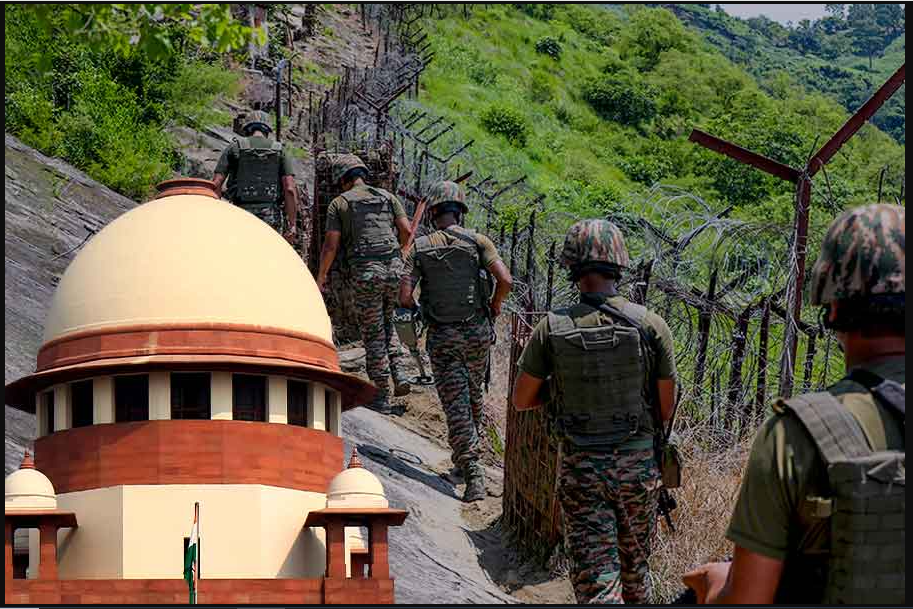
NEW DELHI, Nov 25: The Supreme Court on Tuesday refused to interfere with a Delhi High Court judgment upholding the Indian Amy’s decision to sack a Christian army officer from the armed forces for refusing his senior’s order to enter a gurdwara (to perform a puja) and labelled him a “cantankerous man” and a “misfit” in the Indian Army.
Describing the act as the “grossest kind of indiscipline,” the Supreme Court dismissed Samuel Kamalasan’s petition challenging his termination from the armed forces, after he allegedly refused to participate in regimental religious activities at the sanctum sanctorum of a temple at a place of his posting.
“What kind of message is he sending? Gross indiscipline by an Army officer. He should have been terminated. This kind of cantankerous persons deserves to be in the military?” a bench led by the new Chief Justice Surya Kant and comprising Justice Joymalya Bagchi commented and said his conduct was incompatible with military discipline.
“What kind of message has he been sending? He should have been thrown out for this only. This is the grossest kind of indiscipline by an Army official,” the CJI said. “Leaders have to lead by example. You are insulting your troops,” the bench said, adding, “When a pastor counselled you, you leave it at that. You cannot have your private understanding of what your religion permits. That too in uniform.”
Appearing in the court for Mr Kamalesan, senior advocate Gopal Sankaranarayanan said his client was dismissed from service for a single act of refusal to enter the innermost sanctum of a temple at the place of his posting, saying it violated his Christian faith. He maintained that the officer had otherwise participated respectfully in all multi-faith spaces and regimental events.
“They (i.e., the Army) dismissed him for a single infraction” and that Kamalesan did display respect towards other religions by taking part in festivals like Holi and Diwali. “This one place in Punjab did not have a sarv dharm sthal (i.e., a structure symbolising the unity of all religions, such as the one inside the Parliament building in Delhi). It had a gurdwara…”
“He is standing right outside the sanctorum. He told them, ‘Everything else you want me to do outside, I’ll do… but entering the sanctorum is against my faith…’,” Sankaranarayanan told the court, pointing out that only one person – Kamalesan’s superior officer – had a problem.
“By joining the Army, one does not lose one’s religious identity. I was entering the gurdwara, temple, everything… but I stopped when they asked me to do puja. That much the Constitution provides,” he said, reiterating, “I profess monotheistic faith…” The Supreme Court, though, did not agree with that argument.
“Is this sort of cantankerous conduct permissible in a disciplined force?” the CJI asked, adding as to how a troop leader would refuse to accompany his soldiers into a place they considered sacred. The bench also noted that the regiment also maintained a gurdwara, given the presence of Sikh soldiers. “A gurdwara is one of the most secular places…. The manner in which he is behaving, is he not insulting other religions?” the CJI asked.
The senior lawyer said the appellant’s fundamental right to practise a religion under Article 25 of the Constitution cannot be taken away just because he has donned the uniform. “Article 25 protects essential religious features, not every sentiment…. Where in the Christian faith is entering a temple barred?” Justice Bagchi asked.
The bench pointed out that the officer had ignored even the advice of a local pastor, who reportedly said entering a “sarva dharma sthal” would not violate the Christian faith. “You may be outstanding in 100 things, but the Indian Army is known for its secular approach…. You have failed to respect the sentiments of your own soldiers,” the CJI said, in response to the submission that the penalty of dismissal from service may be done away with.
When the appellant’s counsel said not issuing a notice would be a wrong message for the society, the bench said, “This will send a strong message.” Commissioned in 2017 into the 3rd Cavalry Regiment, Mr Kamalesan was posted as the troop leader of the ‘B’ Squadron, comprising Sikh personnel.
The regiment maintained a temple and a gurdwara, but not a “sarva dharma sthal” or a church. Mr Kamalesan had claimed that he had accompanied troops to both places for weekly religious parades but refrained from entering the sanctum during “aarti, havan or puja,” citing religious conscience.
The Army had said the officer repeatedly refused to attend mandatory regimental parades and senior officers made “multiple attempts” to counsel him on the importance of regimentation. However, he refused and this weakened unit cohesion, a critical requirement for operational effectiveness, the Army had said.
The Army was satisfied that Mr Kamalesan’s further retention was “undesirable” and his dismissal was upheld by the high court. It was held that regimental religious spaces, though rooted in history, serve a secular, unifying purpose, not a denominational one.
In May the Delhi High Court re-affirmed the Army’s decision, which was that Kamalesan “kept his religion above a lawful command from his superior,” and ruled, “This is clearly an act of indiscipline.” The court called Kamalesan’s act a violation of “essential military ethos.” The SC gave a similar short shrift to his plea challenging his termination.