Modi Sparks Controversy over “Vande Mataram,” Reiterate Charge of Nehru having “Sowed Seeds of Partition”





Manas Dasgupta
NEW DELHI, Nov 7: Keeping in mind the coming elections to the West Bengal state Assembly early next year, the Prime Minister Narendra Modi on Friday ignited a fresh controversy over singing of “Vande Mataram” holding the first prime minister Jawaharlal Nehru responsible for “sowing the seeds of partition of India” by presenting a “truncated” version of the national song to “appease the Muslims.”
In an apparent attack at the Congress, Mr Modi on the occasion of 15th anniversary of “Vande Mataram” on Friday said important stanzas of the national song “Vande Mataram” were dropped in 1937 which sowed the seeds of partition and asserted that such a “divisive mindset” was still a challenge for the country.
Nearly 90 years later, that decision by the Congress working committee to sing only first two stanzas of “Vande Mataram” at its gatherings continues to cause turmoil within Indian politics, particularly ahead of high-voltage election in Bengal next year, where issues of patriotism and ‘appeasement (of Muslims)’ have been, and will continue to be, raised.
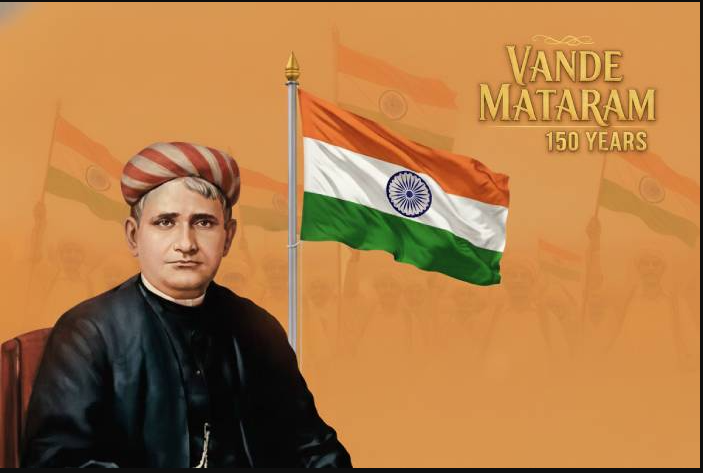
Mr Modi made the comments against the Congress and Nehru while inaugurating the year-long commemoration of “Vande Mataram” to mark 150 years of the national song. He also released a commemorative stamp and coin on the occasion at the Indira Gandhi Indoor Stadium here.
Composed by Bankim Chandra Chattopadhyaya, “Vande Mataram” was first published in the literary journal ‘Bangadarshan’ on November 7, 1875. Later, he incorporated the hymn in his novel ‘Anandamath’, which was published in 1882. On 24 January 1950, India’s constituent assembly adopted it as a national song.
“Vande Mataram became voice of India’s freedom struggle, it expressed feelings of every Indian. Unfortunately, in 1937, important stanzas of Vande Mataram, its soul was removed. The division of Vande Mataram also sowed the seeds of partition. Today’s generation needs to know that why was this injustice done with this ‘maha mantra’ of nation building..this divisive mindset is still a challenge for the country,” he said.
The Congress president Mallikarjun Kharge promptly refuted the charge and taking aim at the BJP and its ideological mentor the Rashtriya Swayamsevak Sangh (RSS) saying it was “deeply ironic that the self-proclaimed guardians of nationalism — the RSS and the BJP, have never sung Vande Mataram and the RSS particularly not even the National Anthem Jana Gana Mana in their shakhas or offices.”
“Instead, they continue to sing Namaste Sada Vatsale, a song glorifying their organisations, not the nation. Since its founding in 1925, the RSS has avoided Vande Mataram, despite its universal reverence. Not once in its texts or literature does the song find mention,” Mr Kharge pointed out in a statement.
Mr Modi, however, in an obvious reference to “Operation Sindoor,” said “Vande Mataram” was relevant in every era. “When the enemy dared to attack our security and honour using terrorism, world saw that India knows how to take the form of Durga.” The Prime Minister said as the country marked 150 years of “Vande Mataram,” it give the people of the country new inspiration and fill them with new energy.
“Vande Mataram is a word, a mantra, an energy, a dream, a resolve. It is the devotion to Mother India, the worship of Mother India. It connects us to our history and gives our future new courage. There is no resolve that cannot be achieved, no goal that we Indians cannot accomplish. We have to build a nation which is at the top on basis of knowledge, science and technology,” he said.
The programme marked the formal launch of the year-long nationwide commemoration — from November 7, 2025 to November 7, 2026 — celebrating 150 years of the timeless composition that inspired India’s freedom movement and continues to evoke national pride and unity.
The Maharashtra Congress accused the BJP of “misusing” the occasion of the 150th anniversary of “Vande Mataram” for “political polarisation” and “hypocritical nationalism.” The Congress refuted the BJP’s reported allegations that any of its party legislators had opposed the singing of ‘Vande Mataram’, terming the BJP’s “campaign” against party MLAs Aslam Shaikh and Amin Patel as “false, shameful, and condemnable”.
Congress spokesperson Sachin Sawant said both Mr Shaikh and Mr Patel had clearly stated that they had no objection to the song, adding, “If BJP leaders wish to sing Vande Mataram, they are welcome to come inside our offices and sing, not outside to create a spectacle.” Accusing the BJP of deliberately targeting Muslim legislators to stoke religious divisions, the Congress said, “It is unfortunate that the BJP is trying to communalise an issue linked to national pride. This exposes its divisive politics.”
“Vande Mataram is part of the Congress’s very soul. Our freedom fighters courageously sang it against British rule when the RSS had no presence in the freedom movement. Those who once opposed the Constitution, called the tricolour inauspicious and refused to hoist it for 52 years, now claim to be the sole patriots,” Mr Sawant said.
In his statement Mr Kharge also described “Vande Mataram” as “the eternal song of our motherland” that awakened India’s collective consciousness. Mr Kharge recalled that the Indian National Congress had been the “proud flagbearer” of Vande Mataram. He said it was first sung publicly at the 1896 Congress session in Calcutta under the leadership of Rahmatullah Sayani, with Rabindranath Tagore lending his voice.
“That moment infused new life into the freedom struggle,” the Congress chief said, adding, “From 1896 to the present day, every Congress meeting, big or small, from a Plenary Session or a Block Level meeting, we have sung Vande Mataram with pride and patriotism as a tribute to the people of India.” He also said Vande Mataram had become the rallying cry against the British Empire’s “divide and rule” policy, resonating from the partition of Bengal in 1905 to the sacrifices of India’s revolutionaries.
The song, he pointed out, was the title of Lala Lajpat Rai’s publication, appeared on Bhikaji Cama’s flag in Germany, and featured in Pandit Ram Prasad Bismil’s Kranti Gitanjali. Mr Kharge cited Mahatma Gandhi’s 1915 reflection that Vande Mataram had become the “most powerful battle cry among Hindus and Musalmans of Bengal,” and Pandit Nehru’s 1938 observation that such “songs of people” could not be imposed but earned their place through public affection.
Tracing the history of the national song, it was pointed out that the Congress leadership then had suggested avoiding the direct references to the Hindu Goddesses in the song. In the original sixth stanza of the song, the composer had paid tributes to the divine feminine and cast India as a fierce yet nurturing ‘mother’ figure, (“… mataram”) offering intellectual, emotional, and physical support. He had referred to the Goddesses Durga, Kamala (or Lakshmi), and Saraswathi, framing them as the feminine guardians of the country, “pure and perfect without peer.”
In 1937 the Congress, then led by Nehru, decided in Faizpur to use only the first two stanzas for national gatherings. The argument was that direct references to Hindu goddesses were not well-received by some members of the Muslim community; they were seen as ‘exclusionary.’ The BJP has argued the exclusions illustrate the Congress’ ‘divisive’ plans; the Prime Minister said dropping the stanzas “sowed the seeds of the nation’s division”, referring to the Partition.
In the letter Nehru wrote to Netaji Shubhash Chandra Bose he seemed to suggest the stanzas in question need not be interpreted as having anything to do with goddesses or divine figures; “… that interpretation is absurd… I think the whole song and all the words in it are thoroughly harmless and nobody can take exception.” But he also acknowledged unease within some members of the Muslim community and said “there does seem some substance in it (the row over those stanzas)” even if the larger controversy, in his opinion, had been “manufactured by the communalists.”
As a result, when the Congress met in Faizpur between December 26 and 28 of that year (1937), ‘Vande Mataram’ was adopted sans the stanzas referring to Durga, Lakshmi, and Saraswathi. The resolution read: “Taking all things into consideration, therefore, the Committee recommends that whenever ‘Vande Mataram’ is sung at national gatherings, only the first two stanzas should be sung.” However, the Congress also acknowledged the freedom of any individual to “sing any other song… in addition to, or in place of, the ‘Vande Mataram’ song.”
Samajwadi Party Maharashtra President Abu Azmi, however, sparked controversy by refusing to recite Vande Mataram. His refusal led to the BJP workers staging protest in front of his Mumbai residence. Reacting to those protesting against his refusal to recite Vande Mataram, Abu Azmi said one who believes in Allah “does not even worship his mother,” let alone anyone else.
“You cannot make someone recite something forcefully. Someone who believes only in Allah and does not even worship his mother cannot worship the earth and the sun according to Islam…,” Abu Azmi said.
He said that he respect Vande Mataram and has no objection to people reciting the national song, but stood firm on his refusal to do the same. “Jo padhta hai padhe kaun mana kar raha hai (Those who want to recite can do so, who is objecting?). Even many Muslims recite the song but those who are religious and believe in Allah cannot worship anyone else,” Abu Azmi said.
Several BJP leaders raised slogans of ‘Vande Mataram’ and ‘Bharat Mata Ki Jai’ outside Azmi’s residence in Mumbai’s Bandra. BJP MLA Raj K Purohit said the protest was symbolic. “Vande Mataram should be recited, and the country should be respected. If you don’t have love (for the country), Then go to Pakistan… You live in this country and are an MLA here…,” he said.