




Manas Dasgupta
NEW DELHI, Oct 18: Unable to digest the beatings it received from India during the recent “Operation Sindoor,” the Pakistani army chief Field Marshal Asim Munir stepped up his rhetoric “warning” India of a “decisive response” to even a minor provocation while saying there was no space for war in a “nuclearised environment.”
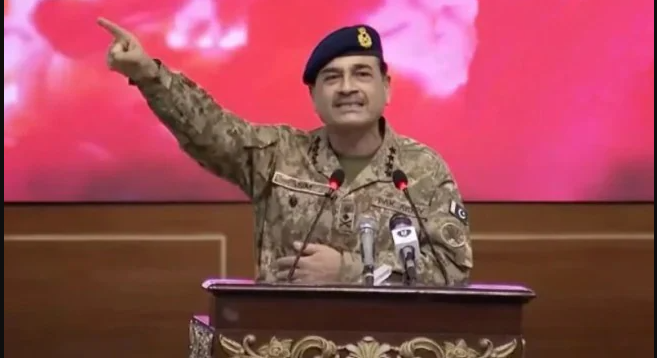
Delivering a highly provocative address at a graduation ceremony of passing out army cadets at the premier Pakistan Military Academy (PMA) Kakul at Abbottabad in Khyber Pakhtunkhwa on Saturday, Munir claimed that Islamabad’s expanding military capabilities could “shatter the misconceived immunity of India’s geographical warspace.”
While Pakistan itself was raining bombs on Afghan civilians, Munir doubled down on anti-India nuclear rhetoric, claiming there was “no space for war in a nuclearised environment” but in the very next sentence, he warned that even a “minor provocation” would invite a “decisive, beyond proportions” response from Pakistan.
“I advise and firmly caution India’s military leadership that there is no space for war in a nuclearised environment,” he said. “We will never be intimidated, not coerced by rhetoric and will respond decisively to even a minor provocation without any qualms,” the Chief of Army Staff (COAS) said.
Referring to the recent military conflict between India and Pakistan, Field Marshal Munir claimed that his country’s armed forces had demonstrated “remarkable professionalism” and “far-reaching capabilities” by “neutralising” all threats and emerged “victorious” against a “numerically superior adversary.”
“Should a fresh wave of hostilities be triggered, Pakistan would respond much beyond the expectations of the initiators. With diminishing distinction between combat and communication zones, the reach and lethality of our weapon systems will shatter the misconceived immunity of India’s geographic vastness,” he said.
“The deeply hurting retributive military and economic losses inflicted will be much beyond the imagination and calculations of the perpetrators of chaos and instability.” The Pakistani leader further cautioned that the onus of ensuing escalations, “one that may ultimately bear catastrophic consequences for the entire region and beyond, will squarely lie with India.”
India launched “Operation Sindoor” on May 7, targeting terror infrastructure in Pakistan in retaliation for the April 22 Pahalgam terror attack that killed 26 civilians. India and Pakistan reached an understanding on May 10 to end the conflict after four days of intense cross-border drone and missile strikes, following direct talks between the Directors General of Military Operations (DGMOs) of the two militaries.
Field Marshal Munir also alleged India of using terrorism as a weapon to destabilise Pakistan, saying a handful of terrorists cannot harm Pakistan and warned that all “proxies” using Afghan soil would be “raised to dust,” in an apparent reference to Tehreek-i-Taliban Pakistan (TTP).
The Army chief also demanded India to settle “core issues” as per international norms, an apparent reference to the Kashmir dispute, while reiterating Pakistan’s commitment to provide “moral and diplomatic support” to the people of Jammu and Kashmir.
Ironically, Munir’s slandering rhetoric comes at a time when the Pakistani military was raining bombs on Afghan civilians living in the border areas between the two nations. Recent reports claim the Pakistani military is under immense pressure following a string of deadly attacks by the Afghan Taliban along the Durand Line.
Incidentally, Munir delivered a similar provocative speech against India days before the terrorists killed 26 civilians in Jammu and Kashmir’s Pahalgam. At the time, Munir called Kashmir Islamabad’s “jugular vein.” In April he had said, “Our stance is absolutely clear, it was our jugular vein, it will be our jugular vein, we will not forget it. We will not leave our Kashmiri brothers in their heroic struggle.”
At the ceremony, cadets from several friendly countries, including Malaysia, Nepal, Palestine, Qatar, Sri Lanka, Bangladesh, Yemen, Mali, Maldives and Nigeria, also graduated. Field Marshal Munir congratulated them and lauded the PMA’s role as a “cornerstone of military excellence and international camaraderie.
Munir had earlier also attempted to reject India’s assertions that Pakistan had received external support during “Operation Sindoor” saying such assertions are “factually incorrect.” This followed statements by India’s deputy army chief Lt Gen Rahul Singh’s statement where he said India had to deal with three adversaries during Operation Sindoor, with Pakistan being the “front face” and China and Türkiye providing vital support to India’s western neighbour.
Munir had maintained that “any misadventure or attempt to undermine Pakistan’s sovereignty will be met with a swift, and resolute response without any constraints or inhibitions. “Insinuations regarding external support in Pakistan’s successful Operation Bunyanum Marsoos are irresponsible and factually incorrect and reflect a chronic reluctance to acknowledge indigenous capability and institutional resilience developed over decades of strategic prudence,” he said.
“Naming other states as participants in the purely bilateral military conflagration is also a shoddy attempt at playing camp politics…,” he said. Munir claimed that in contrast to India’s strategic behaviour resting on “parochial self-alignment,” Pakistan has forged lasting partnerships based on principled diplomacy, anchored in mutual respect and peace, establishing itself to be a stabilizer in the region.
“Any attempt to target our population centres, military bases, economic hubs and ports will instantly invoke a deeply hurting and more than reciprocal response,” Munir had said. He added that wars were not won through media rhetoric, imported fancy hardware, or political sloganeering, but through faith, professional competence, operational clarity, institutional strength and national resolve.