

Manas Dasgupta
NEW DELHI, Oct 8: Prime Minister Narendra Modi on Wednesday (October 8, 2025) inaugurated phase one of the Navi Mumbai International Airport built at a cost of ₹19,650 crore.
The new airport, spread over 1,160 hectares, is set to significantly boost India’s aviation capacity and ease the heavy traffic burden on Mumbai’s existing Chhatrapati Shivaji Maharaj International Airport.
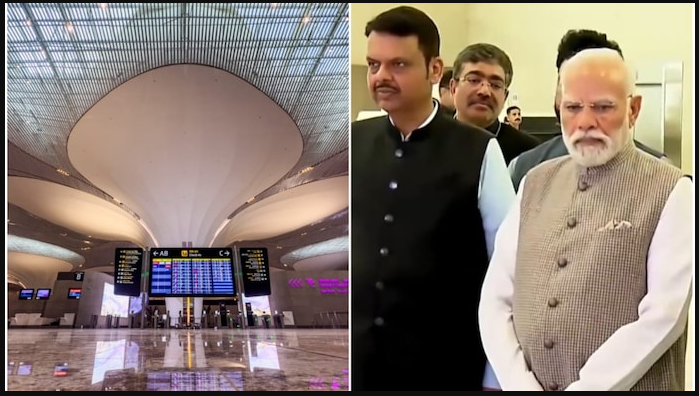
Before the formal inauguration, the Prime Minister took a walkthrough of the newly constructed facility. Civil Aviation Minister Kinjarapu Rammohan Naidu, Maharashtra Chief Minister Devendra Fadnavis, and Adani Group Chairman Gautam Adani were present on the occasion.
It is India’s largest greenfield airport project, developed under the Public Private Partnership (PPP) model and is the second international airport for the Mumbai Metropolitan Region.
Mr Modi also inaugurated Phase 2B of the Mumbai Metro Line-3, stretching from Acharya Atre Chowk to Cuffe Parade, constructed at a cost of ₹12,200 crore. He dedicated the entire ₹37,270 crore Mumbai Metro Line 3 (Aqua Line) to the nation, marking a major milestone in the city’s urban transport transformation.
Mr Modi also launched the Mumbai One app which offers commuters a range of benefits, including integrated mobile ticketing across multiple public transport operators. He also inaugurated the Short-Term Employability Program (STEP) initiative of the Department of Skill, Employment, Entrepreneurship, and Innovation in Maharashtra.
The programme is being rolled out across 400 government ITIs and 150 Government Technical High Schools, marking a major step in aligning skill development with industry requirements to enhance employability.
Mr Modi said the inauguration of the Navi Mumbai airport has ended Mumbai’s long wait. He also said the Viksit Bharat vision envisages ‘gati aur pragati’ (speed and progress). India had only 74 airports in 2014, but now it has 160, the Prime Minister said. “Due to UDAN Yojana, lakhs of people have taken to the skies for the first time in the past decade, fulfilling their dreams,” he added.
“The wait is finally over,” said Chief Minister Devendra Fadnavis in a post on X. “This airport is set to redefine air travel, boost Maharashtra’s growth, and connect India to the world like never before,” he added. The airport is initially expected to handle 2 crore passengers a year. It will not only facilitate seamless travel but also provide direct access to global markets for industries in Pune.
The airport is built under a Public-Private Partnership between Mumbai International Airport Ltd (a subsidiary of Adani Airports Holdings Ltd), and CIDCO (City and Industrial Development Corporation of Maharashtra Ltd). Ahead of the inauguration, Adani Group Chairman Gautam Adani praised the collective efforts behind the project. Responding to a post on X by Jeet Adani, Director of Airports at the Adani Group and his youngest son, Gautam Adani wrote, “To every hand that worked and every heart that cared, this is your creation.”
The country’s largest Greenfield airport project with a 3,700-metre runway, it would work with Mumbai’s Chhatrapati Shivaji Maharaj International Airport. The second international airport for the Mumbai Metropolitan Region would ease congestion and elevate Mumbai into the league of cities with multi-airport systems like London, Tokyo and New York.
Airlines such as IndiGo, Akasa Air, and Air India Express have already announced plans to begin operations at the new airport, with initial flights connecting various domestic cities. Once completed, the airport will serve 90 million passengers and manage over 3.2 million metric tonnes of cargo a year.
Operations at the state-of-the-art airport are set to begin in December 2025. Ticket sales are likely to start by the end of October. IndiGo, Akasa Air and Air India Express are ready for flights. The tag of Navi Mumbai International Airport (NMIA) being India’s first fully digital airport means facilities for pre-booking vehicle parking slots, as well as online baggage drop booking, and immigration services.
The digital features that cut waiting times and add convenience at every stage make it an “anxiety-free” airport, according to Arun Bansal, CEO of Adani Airports Holdings Limited (AAHL) that manages that airport. “You will be able to get a message on your phone telling you, for example, that your bag is number 20 on the carousel,” he said. It is being developed in five phases by the Adani group with the City Industrial Development Corporation.
Mr Modi also inaugurated Phase 2B of the Mumbai Metro Line-3, stretching from Acharya Atre Chowk to Cuffe Parade, constructed at a cost of ₹12,200 crore, as well as the final phase of Mumbai Metro Line-3, also called Aqua Line, during his two-day Maharashtra visit that began on Wednesday.
Mumbai’s first fully underground Metro corridor will become fully operational after the inauguration of the 10.99-km-long final stretch between Acharya Atre Chowk and Cuffe Parade stations. The prime minister dedicated the entire ₹37,270 crore Mumbai Metro Line 3 (Aqua Line) to the nation, marking a major milestone in the city’s urban transport transformation.
Regular services will begin on September 15, with trains running from 5.55am to 10.30pm between Aarey JVLR and Acharya Atre Chowk, carrying up to 13 lakh passengers daily. The first phase (Aarey JVLR–BKC) was inaugurated on October 7, 2024, and the second phase (BKC–Acharya Atre Chowk) opened on May 10, 2025. The newly opened Phase 2B completes the corridor.
Metro Line-3 is Mumbai’s first and only fully underground Metro line, featuring 27 stations and spanning major residential, commercial, and heritage areas. The final stretch cost ₹12,195 crore, while the total project cost stands at approximately ₹37,270 crore.
The construction work began in 2017 under the Mumbai Metro Rail Corporation Ltd (MMRCL), with over 15,000 workers involved at peak construction. For the first time in India, 17 Tunnel Boring Machines (TBMs) were deployed simultaneously, a national record in underground construction.
The Aqua Line will connect seamlessly with Central Railway at CSMT and Western Railway at Mumbai Central and Churchgate, improving intermodal travel. The line enhances access to Nariman Point, Fort, Kalbadevi, RBI, BSE, and Mantralaya, easing travel for professionals working in the city’s core business and administrative zones. The line will provide direct Metro access to Chhatrapati Shivaji Maharaj International Airport from south Mumbai, a major relief for air travellers.
Once operational, the Aqua Line will serve around 13 lakh passengers daily, cutting travel time from Cuffe Parade to Aarey JVLR to just one hour, compared to the current 1–2 hours by road.
Alongside the metro launch, Modi unveiled “Mumbai One”, a common mobility app for 11 transport operators, including Mumbai Metro Lines 1, 2A, 7, Aqua Line 3, Monorail, Navi Mumbai Metro, suburban rail, and BEST. The app allows digital ticketing, multimodal trip planning, and cashless payments, reducing queues and simplifying commutes.