Nobel Prize in Physics Goes to Three US Scientists, Medicine Jointly to Two US and a Japanese Scientists






Manas Dasgupta
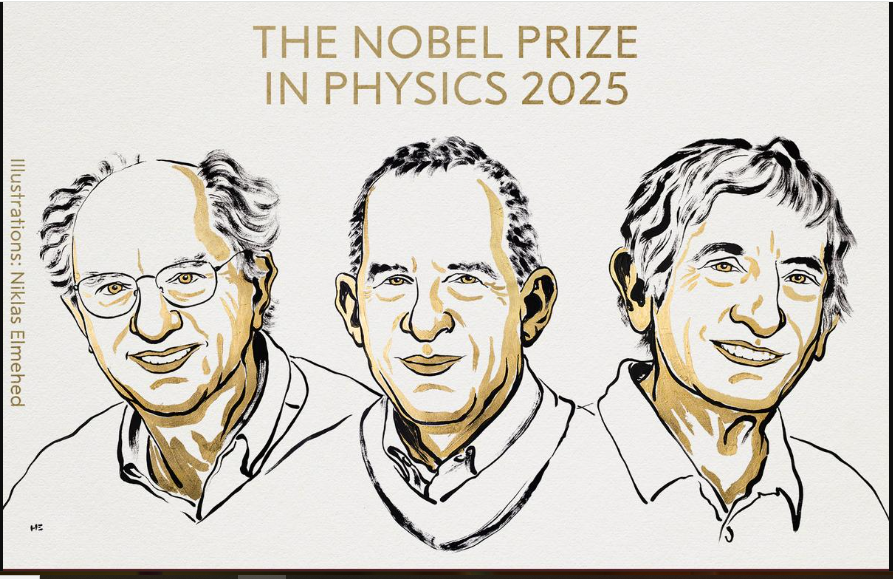
NEW DELHI, Oct 7: Scientists John Clarke, Michel Devoret and John Martinis won the 2025 Nobel Prize in Physics for “the discovery of macroscopic quantum mechanical tunnelling and energy quantisation in an electric circuit,” the Royal Swedish Academy of Sciences announced in Stockholm on Tuesday.
“It is wonderful to be able to celebrate the way that century-old quantum mechanics continually offers new surprises. It is also enormously useful, as quantum mechanics is the foundation of all digital technology,” said Olle Eriksson, Chair of the Nobel Committee for Physics. All three winners are based in the United States.
The Nobel physics prize is awarded by the Royal Swedish Academy of Sciences and includes a prize sum totalling 11 million Swedish crowns ($1.2 million) that is shared among the winners if there are several, as is often the case. The prizes will be awarded on December 10.
The transistors in computer microchips are one example of the established quantum technology that surrounds us. This year’s Nobel Prize in Physics has provided opportunities for developing the next generation of quantum technology, including quantum cryptography, quantum computers, and quantum sensors, the Nobel Prize committee said in a media release.
The annual Nobel Week — when the world’s most prestigious prizes for scientific achievement are announced — kicked off Monday with the Prize for Physiology. Three scientists — Mary E. Brunkow, Fred Ramsdell, and Shimon Sakaguchi — two Americans and one Japanese — shared the Nobel Prize in Physiology (Medicine) for unravelling tantalising aspects of the human immune system by identifying the immune system’s security guards, regulatory T cells.. Their discovery has helped blaze new paths into treating cancer as well as auto-immune disease – a condition by which the immune system ends up harming healthy cells they are meant to protect.
Our immune system is a complex of several kinds of cells – B cells, T cells, neutrophils, macrophages – that have a role in identifying and eliminating foreign bodies that may bring with it disease. However the immune system also identifies cells that have gone rogue – such as in cancerous tumours – or that have mutated in a way that they harm the bodies they constitute. Telling apart benign cells from harmful invaders is the key challenge the immune system must negotiate.
“Their discoveries have been decisive for our understanding of how the immune system functions and why we do not all develop serious autoimmune diseases,” Olle Kämpe, chair of the Nobel Committee, said in a statement.
Shimon Sakaguchi made the first key discovery in 1995. At the time, many researchers were convinced that immune tolerance only developed due to potentially harmful immune cells being eliminated through a process called central tolerance. Sakaguchi showed that the immune system is more complex and discovered a previously unknown class of immune cells, which protects the body from autoimmune diseases.
Mary Brunkow and Fred Ramsdell made the other key discovery in 2001, when they presented the explanation for why a specific mouse strain was particularly vulnerable to autoimmune diseases. They had discovered that mice have a mutation in a gene that they named Foxp3. They also showed that mutations in the human equivalent of this gene triggered a serious autoimmune disease, IPEX.
Two years after this, Shimon Sakaguchi was able to link these discoveries. He proved that the Foxp3 gene governs the development of the cells he identified in 1995. These cells, now known as regulatory T cells, monitor other immune cells and ensure that our immune system tolerates our own tissues.
The laureates’ discoveries launched the field of peripheral tolerance, spurring the development of medical treatments for cancer and autoimmune diseases. This may also lead to more successful transplantations. Several of these treatments are now undergoing clinical trials.
At the time of their discoveries Dr Ramsdell was affiliated to Sonoma Biotherapeutics, San Francisco, California, United States; Dr Brunkow with the Institute for Systems Biology, Seattle, Washington, U.S. and Dr Sakaguchi with the Osaka University, Osaka, Japan. They each share one-third of the 11 million Swedish kronor (₹1.03 crore) cash prize.
The winners for Chemistry will be announced on Wednesday, while the winners of the Literature, Peace and Economic Sciences Prize will be declared on October 9, October 10, and October 13 respectively. The peace prize, which will be announced on Friday, is awarded in a separate ceremony in Oslo.
The Nobel Prizes were established through the will of Swedish inventor Alfred Nobel, who amassed a fortune from his invention of dynamite. In his will he had dictated that his estate should be used to fund “prizes to those who, during the preceding year, have conferred the greatest benefit to humankind.” Since 1901, with occasional interruptions, the prizes have annually recognised achievements in science, literature, and peace. Economics was a later addition.
Physics was the first category mentioned in Nobel’s will, likely reflecting the prominence of the field during his time. Today, the Nobel Prize in Physics remains widely regarded as the most prestigious award in the discipline.
Past winners of the Nobel physics prize include some of the most influential figures in the history of science, such as Albert Einstein, Pierre and Marie Curie, Max Planck and Niels Bohr, a pioneer of quantum theory.
Last year’s prize was won by US scientist John Hopfield and British-Canadian Geoffrey Hinton for breakthroughs in machine learning that spurred the artificial intelligence boom, a development about which both have also expressed concerns.
In keeping with tradition, physics is the second Nobel to be awarded this week, after two American and one Japanese scientist won the medicine prize for breakthroughs in understanding the immune system. The chemistry prize is due next, on Wednesday.
The science, literature and economics prizes are presented to the laureates by the Swedish king at a ceremony in Stockholm on December 10, the anniversary of Alfred Nobel’s death, followed by a lavish banquet at city hall.