




Manas Dasgupta
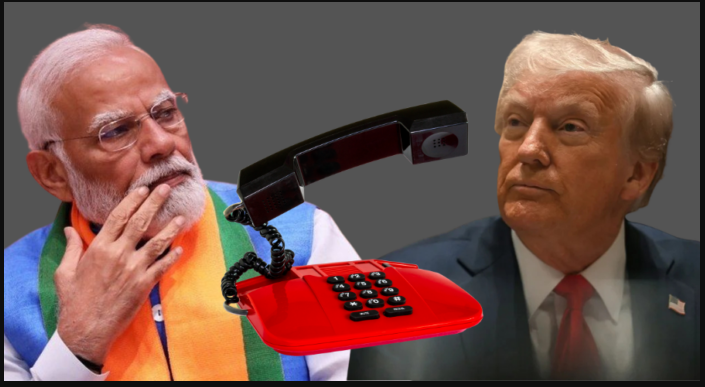
NEW DELHI, Aug 27: As the India – US ties slumped to a new low with the President Donald Trump imposed 50% tariff on Indian exports becoming a reality on Wednesday, the Prime Minister Narendra Modi is claimed to have refused to respond to at least four calls from his “friend” Trump in the recent days apparently showing his depth of anger at the unexpected turn of events, and also perhaps his caution.
Several foreign media quoting sources have reported about Mr Modi’s refusal to respond to Mr Trump’s call who lately was showing warm relations with Pakistan at the expense of India even as he has kept claiming about “mediating” into the recent conflict between the two countries and India forcefully rebutting the claim. Some media reports also claimed that Mr Modi’s refusal to take his calls, was “heightening Trump’s frustration.”
Ties between New Delhi and Washington have been tense after President Trump doubled tariffs on Indian goods to a staggering 50 per cent, the highest for any country other than Brazil. This includes a 25 per cent additional duty for India’s purchase of Russian crude oil. India has asserted that it was prepared to stand firm against US pressure, with Mr Modi vowing he would “never compromise” the interests of the country’s farmers.
A German publication has reported that the US-India trade clash illustrates that New Delhi would not bow to Washington’s pressure. “There are signs indicating that Modi felt insulted,” it said adding that PM Modi’s unwillingness to talk to Trump demonstrates the extent to which the premier was irritated by the US president’s actions.
The newspaper also noted that Trump’s image in Indian perception has considerably changed, particularly due to his statements about plans to boost relations with Pakistan. Since May, Trump has repeatedly said that it was his mediation that stopped fighting between India and Pakistan, a claim India denies. The US leader’s “showy, deal-driven style of diplomacy” has become another point of strain in the two nations’ ties, a Japanese media report said.
Some experts have also claimed that America’s idea of an Indo-Pacific alignment, where India play a central role in containing China, “is falling apart.” India and the US have drawn closer over the past two decades in a strategic bid to counter China. But with Trump’s punitive tariffs in play, the once-celebrated partnership is showing signs of unravelling– a prospect that has been so far welcomed by both in Beijing and Moscow.
Mr Trump’s 50% tariff took effect on Wednesday morning and the US Department of Homeland Security has confirmed that the higher rate will apply to any Indian goods “entered for consumption or withdrawn from warehouse for consumption” on or after this time.
According to estimates by the Global Trade Research Initiative (GTRI), nearly two-thirds of India’s total exports to the US, worth $60.2 billion out of $86.5 billion in FY25, will now fall under the higher 50 per cent tariff bracket. Government estimates peg the impacted exports slightly lower, at around $48.2 billion.
The hardest-hit sectors are those where India has a labour-intensive edge and a significant dependency on the US market. If the duties remain in place, GTRI projects that Indian exports to the US may drop to $49.6 billion in FY26, effectively reversing nearly five years of export growth.
The biggest shock will be felt in textiles, gems and jewellery, seafood, chemicals, and auto parts — sectors that have powered India’s export engine for years and together employ millions of workers, especially in small and medium enterprises (SMEs).
The US is India’s largest buyer of textiles, with exports exceeding $10.8 billion a year. The sector, already under pressure from cheaper players like Bangladesh and Vietnam, is now faced with 63.9 per cent effective duties, wiping out any price advantage. The Tiruppur cluster, which alone accounts for 30 per cent of India’s ready-made garment exports, is among the most exposed. Tiruppur, in Tamil Nadu, is a global hub for cotton knitwear and supports over 600,000 workers. Exports of ready-made garments alone were worth $5.33 billion in FY25.
Gems and Jewellery sector exports goods worth $9.94 billion to the US, nearly one-third of the industry’s global trade. It will now face 52.1 per cent total duties. Surat, which handles 80 per cent of India’s diamond processing, is already reporting order halts and layoffs.
The US accounts for around 50 per cent of India’s shrimp exports, valued at $2.4 billion, or roughly Rs 20,000 crore. With the total duty now reaching 60 per cent, Indian exporters are warning that they will be priced out by Ecuador, whose shrimp face just 15 per cent duties. Ecuador’s trade pact with the US gives it preferential access.
Carpet exports stood at $1.2 billion in FY25, and now face 52.9 per cent effective duties. Rising inflation in the US has already dampened demand, and the new tariff wall may push buyers toward Turkey or Vietnam. Both leather goods and footwear are now subject to the full 50 per cent tariff, adding further strain to a sector already battling rising raw material and logistics costs.
India’s auto component exports to the US stood at $6.6 billion in 2024. Of this, $3.4 billion, mainly parts for cars and small trucks, will face a 25 per cent tariff, while the rest will be subject to the full 50 per cent rate. Key segments like gearboxes and transmission systems, where India has a 40 per cent US market share, are likely to lose ground to suppliers in Mexico or Europe.
Indian exports of basmati rice, tea, spices, and other farm products worth $6 billion will now be subject to the full 50 per cent duty, placing them at a disadvantage against similar goods from Thailand and Pakistan. India is currently the world’s largest exporter of basmati rice, and any price hike in the US could see a major loss of market share. Processed foods too are in the high-duty category.