Anti-India Rhetoric by Pakistani Leaders: India Warns of “Painful Consequences,” Unrest in PoK









Manas Dasgupta
NEW DELHI, Aug 14: As India warned Pakistan against continued “hateful” rhetoric against New Delhi and cautioning it that any “misadventure” would have “painful consequences,” tension escalated in Rawalakot, a major town in Pakistan-occupied Kashmir (PoK) with thousands of civilians taking to the streets on Thursday demanding freedom from Pakistan.
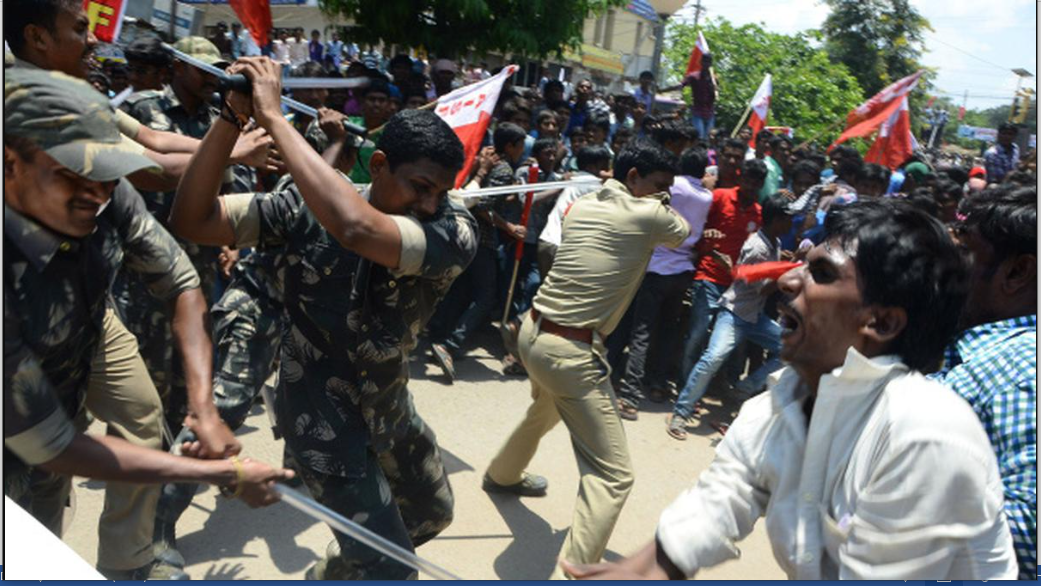
In one of the largest anti-Pakistan protests in the region in recent years, demonstrator including children and the elderly, waved flags and raised slogans demanding ‘Azaadi’ (freedom) from the Pakistan Army and Islamabad’s administration, triggering a brutal crackdown by security forces.
Top Indian intelligence sources said the protests stemmed from years of systemic neglect, rampant unemployment, and the chronic absence of basic amenities in the region. The situation turned violent when Pakistan Army personnel launched a lathi-charge and fired tear gas on the peaceful protestors, injuring several civilians, including elderly individuals and women.
Multiple protest leaders were detained in a bid to quell the uprising before it could spread to other parts of PoK. However, the arrest of key organisers only served to intensify public anger, with many locals vowing to continue their struggle despite the risks.
The unrest highlights what sources describe as a deliberate policy by the Pakistan Army: to maintain PoK in a state of economic dependence and political invisibility. While infrastructure projects in the region were prioritised for military logistics, civilian demands for hospitals, schools, and roads were systematically ignored.
Furthermore, local natural resources, especially hydropower and minerals, are being heavily exploited to benefit Punjab province and military establishments, leaving local populations without fair compensation or development opportunities. “Islamabad has deliberately kept PoK economically backward to maintain control,” the sources said. “Infrastructure that does exist is built for the Pakistan Army’s benefit—not for the civilians who live here.”
Even though PoK is technically a self-governing region, Islamabad exercises tight control through bureaucratic interference and military oversight, rendering local leadership virtually powerless. Human rights organisations have long accused Pakistan of using heavy-handed tactics in PoK, including arbitrary arrests, custodial torture, enforced disappearances, and targeted killings of dissenters. These methods have kept a lid on dissent for years, but the scale and anger of the current protests suggest that the fear barrier is beginning to break.
Meanwhile, India’s reaction on Pakistani rhetoric came a day after he Pakistani Prime Minister Shehbaz Sharif threatened India for keeping the Indus Waters Treaty (IWT) in abeyance following the ghastly Pahalgam terror attack. While addressing an event in Islamabad on Tuesday, Sharif said, “I want to tell the enemy today that if you threaten to hold our water, then keep this in mind — you cannot snatch even one drop of Pakistan.”
He warned that if India tried, “you will again be taught such a lesson that you will be left holding your ears.” A day earlier, former Foreign Minister Bilawal Bhutto-Zardari called the suspension of the IWT an attack on the Indus Valley Civilisation, warning that the country would not back down if pushed into war.
Speaking at a function organised by the Culture Department of the government of Sindh on Monday, Mr Bhutto had also issued a threat to India claiming that the latter had caused “great damage” to Pakistan and urged Pakistanis to “unite” against Prime Minister Narendra Modi. “The actions of the Indian government, under the leadership of Narendra Modi, have caused great damage to Pakistan. It is necessary that we, as a united people, stand together against PM Modi and these aggressions,” Bhutto said. He also said Pakistan would have “no choice” but to consider war if India continue to suspend the IWT.
“You people (Pakistanis) are strong enough for war to get back all six rivers. If India continues on this path, it leaves us with no choice except to consider all options, including the possibility of war, to protect our national interests,” he said. He added that Pakistan would not “bow down” and that this would be a war that India would “definitely lose.” “We did not start the war. But if you think of carrying out an attack like Sindoor, then know that the people of every province of Pakistan are ready to fight you – and this is a war that you will definitely lose. We won’t bow down,” Bhutto warned.
Before that, Pakistan Army Chief Asim Munir reportedly said Islamabad would destroy any dam if India cut off water flow. “We will wait for India to build a dam, and when they do so, we will destroy it,” he said. “The Indus River is not the Indians’ family property. We have no shortage of resources to undo the Indian designs to stop the river.”
While addressing an event in Florida during his visit to the US, he threatened India, warning that Islamabad would plunge the region into nuclear war and could take “almost half of the world” down if faced with an existential threat in a future conflict with New Delhi.
On several occasions, Munir has blamed India without any evidence for the recent tensions in the region in the aftermath of the April 22 Pahalgam terror attack. After the Pahalgam attack, the diplomatic ties between India and Pakistan were downgraded with New Delhi announcing several punitive measures, including suspension of the Indus Waters Treaty, cutting Islamabad Mission strength, and expulsion of its military attaches.
On Pakistani leaderships’ comments, Ministry of External Affairs (MEA) spokesperson Randhir Jaiswal on Thursday strongly criticised Pakistan for “reckless, war-mongering and hateful” comments from its leadership against New Delhi, and said it was well-known modus operandi of Islamabad to rant anti-India rhetoric again and again.
“We have seen reports regarding a continuing pattern of reckless, war-mongering, and hateful comments from Pakistani leadership against India. It is a well-known modus operandi of the Pakistani leadership to whip up anti-India rhetoric time and again to hide their own failures,” he said.
Further responding to a question regarding the award by the Court of Arbitration under the Indus Waters Treaty, Jaiswal said India never accepted the legality, legitimacy, or competence of the so-called ‘Court of Arbitration.’ “Its pronouncements are therefore without jurisdiction, devoid of legal standing, and have no bearing on India’s rights of utilisation of waters. India also categorically rejects Pakistan’s selective and misleading references to the so-called “award.” The Indus Waters Treaty stands in abeyance by a sovereign decision of the Government of India,” he added.
Pakistan recently praised a decision by the Permanent Court of Arbitration on the design norms for India’s new run-of-river hydropower projects on the Western Rivers — Chenab, Jhelum and Indus — saying that it vindicates its position on the Indus Water Treaty, which India has put in abeyance since the Pahalgam terror attack.