




Manas Dasgupta
NEW DELHI, Aug 6: With the recovery of two more bodies from the rubble in flood-ravaged Dharali village as the search for the missing resumed on Wednesday amid rain, the death toll in the flash floods and landslides in Uttarkashi district in Uttarakhand rose to six while more than 100 persons, including at least 11 army personnel, are still reported missing besides scores of others feared to have remained trapped under the debris.
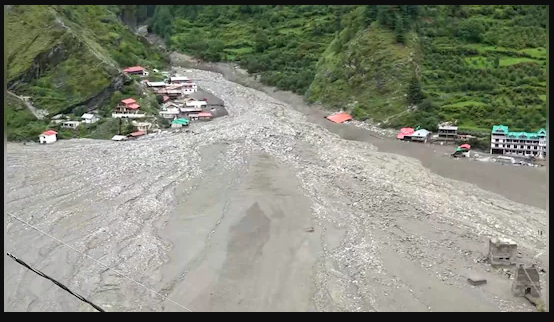
The Uttarakhand Chief Minister Pushkar Singh Dhami reached the village of Dharali to take stock of the situation and personally supervise the rescue and relief operations. The floods hit hotels and residential buildings in Dharali town, situated 8,600 feet above sea level, where video footage recorded by residents showed giant waves of water gushing through the area and swallowing everything in their way, including people and homes.
At least 190 people were rescued, according to Mr Dhami, as rescuers resumed their operations on Wednesday in Dharali, searching for flash flood victims amid the rubble. The India Meteorological Department (IMD) has issued warnings for heavy rainfall across Uttarakhand, particularly in the hill districts.
Mr visited the area to check on relief and rescue efforts. He met with families impacted by the disaster and promised full support from the government. Dhami said the state understand their pain and was doing everything possible to help. Before visiting the village, he also carried out an aerial survey of the flood-hit region and reviewed the situation from the disaster control room in Uttarkashi.
The Uttarakhand Health Department has taken charge on the instructions of Mr Dhami. Health department teams have reached ground zero, and treatment of the injured has been started on the spot. Soon, other medical teams will also get involved in relief work.
Health Secretary Dr R. Rajesh Kumar said the Health Department has taken quick and concrete steps amid the challenge of the Dharali disaster. Arrangements have been made in the hospitals, teams are active at ground zero, and aspects like mental health are also being taken seriously, he said.
Two cloudbursts, one in Dharali and another in the Sukhi Top area, caused widespread destruction, with Dharali bearing the brunt. Reportedly, the region also suffered from mudslides. Rescue and relief efforts are ongoing by the Indian Army, Indo-Tibetan Border Police (ITBP), National Disaster Response Force (NDRF), and State Disaster Response Force (SDRF).
At least 28 tourists from Kerala have gone missing, according to family members. Kerala Chief Minister Pinarayi Vijayan said he was deeply distressed by the damage caused by the flash flood in Uttarakhand’s Uttarkashi district. In a post on X, he expressed solidarity with the people of the state and offered full support to Chief Minister Pushkar Singh Dhami and his administration. He also noted that reports have emerged of some Keralites possibly being affected and assured that the state was closely monitoring the situation.
A Junior Commissioned Officer (JCO) and eight jawans from the Indian Army are still missing after a devastating cloudburst triggered flash floods and landslides near Uttarkashi’s Dharali, close to Harsil, where an army camp is located, officials said on Wednesday.
Rescue operations are ongoing in extremely challenging conditions as the region remains cut off from both north and south. Mohsen Shahedi, NDRF’s Deputy Inspector General (Operations), said more rescue teams can’t reach Dharali due to continuous landslides blocking the Rishikesh-Uttarkashi highway. He said about 150 people have been rescued so far.
The Dharali tragedy has yet again brought to the spotlight the perils of unplanned construction in the ecologically sensitive Himalayan region. The argument in favour of development is the economic boost tourism brings to the hills, but recent calamities have shown the risks of rapid and unplanned construction in these fragile areas.
On February 7, 2021, residents of a few villages in Chamoli had heard loud sounds and witnessed huge amounts of mass consisting of rocks, mud, water, and ice blocks roaring down the Dhauli Ganga river, destroying parts of two hydropower plants in its path. More than 204 people lost their lives, while hundreds went missing. Two years later, over 700 houses across the holy town of Joshimath developed cracks, with water oozing out of walls and roads, exposing massive land subsidence.
Some experts believe the mudslide in Uttarkashi district may not have been triggered by a cloudburst caused by heavy rain. Several experts have indicated that the area near Dharali village did not receive heavy rain in the hours preceding the calamity. Instead, a glacial pond burst could be behind the deluge.
Dr DD Chauniyal, who teaches geography at Doon University’s Nityanand Himalayan Research and Study Center and has extensively studied the Himalayan region, has said there were several glacial ponds in the snow-covered mountain areas north of Dharali village. “The river, Kheer Ganga, originates in this snow-covered area at a steep altitude. There are several glacial ponds in this area. Due to heavy rain and the melting of snow, these ponds had filled up. I think one of these ponds burst, and caused others to burst. And then water and debris flowed downstream with great force. The gradient is also very high. And then it hit Dharali,” he explained.
He added that the Kheer Ganga river flows downstream to merge with the Bhagirathi and Dharali was located near the confluence. Over the years, buildings have been constructed on both sides of Kheer Ganga’s course. Dr Chauniyal said the river had a different route earlier. “With time, the course changed and the river started flowing upstream. Yesterday, the debris-laden river flowed along its previous course where settlements had come up, razing hotels, homes and markets.”
The senior professor also pointed out that the old Dharali village, located to the right of the river flowing downstream, is safe even though the area on its left was wiped out. “Earlier, people carefully chose the safe area to build their homes. The new settlements, built without planning for natural disasters, were razed. Earlier, this area was an agricultural land, then hotels came up, roads were built,” he said. Dr Chauniyal said the devastation occurred within seconds, indicating that it may have been caused by a glacial pond burst. “Within seconds, the flow stopped. The same thing happened during the 2013 Kedarnath disaster,” he said.
In the hours that followed the mudslide, many attributed the tragedy to a cloudburst. A cloudburst refers to very heavy rainfall within a short period over a small area. Such a downpour in mountainous regions can lead to flash floods and landslides. But the weather officer’s data raises questions about the cloudburst theory. Harsil received just 6.5 mm of rainfall on Tuesday. The cumulative rainfall in Harsil and Bhatwari over 24 hours was 9 mm and 11 mm, respectively, much lower than the threshold of 100 mm of rain within an hour that is known to trigger flash floods.
Speaking to the media, Congress MP Priyanka Gandhi Vadra advocated long-term preventive planning. “Every year, whether it’s Himachal, Uttarakhand, or Wayanad, we are witnessing such disasters. We need a comprehensive strategy for prevention,” she said.
Samajwadi Party president Akhilesh Yadav said it was time to revive socialist leader Ram Manohar Lohia’s call to save the Himalayas and its rivers. “Not just Uttarakhand, but the entire hill region is repeatedly witnessing such large-scale destruction. We all need to come together and work in that direction,” he said, according to a PTI report.
Congress MP Ranjeet Ranjan called it a “man-made calamity.” “In the last session, we raised concerns with Defence and Environment ministers over the widening of roads for the Char Dham Yatra in vulnerable zones like Dharali. This is an eco-sensitive region near the Bhagirathi River. Bringing concrete into landslide-prone zones is a recipe for disaster. This is a man-made calamity,” she said.