



Manas Dasgupta
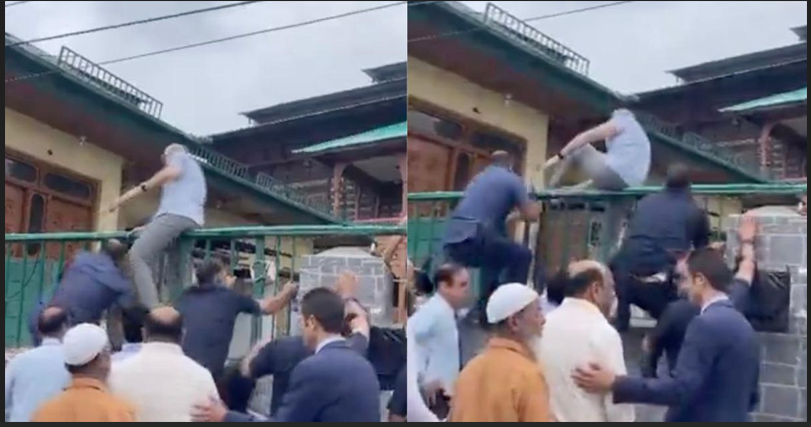
NEW DELHI, July 14: In an act of defiance of the orders of the Lieutenant Governor Manoj Sinha, the elected chief minister of Jammu and Kashmir Omar Abdullah and his ministerial and party colleagues on Monday were forced to climb wall and scuffle with the police to pay homage to the 22 civilians killed during an uprising by the Dogra army of the then ruler of Kashmir Maharaja Hari Singh on July 13, 1931.
Mr Abdullah along with his senior Ministers and legislators reached the Mazar-e-Shuhada and climbed a wall to enter the martyr’s graveyard as the entrance was blocked by the police at the orders of the Lt Governor Nowhatta area in Srinagar. The chief minister and his senior ministers and party leaders including his father and chairman of the National Conference Farooq Abdullah had to walk from Nowhatta Chowk after access to the site was restricted.
The Chief Minister scaled the fenced wall of the premises because the security forces had blocked the entrance of the graveyard. A police officer made a bid to stop the J&K Chief Minister from offering ‘fatiha’ at the graveyard. A senior Cabinet minister, Sakina Ittoo, rode a two-wheeler to avoid the security checkpoints and reached the site.
It came a day after the L-G administration barred the government and regional parties from paying tributes at the site. The BJP had described the deceased civilians as “rioters.” The L-G administration dropped July 13 from the official holiday calendar of J&K after the Centre ended J&K’s special status in 2019.
“I was pushed, shoved and grappled by ‘protectors of the law’. My crime? Wanting to offer Fatiha at the graves of the martyrs of 13th July 1931. The men in uniform sometimes forget the law. I won’t be stopped and I won’t be browbeaten. Barriers were raised, but so was our resolve,” Mr Abdullah said.
Targeting J&K L-G Manoj Sinha, Mr Abdullah said, “It is unfortunate. Those who claim their only responsibility is law and order — we were not allowed to offer ‘fateha’ on July 13. When I told the control room that I intended to visit, a bunker vehicle was parked outside my residence till midnight (on Sunday). Even today they (security forces) tried to stop us by erecting vehicles. If the restrictions were for July 13, under what law was I stopped today?” Mr Abdullah asked.
He said “this country is known as a free country, but they (the L-G administration) think we are their slaves. We are not their slaves. We are servants of our people. They even tried to tear our party flag. If they stop us on July 13, we will visit on the next day or next month. No one can stop us,” the Chief Minister said.
Visibly angry over the police action, NC MLA Tanvir Sadiq said it was for the first time in the history of India that “an unelected government locked up an elected government.” “What are they trying to tell the world that there is no democracy in J&K? What saddens us more is that no one in Delhi condemned the action. We have been paying tributes to these martyrs for decades in J&K. Those taking decisions do not realise the ground realities of J&K,” Mr Sadiq said.
The West Bengal Chief Minister Mamata Banerjee condemned the J&K L-G administration’s actions. “What is wrong in visiting the graveyard of martyrs? This is not only unfortunate, it also snatches the democratic right of a citizen. What happened this morning to an elected Chief Minister Omar Abdullah is unacceptable. Shocking. Shameful,” Ms Banerjee said in a tweet.
Hurriyat chairman Mirwaiz Umar Farooq posted a sarcastic statement on X over the police action. “Power teaches little, Powerlessness teaches more!
Today the CM sahab tasted the bitter medicine of authoritarian high-handedness and subsequent helplessness that common Kashmiris face every day in different forms, as all agency and space are denied to them. Hoping this experience shifts his focus to what is the first priority of every people — upholding their dignity and their fundamental rights and working sincerely towards its restoration,” the Mirwaiz said.
The J&K Peoples Conference (JKPC) president Sajad Lone said it was all scripted. “For a moment I was impressed. But now that you have given a ball-by-ball commentary of your so-called struggle in reaching the Martyrs Graveyard, I will bet my life. It was all scripted,” Mr Lone said.
Visibly furious, Mr Abdullah shortly after videos of police almost assaulting his ministerial colleagues and him made headlines, and repeatedly ripped into the ruling BJP attacking the “idiots” behind a “foolish, short-sighted decision” and then demanding restoration of J&K’s statehood. Pahalgam terror attack, Mr Abdullah insisted, would not stand in the way of J&K becoming a state again, warning those who might oppose this, “We have plans if this promise is not fulfilled. We have ways to get our voice to Delhi… democratic and peaceful means will be used.”
J&K had been bifurcated into two union territories, the first was the UT of Jammu and Kashmir and the second was the UT of Ladakh, in 2019. This was after the BJP-led centre scrapped Article 370 that gave the former state ‘special status’ and a host of privileges. Both Prime Minister Narendra Modi and Home Minister Amit Shah have since said statehood would be restored but neither has provided timelines.
Mr Abdullah, after he was sworn in last year, said he would work towards that goal but said he wanted a cooperative approach between the centre and his administration to achieve that end. Now, however, it appears the Chief Minister is ready to force that issue. “J&K was promised statehood… and what was promised should be given. PM had said, ‘this is Modi’s promise’…”
Mr Abdullah – who recorded a thumping win in last year’s Assembly election, the first in a decade in the former state – also warned the BJP against underestimating the Kashmiri people, saying today’s actions said the federal government did not care about the people of J&K. “This is not about what happened to me… or my colleagues. This is about the wider message that you are sending to the people of Jammu and Kashmir – that their voice doesn’t matter.”
“You are going out of your way to tell the people of Jammu and Kashmir that they are ‘powerless’… but they are not. Don’t blame us for what happens,” Mr Abdullah raged ominously, “If they had just let us go quietly to offer prayers… then this would have been a non-issue.”
The all-out attack continued with stinging references to those killed in July 1931 protests. “They were protesting against the British rule just like anyone else in the country at that time… but you treat them as ‘villains’… you treat them differently because they are Muslim.”
Attached to that jab was an invitation to the BJP to look to Delhi and the wave of support for the saffron party that propelled it to a massive win over Arvind Kejriwal’s AAP in the February election. So tomorrow, if you have an election and 20 per cent come out (to vote) instead of 60 per cent, please remember this day and remember who to blame… if you are going to continue to mess with democratically-elected institutions… to project them as ‘powerless’, don’t expect a result like Delhi.”
The Delhi reference was unmissable. Mr Abdullah was referring to the previous Aam Aadmi Party (AAP) government that was voted out in the election earlier this year. During his term as Chief Minister, AAP leader Arvind Kejriwal often complained that the Centre had curtailed his government’s powers and that the Lieutenant Governor’s office derailed the state government’s work. Like in Delhi, the Jammu and Kashmir government now has limited authority, and key subjects such as law and order are under Lieutenant Governor Manoj Sinha’s control.
“I think somebody in BJP seems to feel that if they are able to project us as powerless, tomorrow the people of Kashmir will select BJP. They won’t, they will just not select anybody, and if that’s what the government of India wants after a successful election, they want the next election to be completely unsuccessful, then continue to behave like this, but don’t blame us then for what happens,” Mr Abdullah said.
Mr Abdullah took over as Chief Minister in October last year after the National Conference-Congress alliance scored a thumping win in the first election after Jammu and Kashmir’s special status was revoked and the erstwhile state was bifurcated into two Union Territories.
The months after the swearing-in saw a bonhomie developing between the Omar Abdullah government and the Centre and Lieutenant Governor Sinha. In the aftermath of the Pahalgam terror attack, Mr Abdullah backed the Centre in its response. His emotionally-charged speech in the Assembly, during which he said his politics was not so “cheap” that he would use the tragedy as an opportunity to press for his statehood demand, won praise even from his critics.
Asked if the developments during the Martyrs’ Day row would affect this bonhomie, Mr Abdullah said, “Don’t ask me, ask the people who did this.” He said that if Kashmir leaders were allowed to pay tributes at the Martyrs’ Day yesterday, it would have been a “non-event,” but the curbs imposed by the local administration made headlines. “Please ask the idiots who did this.”
Chaotic scenes played out near the Martyrs’ Graveyard in Srinagar on Monday morning as Mr Abdullah and his supporters reached the memorial to pay tributes and police personnel tried to stop them. Sharing a video on X, Mr Abdullah said, “This is the physical grappling I was subjected to but I am made of sterner stuff and was not to be stopped. I was doing nothing unlawful or illegal. In fact, these ‘protectors of the law’ need to explain under what law they were trying to stop us from offering Fatiha.”
The Chief Minister and top Jammu and Kashmir leaders were barred from visiting the Martyrs’ Graveyard, or Mazar-e-Shuhada, on Sunday. “We were not allowed to read the Fatiha here yesterday. People were kept confined to their homes. When the gates were opened and I informed the control room that I wanted to come here, a bunker was set up in front of my gate and it was not removed till late at night. Today I did not tell them at all. Without telling them, I sat into the car (and drove here),” he told the media after offering his tribute at the memorial. Other Kashmir leaders, including PDP chief Mehbooba Mufti and Jammu and Kashmir People’s Conference leader Sajad Lone, too, put out posts slamming their confinement.
July 13 is an epochal day in the history of Kashmir. On this day in 1931, a group of Kashmiris were protesting outside the Srinagar jail. They were supporters of Abdul Qadeer, who had called on Kashmiris to rise against Dogra ruler Hari Singh and was charged with sedition. On July 13, a large group of protesters gathered outside the prison where Abdul Qadeer was being held. Faced with the protesters, the Maharaja’s forces opened fire, killing 22 people.
The July 13 killings triggered massive protests and forced the Dogra ruler and the British to look into the grievances of the Muslim community in the Valley. The first Assembly polls in Jammu and Kashmir were also a political fallout of the July 13 killings. These polls marked the beginning of the democratic process in Jammu and Kashmir after centuries of autocratic rule, even though the Maharaja had sweeping powers on key matters.
Earlier, police personnel gave a gun salute and floral tributes were offered at the Martyrs’ Graveyard on July 13 every year. Political leaders would pay tributes and hold public meetings in memory of those killed in 1931. But ever since the special status of Jammu and Kashmir was revoked in 2019 and the erstwhile state was bifurcated into two Union territories, the administration has prohibited any function at the Martyrs’ graveyard.
Since 2020, July 13 and December 5 — former Jammu and Kashmir Prime Minister and Chief Minister Sheikh Abdullah’s birth anniversary — have been dropped as official holidays. Instead, the birth anniversary of Dogra ruler Hari Singh is now a public holiday in Jammu and Kashmir.