


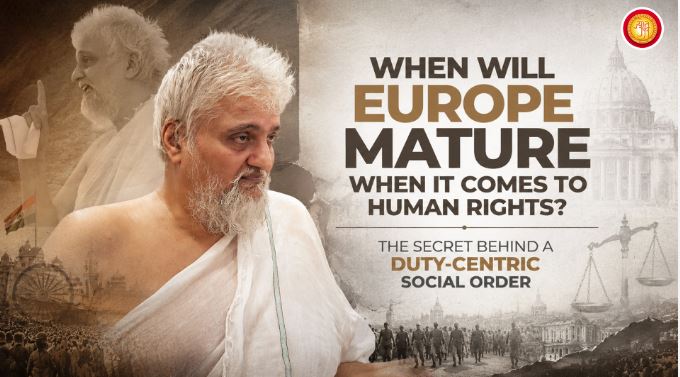
The Secret Behind a Duty-Centric Social Order
Spiritual Sovereign Jainacharya Yugbhushansuri
A Reply to the Question from Oslo
When a Norwegian journalist stood at a press briefing in Oslo on 18th May, 2026, and asked the Ministry of External Affairs whether India’s Prime Minister would take critical questions from the Indian press, the question carried an older and more revealing assumption that Europe still occupies the seat of the teacher on the matter of human rights and India occupies the bench of the pupil. The MEA secretary’s reply was measured, correct, and necessary. It was also too modest. A deeper reply must be spoken, not in anger but in clarity and instruction.
Europe’s Account of Human Rights Violations
Before any conversation about human rights can be honestly had, the ledger of the last 500 years must be read aloud. Between 1501 and 1867, roughly 12.5 million Africans were trafficked across the Atlantic in European ships, the largest forced migration and slavery in recorded history. From 1492 onward, the indigenous population of the Americas collapsed by some 90 percent. Around 56 million people were extinguished within 150 years, the largest mortality event in proportion to global population in all of history. Under one Belgian king, between 1885 and 1908, an estimated 10 million Congolese perished. British-era famines in India took 15 million lives between 1876 and 1943, while grain ships continued to sail out of Indian ports. Within a single generation, two European-origin World Wars killed tens of millions of people.
This is not whataboutery. A civilisation that led to the deaths of millions of lives between Columbus and the Berlin airlift does not enter the chamber of human rights as a judge. It enters, at best, as a defendant. The locus to lecture others has, on the plain reading of the account, simply closed.
The Deeper Concession and Its Refusal
Yet let the conversation be conducted at the highest charity. Concede, for the sake of argument, that the Europe of the last 70 years has tried in earnest to become the world’s champion of human rights. Even granting this—and it is a generous granting—the architecture Europe has built remains structurally unsound. The well-intentioned scaffolding of the last seven decades has produced atomised individuals, collapsing families, an epidemic of loneliness, increasing crime rates and an unending litigation over who owes what to whom. The rights, once secured on parchment, never quite settle into life. This is not a failure of sincerity. It is a failure of design—a defect that no further declarations can repair because it lies in the very foundation upon which the order has been built.
The Civilisational Alternative
Bharat’s civilisational order was built on a different axis altogether. Nyay-Niti—the binding fabric of duties—was the foundation; rights were never the foundation but always the fruit. Every relation, from the cosmic to the domestic, was structured as a circuit of obligations, and rights flowed quietly along that circuit like a current through a closed loop.
In 3rd century BCE, when Ashoka engraved upon stone that the welfare of all beings (sarva-loka-hita) is the binding duty of the sovereign, he was speaking from within this architecture. In 1940, when Gandhiji received H.G. Wells’s draft of what would become the Declaration of the Rights of Man and cabled back that the entire architecture was inverted, “Begin with a charter of Duties of Man, and I promise the rights will follow as spring follows winter,” he was naming the same secret. In his 1947 letter to Julian Huxley of UNESCO, he restated it, “All rights to be deserved and preserved came from duty well done.” When the framers of the Indian Constitution placed Fundamental Duties beside Fundamental Rights in Article 51A, they were preserving the same insight in modern form.
So, what is the secret ingredient without which the European rights-centric order fails and with which the Indian duties-based order succeeds? The answer lies in arithmetic, not in sentiment.
The Arithmetic of Rights
Imagine a society in which every member is a claimant. Every individual carries a portfolio of entitlements; every other individual is then an obstacle to those entitlements. The right to speak meets the right not to be offended. The right of the parent meets the right of the child. The right of the believer meets the right of the unbeliever. The right of this generation meets the right of the next.
The collisions are not failures of the system. They are the system. Once rights are made the axis, society becomes a marketplace of competing claims, and every protection won is another protection eroded. The sword never falls, but it never lifts either. Rights are not enjoyed; they are only defended.
In an order where every member is armed with rights and turns to law to enforce them, who is left to perform duties? The rights-centric order, by design, dries up the soil in which duties naturally grow, and the rights it sought to protect find no source to flow from.
The Arithmetic of Duties
Now, invert the axis. Conceive every member of society not as a claimant but as a bearer of obligation. The teacher carries a duty to the student, the student to the teacher; the ruler to the ruled, the ruled to the ruler; the householder to the guest, the strong to the weak; the human to the animal, to the tree, to the river, to the ancestor, and to the generation yet unborn.
Observe what happens. When the teacher discharges his duty, the student’s right to learn is fulfilled without claim. When the ruler discharges his duty, the subject’s right to justice is fulfilled without litigation. When the parent discharges their duty, the child’s right to dignity is fulfilled without legislation. Rights are not declared into existence; they arise as the natural fruit of duties performed. Cohesion is not imposed; it grows.
This is the whole secret. A duty-centric order does not abandon rights. It secures them more deeply and durably than any declaration ever could. It is the only order in which rights are truly protected because rights are never held against others; they are quietly delivered by others as the natural by-product of obligations faithfully discharged.
A Message to the Questioner
The journalist in Oslo and the wider European world that frames such questions, is therefore invited—not commanded, not pleaded with, but invited—into a maturity it has not yet reached. The world of human rights as Europe currently inhabits is not the real world of human rights. It is a half-formed first chamber, useful in its place but mistaken for the whole house. To step out of it is not to abandon human rights. It is finally to understand them.
A society that wants to protect rights must, paradoxically, stop trying to protect rights. It must instead patiently build an order in which every member is bound by duties so finely woven into the whole that rights need never be claimed because they have already been delivered. This is what India has always known. The civilisation that gave the world Vasudhaiva Kutumbakam (the whole earth is one family) does not stand before a tribunal of those still litigating their first century of declared rights. It stands as a quiet elder in the room, willing to share the secret when the room is finally ready to listen.
India will answer questions. India will also, at long last, ask its own, beginning with the gentlest one of all: are you ready to grow up into the real conversation about human rights?
(The author His Holiness Spiritual Sovereign Jainacharya Yugbhushansuri is 79th successor to Tirthankar Mahavir in the lineage of Sudharma Swami. He is the mentor of an NGO, Jyot (India) and Gitarth Ganga, a spiritual research institute. He has also conceptualised movies on moral subjects like Chal Man Jeetva Jaiye Part 1 and 2 and Ek Cheez Milegi Wonderful. He is the mentor of and under whose aegis Jyot organizes Vasudhaiva Kutumbakam ki oar international conclaves)