


Virendra Pandit
New Delhi: Inclement weather, including impacts of cyclone, landslides, heavy rains and floods, has claimed lives of hundreds and left hundreds of thousands homeless in Sri Lanka, Thailand and Indonesia in the last few days, the media reported on Saturday.
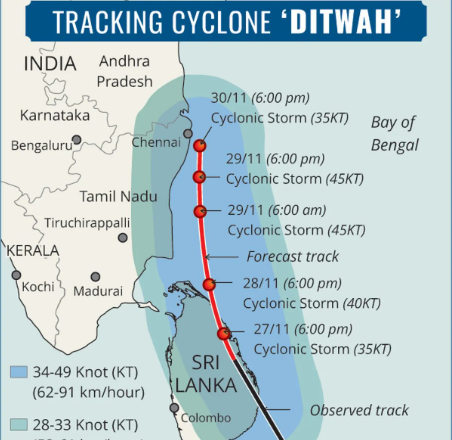
On Saturday, Tamil Nadu and Andhra Pradesh were alerted for heavy rains and floods as Cyclone Ditwah, which killed at least 123 persons in Sri Lanka, moved towards India’s eastern coast in the Bay of Bengal.
An aircraft carrying aid including tents, blankets, hygiene kits and food items from India arrived in Sri Lanka on Saturday morning, the President’s media division said in a statement. The country is seeking contributions to relief efforts from Sri Lankans living overseas and from foreign nationals.
Due to torrential rains and the worst flooding crisis in Sri Lanka, the island country’s scheduled budget debate was cancelled on Friday and Saturday and the Colombo Stock Exchange shortened its trading hours on Friday due to the adverse weather.
Cyclone Ditwah hit Sri Lanka on Wednesday, triggering heavy rains and flooding across the island-state. It killed 123 people across the island nation, with another 130 missing.
The risk level is high in northern and central Sri Lanka and the public should remain vigilant about the “impending extreme weather situation” through Sunday, the nation’s Department of Meteorology said in an advisory on Saturday morning. Relief operations are underway, and nearly 44,000 people have been moved to state-run welfare centres after their homes were destroyed in the rains.
“Fairly heavy falls above 50 mm (2 inches) are likely at some places in Sabaragamuwa and Western provinces,” the met department said. Strong winds can also be expected over the most parts of the island, home to about 22 million people, it added.
On Saturday, Ditwah was seen moving northwards toward Tamil Nadu, where rains have started to lash the coast and the state has issued an advisory for locals and tourists.
People living in valleys, including along the banks of the Kelani River in Colombo district, were urged to move to higher ground, with schools and most government offices, other than essential services, ordered to close.
Sri Lanka’s government has deployed the armed forces to bolster rescue and relief operations across the country, with military helicopters and boats used to evacuate marooned residents. The navy rescued 40 passengers stranded in a flash flood on Saturday.
The risk of major flooding is high near the Kelani River, Manik River and Attanagalu Oya, the state-run Daily News said. Mobile phone service and internet connectivity has been disrupted in several parts of the country.
Meanwhile, media reported from Thailand that at least 145 people have died in the massive flooding that ravaged southern Thailand as receding waters exposed widespread destruction across the region.
Over 100 casualties were reported from the southern province of Songkhla alone as homes and hotels were submerged in the floodwater. Thailand, which is set to host the South East Asian Games next month, will be moving the 11 sporting events to its capital Bangkok due to floods in its southern region.
According to the Department of Disaster Prevention and Mitigation, more than 1.2 million households and 3.6 million people across 12 southern provinces have been affected by days of relentless heavy rain. The flooding, among the worst in decades, submerged large areas, stranded thousands, and caused extensive damage to property and infrastructure.
Government spokesperson Siripong Angkasakulkiat said the death toll, reported in eight provinces, has risen sharply, with Songkhla province alone accounting for at least 110 deaths. Authorities said search and rescue teams are gaining more ground as water levels continue to fall.
Songkhla has witnessed a sudden surge in fatalities after waters began to recede. Rescue teams accessed residential areas that had been unreachable for days, particularly in Hat Yai, the region’s largest city, where several bodies were recovered from previously submerged neighbourhoods.
While water levels dropped in most affected locations, some areas remained heavily inundated. The Meteorological Department said rains’ fury has abated but warned of possible thunderstorms in parts of the south.
Flooding has severely disrupted daily life, leaving roads impassable and low-rise buildings and vehicles completely submerged. Images from the region on Friday showed damaged roads, toppled power poles, and piles of debris including household appliances scattered along muddy streets. Abandoned cars sat overturned or stacked on top of one another, apparently swept away by powerful currents.
Authorities continue relief and recovery operations as the scale of devastation becomes clearer with each passing day.
Reports from Bali said floods and landslides triggered by a tsunami and earthquake in Indonesia’s Aceh and parts of Sumatra killed at least 248 people. Authorities warned that the toll might rise as over 100 others remain missing.
Rescue operations in the affected areas were disrupted as most of the areas are still inundated. Most of the areas remained inaccessible due to damaged roads and disrupted communication lines.
In West Sumatra, over 60 people reportedly died in the natural calamity. In North Sumatra, over 116 people have died so far in floods triggered by the tsunami and the earthquake. In Aceh province, 35 people were killed, the West Sumatra Regional Disaster Mitigation Agency said.
Several pictures and videos of people suffering from flooding also surfaced online. Thousands of people in the affected area left their homes for safer locations.
According to the National Disaster Management Agency, rivers were overflowing and bursting their banks in North Sumatra province. Things became worse on Thursday after a 6.3-magnitude earthquake struck off the coast of Aceh.