


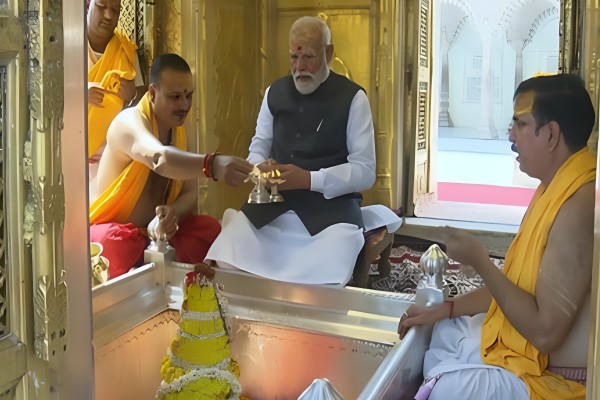
New Delhi: Prime Minister Narendra Modi visited the Shri Kashi Vishwanath Temple in his parliamentary constituency of Varanasi on Wednesday, where he took part in traditional rituals accompanied by Vedic chants.
He was welcomed at the temple with ceremonial ‘damru’ beats and the sound of ‘shankhnaad.’ During his visit, he performed ‘aarti’ and ‘abhishek’ of Lord Shiva, offering prayers and seeking blessings.
The temple administration also presented him with symbolic items, including a ‘Trishul’ and ‘Damru’.
Devotees gathered at the temple premises enthusiastically chanted “Jai Shri Ram,” “Om Namah Shivaya,” and “Har Har Mahadev” as the Prime Minister greeted them. Many children, excited by his presence, crossed barricades to meet him.
Following the temple visit, PM Modi is scheduled to travel to Hardoi to inaugurate the Ganga Expressway, a major infrastructure project built at a cost of Rs 36,230 crore. He will also address a public gathering there.
The inauguration of the Ganga Expressway will mark a significant milestone in the development of world-class infrastructure in the country.
The Ganga Expressway, stretching 594 kilometres, is a six-lane access-controlled greenfield corridor—expandable to eight lanes—built at a total cost of around Rs 36,230 crore, according to an official statement.
The expressway will pass through 12 districts—Meerut, Bulandshahr, Hapur, Amroha, Sambhal, Badaun, Shahjahanpur, Hardoi, Unnao, Raebareli, Pratapgarh, and Prayagraj—creating a seamless high-speed corridor that links the western, central, and eastern parts of the state.
The project is expected to significantly cut travel time between Meerut and Prayagraj from 10–12 hours to around 6 hours, improving connectivity and transportation efficiency, said the statement.
A notable feature of the expressway is a 3.5-kilometre Emergency Landing Facility (airstrip) in Shahjahanpur district. This airstrip is designed for dual use, strengthening national security preparedness while adding strategic value beyond its economic benefits.
The expressway is also planned as a major economic corridor, with the development of Integrated Manufacturing and Logistics Corridors spanning approximately 2,635 hectares across the 12 districts it connects.
This is expected to reduce logistics costs, streamline supply chains, and enhance industrial competitiveness, the statement said.
Improved connectivity will benefit farmers by providing better access to urban and export markets, helping them secure improved prices and boost rural incomes.
The project is also expected to promote tourism, create new economic opportunities, and generate both direct and indirect employment across the region.
The Ganga Expressway will serve as a key component of a broader expressway network in Uttar Pradesh, linking with projects such as the Agra–Lucknow Expressway, Jewar Link Expressway, Farrukhabad Link Expressway, and the proposed Meerut–Haridwar extension.
This expanding network will strengthen high-speed road connectivity across Uttar Pradesh—from East to West and North to South—supporting balanced regional development.
The Ganga Expressway is envisioned not just as a transport project, but as a transformative initiative aimed at boosting industrial growth, agriculture, employment, and the broader economy, the statement said.
(DD News)