


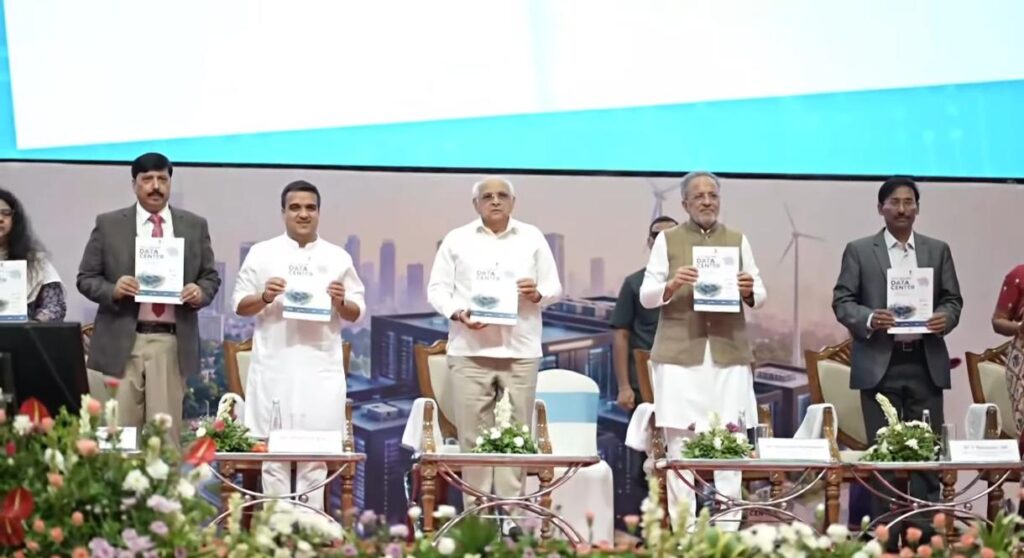
Gandhinagar: The Gujarat government on Thursday launched the ‘Viksit Gujarat – Data Centre Policy 2026-29’, aimed at attracting investments in hyperscale data centres, artificial intelligence (AI) infrastructure and digital services, with Chief Minister Bhupendra Patel unveiling the policy booklet at an event in Gandhinagar.
Deputy Chief Minister Harsh Sanghavi, Science and Technology Minister Arjun Modhwadia, Chief Secretary Manoj Kumar Das, senior government officials and representatives from the technology sector attended the launch programme.
Speaking at the event, Science and Technology Department Secretary P. Bharathi said the policy was designed to create the infrastructure required to support India’s expanding digital economy.
“Data is even more valuable than oil. Every digital payment, every AI model, every cloud application, every online transaction, every government service and every innovation is powered by data,” she said, highlighting the growing importance of data centres as strategic digital infrastructure.
Bharathi said India generates nearly 20 per cent of the world’s data but accounts for only around three per cent of global data centre capacity, while the United States and China together account for nearly 70 per cent of worldwide capacity.
“The question is, where will India’s future digital infrastructure be built? Gujarat is ready to answer that question,” she said.
She also announced plans for two cable landing stations in Gujarat and said another project would be announced soon, adding that improved international connectivity would strengthen the state’s position as a preferred destination for data centre investments.
Under the policy, Gujarat has recognised data centres as strategic infrastructure and will provide a range of fiscal incentives, including capital and interest subsidies, power tariff support, SGST reimbursement, electricity duty reimbursement, assistance for desalination plants and stamp duty exemptions.
Officials said the policy also includes non-fiscal measures aimed at creating a competitive environment for hyperscale data centres and AI infrastructure development.
The policy document highlights Gujarat’s existing infrastructure strengths, including 69 gigawatts of installed power capacity, of which 47 gigawatts comes from renewable energy sources, along with industrial hubs such as Dholera and GIFT City.
It states that global data centre capacity is expected to approach 200 gigawatts by the end of the decade and notes that Gujarat aims to play a larger role in this expansion while supporting the state’s goal of becoming a USD 3.5 trillion economy by 2047.
Addressing the gathering, Science and Technology Minister Arjun Modhwadia said India had missed some earlier industrial opportunities but had emerged as a global player in sectors such as vaccine manufacturing and semiconductors.
He said the next phase of economic growth would be driven by artificial intelligence and quantum computing. “Data is the new oil well of the developing economy,” Modhwadia said.
Comparing global data centre capacities, he said the United States has nearly 5,500 data centres and the United Kingdom more than 500, while India has around 200. He added that the US has nearly 30 gigawatts of installed data centre capacity compared with India’s current capacity of about 2-3 gigawatts, which is expected to rise to around eight gigawatts with upcoming projects.
Modhwadia said Gujarat had already received proposals for nearly 10 gigawatts of data centre capacity and emphasised that the sector was part of a broader AI ecosystem.
“This is not just about data centres; it is part of the entire AI ecosystem. If we become leaders in data centres, Gujarat will become not only the country’s but also the world’s leader in the AI ecosystem,” he said.
He added that the state government aims to develop up to eight gigawatts of data centre capacity in Gujarat and invited domestic and international investors to participate in the sector, assuring government support for building a robust digital infrastructure ecosystem.
(DD News)