


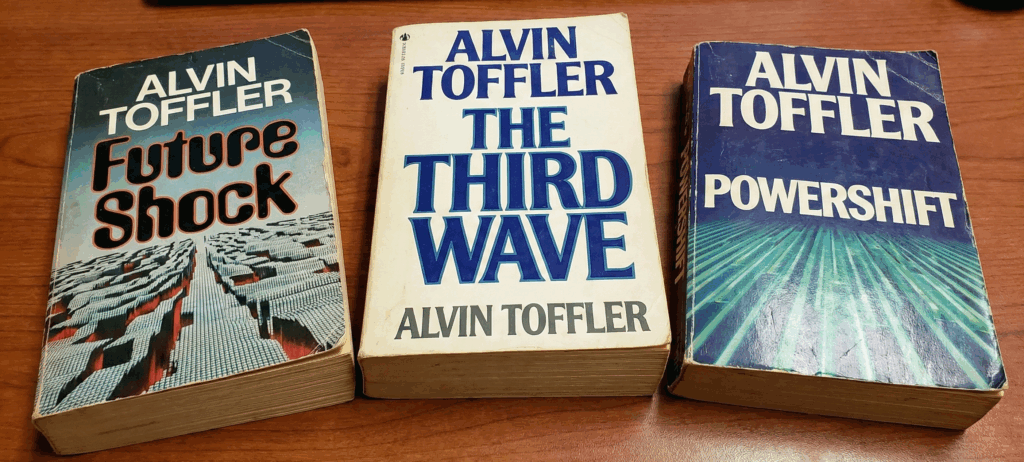
Future Shock, The Third Wave & Powershift — Why These Books Still Shape the Way I Read the World


After spending more than three decades in media, storytelling, and strategic communication, I’ve learned one truth: the future rarely arrives as a surprise—if you’re paying attention to the right thinkers.
And among all the futurists and analysts I’ve encountered in my professional journey, Alvin Toffler remains unmatched. His book trilogy—Future Shock, The Third Wave, and Powershift—didn’t just predict technological and social transformation; it gave leaders like me a framework to interpret the chaos, opportunities, and contradictions of modern India.
Whenever I analyse market trends, political signals, shifts in consumer behaviour, or the evolution of media ecosystems, I still find myself returning to Toffler. Not for nostalgia—but because the world continues to unfold exactly the way he warned it would.
When I first read Future Shock, early in my career, I felt as if someone had decoded the turbulence I saw around me.
Toffler’s idea of “too much change in too little time” wasn’t theoretical—it was the world I was reporting, producing, and living through.
The disruptions he predicted became the disruptions I witnessed:
- Careers becoming shorter
- Technology eating attention spans
- Information exploding faster than people could process
- Entire industries collapsing and new ones rising overnight
- Social identities becoming fluid, even fragile
In my professional life—whether managing content teams, leading media businesses, or observing India’s digital evolution—I’ve seen this psychological overload up close. In many ways, Future Shock prepared me for a career where adaptability is the only permanent skill.
If Future Shock explained the anxiety, The Third Wave explained the architecture.
Toffler’s three civilisational waves—Agrarian, Industrial, and Information—became a lifelong reference point for me as I analysed markets, political structures, and socio-cultural change.
India is the perfect example of “wave collision.”
Even today, India is living in all three waves at the same time:
- A massive agrarian population
- A rapidly expanding industrial sector
- A globally competitive digital economy
This overlap creates enormous opportunity—and enormous friction.
I’ve seen this tension across classrooms where I teach, boardrooms where I consult, and digital platforms where I publish.
The Third Wave predicted:
- Remote work
- Decentralised media (exactly where REVOI thrives today)
- Knowledge-based industries
- Customised products and experiences
- Electronic currencies
- Multi-career lives
- Technology empowering individuals more than institutions
Every major shift in India’s last 25 years—from IT services to social media to the startup boom—fits squarely into Toffler’s framework.
As someone who has spent 30 years documenting change, I can say with conviction:
Toffler didn’t just describe the Third Wave; he described India’s destiny.
By the time I read Powershift, I was already witnessing the media revolution from the front row.
But this book reframed something fundamental for me:
Power is no longer about wealth or force—it’s about who controls information.
As someone who has spent his life shaping narratives, building platforms, training young professionals, and decoding market behaviour, this insight hit me with full force.
Today, Toffler’s thesis has become reality:
- Data is more valuable than capital
- Tech platforms have greater reach than many governments
- Algorithms influence public opinion more than editorials
- Startups disrupt legacy empires with sheer knowledge
- A single well-informed individual can challenge entire institutions
Every election, every social movement, every corporate transformation I’ve analysed in recent years echoes Toffler’s premise:
Knowledge is the new currency of power.
Where Toffler Was Remarkably Accurate
Even as someone who has lived and worked through multiple technological cycles, I remain amazed by the accuracy of Toffler’s predictions:
- Remote work (he called it “electronic cottages”)
- Personalised media and citizen journalism
- Decentralised power structures
- Digital currencies
- Cognitive overload and burnout
- The governance struggles created by rapid technology
Much before AI, smartphones, and social platforms existed, Toffler mapped the psychological, economic, and political disruptions we now take for granted.
Where He Missed the Mark
After three decades in this field, I can also see where Toffler underestimated the future:
- He didn’t anticipate the rise of algorithmic addiction
- He didn’t predict the massive globalisation–nationalism swing
- He underplayed the intensity of climate disruption
- He expected smoother transitions between waves than the turbulent reality
Yet, even his “misses” offer valuable lenses through which we understand today’s challenges.
Why Toffler Matters Even More in 2025
As India steps into an era dominated by AI, digital governance, demographic strength, and entrepreneurial energy, I find Toffler more relevant than ever.
- We are entering a Fourth Wave — AI Autonomy
Toffler didn’t see this, but his frameworks help us interpret it.
- Institutions must reinvent themselves
Rigid, industrial-age thinking no longer works in a fluid, knowledge-driven economy.
- India stands at a pivotal moment
We are uniquely positioned to leapfrog into global leadership—if we manage wave transitions intelligently.
- Media must evolve faster
Platforms like REVOI represent the future Toffler imagined:
- niche voices
- decentralised content
- multilingual digital ecosystems
- participatory public discourse
- Education must prioritise adaptability
The next generation needs flexible thinking, emotional resilience, and digital fluency—qualities Toffler warned would define survival.
My Final Word: Toffler Didn’t Predict My Career, But He Did Shape It
Every time a new technology emerges, every time a policy changes, every time society reacts with excitement, anxiety, fear, or hope, I am reminded of Toffler’s words.
As someone who has spent 30 years navigating India’s media, academic, and corporate landscapes, I can confidently say:
Alvin Toffler didn’t just predict the future— he prepared people like me to understand it.
His trilogy remains one of the most important intellectual compasses for anyone trying to interpret the speed, scale, and shock of modern change.
Read this also:
The Treasure Within: Paulo Coelho’s The Alchemist and the Journey Toward Self
About the Author
Vinod Dave is a senior media professional with over 30 years of experience in advertising, strategy, and content. He is the Founder of Shaandil Consulting Group and TRIM Media Pvt. Ltd., which owns REVOI – Real Voice of India, a digital news and knowledge platform dedicated to amplifying India’s real growth stories.