


Manas Dasgupta
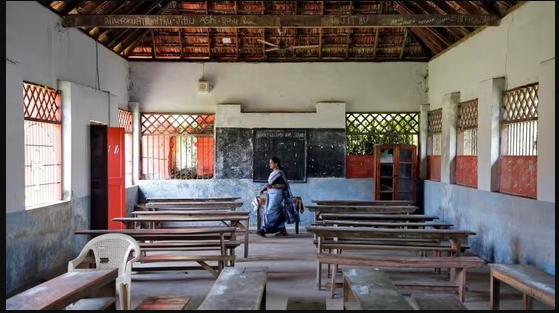
NEW DELHI, Oct 26: The West Bengal government has earned the dubious distinction of running the maximum number of schools without a single enrolment of students and paying salaries to over 17,000 teachers in such schools.
According to the data released by the union ministry of education, close to 8,000 schools across the country had zero enrolments during the 2024-25 academic session, with West Bengal accounting for most such schools, 3,812 in number, followed by Telangana.
A total of 20,817 teachers were employed in the schools with zero enrolments with West Bengal accounting for 17,965 such teachers. The number of such schools with zero enrolment, however, showed a downward trend, from 7,993 this year from 12,954 such schools last year, down by over 5,000 from the previous year’s count.
To their credit, Haryana, Maharashtra, Goa, Assam, Himachal Pradesh, Chhattisgarh, Nagaland, Sikkim, and Tripura had no such schools. “School education is a State subject, States have been advised to address the issue of zero enrolments in schools. Some States have merged some schools for optimum utilisation of resources such as infrastructure as well as staff,” a senior official of the education department said.
There were no schools with zero enrolment in the Union Territories of Puducherry, Lakshadweep, Dadra and Nagar Haveli, Andaman and Nicobar Islands, Daman and Diu, and Chandigarh, according to the data. Delhi also had no schools with zero enrolments.
After West Bengal, the second highest number of schools with zero enrolment in Telangana (2,245), followed by Madhya Pradesh (463). While Telangana had 1,016 teachers employed in these schools, Madhya Pradesh employed 223.
Uttar Pradesh had 81 such schools. The Uttar Pradesh Madhyamik Shiksha Parishad (UP Board) had announced that it is preparing to revoke the recognition of its affiliated schools across the state that have recorded zero student enrolment for the past three consecutive academic years.
Over 33 lakh students across the country are enrolled in more than 1 lakh single-teacher schools, with Andhra Pradesh recording the highest number of these schools, followed by Uttar Pradesh, Jharkhand, Maharashtra, Karnataka, and Lakshadweep.
However, when it comes to student enrolment in schools with a single teacher, Uttar Pradesh tops the list, followed by Jharkhand, West Bengal, and Madhya Pradesh. The number of single-teacher schools decreased from 1,18,190 in 2022–23 to 1,10,971 in 2023–24, recording a drop of around 6%.
According to the Ministry of Education’s statistics, in the academic year 2024-25, there were 1,04,125 schools in India run by a single teacher each, and such schools catered to 33,76,769 students – an average of about 34 students per school.
The Right to Education Act, 2009 mandates a pupil-teacher ratio (PTR) of 30:1 at the primary level (classes I-V) and 35:1 at the upper primary level (classes VI-VIII). The highest number of “single-teacher” schools in the country are in Andhra Pradesh, followed by Uttar Pradesh, Jharkhand, Maharashtra, Karnataka and Lakshadweep. However, when it comes to student enrolment in schools with a single teacher, Uttar Pradesh tops the list, followed by Jharkhand, West Bengal and Madhya Pradesh.
The number of single-teacher schools has decreased from 1,18,190 in 2022–23 to 1,10,971 in 2023–24, recording a drop of around 6%. “The government is on a mission to improve the learning outcomes and entail the best possible utilisation of available resources by undertaking school mergers and consolidation of schools often called ‘rationalisation of schools’,” a senior official explained.
“Single-teacher schools hinder the teaching learning process and hence efforts are being made to redeploy teachers from schools with zero student enrolment to single-teacher schools to ensure optimal teacher availability,” the official added.
Andhra Pradesh has 12,912 single-teacher schools, Uttar Pradesh 9,508, Jharkhand 9,120, Maharashtra 8,152, Karnataka 7,349, Lakshadweep 7,217, Madhya Pradesh 7,217, West Bengal 6,482, Rajasthan 6,117, Chhattisgarh 5,973 and Telangana (5,001). Delhi has nine single-teacher schools.
There are no single-teacher schools in the Union Territories of Puducherry, Ladakh, Dadra and Nagar Haveli and Daman and Diu and Chandigarh. The Andaman and Nicobar Islands have just four single-teacher schools. In terms of student enrolments in single-teacher schools, Uttar Pradesh leads with 6,24,327 students taking lessons in such schools, followed by Jharkhand with 4,36,480 students, West Bengal 2,35,494, Madhya Pradesh 2,29,095, Karnataka 2,23,142, Andhra Pradesh 1,97,113, and Rajasthan 1,72,071, among others.
When it comes to average student enrolments per school, Chandigarh and Delhi have the highest number of students per school, at 1,222 and 808, respectively. Ladakh, Mizoram, Meghalaya, and Himachal Pradesh, on the other hand, have significantly lower enrolments per school, at 59, 70, 73, and 82, respectively.
“High number of students per school indicates optimum utilisation of school infrastructure and schools with low enrolments are currently being merged to ensure optimal utilisation,” the official explained.
The academic experts have said India’s expanding education system could benefit from data collection and analysis if it overcome the problems of poor data privacy, outdated technology and data fragmentation. Schools often struggle with the practical application of data. The digital divide poses a significant barrier, especially in rural and underprivileged regions, leading to data gaps which result in skewed policy decisions.
The experts have recommended the formation of a central agency responsible for the annual collection of educational data through a standardised and rigorous process, coupled with the promotion of open data principles. Teachers undertaking data entry tasks should receive financial incentives for the additional workload.
“India has one of the largest education systems in the world, and data plays an increasingly pivotal role in shaping its policies and interventions. When handled responsibly, this data can transform educational outcomes for the better. But there are also significant risks, from mismanagement to misuse,” some experts said. The Indian school education system includes over 1.49 million institutions, from grade schools to universities, and serves more than 265 million students.