


Manas Dasgupta
NEW DELHI, Mar 15: The Election Commission of India (ECI) on Sunday announced the Assembly election schedule for four states and a union territory with two-phase polling in high voltage West Bengal on April 23 and 29 with single phase polling in Assam, Kerala and the union territory of Puducherry on April 9 and Tamil Nadu on April 23 with the counting of votes in all the states and the union territory to be taken up simultaneously on May 4.
Unlike in the 2021 elections when West Bengal saw eight-phase polling held amid the Covid-19 pandemic spread over from March 27 to April 29, the polling this time had been squeezed to two-phases following representations from various political parties and others. Leaders of several political parties, it is learnt, told the Election Commission officials this time that the polls should be held in two or three phases. They told the officials that a prolonged schedule jacks up election expenses and also reduces public spirit about the voting exercise.
One rationale behind holding polls in multiple phases is that this makes the deployment of central forces easier. Bengal has witnessed incidents of political violence and loss of lives during earlier elections. But this time, parties have argued that a large number of central forces are already stationed in the state, making a prolonged election unnecessary.
Asked why the number of phases in West Bengal has come down from eight to just two, the chief election commissioner (CEC) Gyanesh Kumar said the poll body has had detailed deliberation and found necessary to reduce the number of phases and bring it down to an extent where it was convenient for everybody.
Assam has 126 assembly constituencies, Kerala 140, Puducherry 30, Tamil Nadu 234, and West Bengal 294. CEC Gyanesh Kumar said 2.18 lakh polling stations will be set up for the voting exercise in the four states and Puducherry.
While talking about elections in Bengal this time, CEC Gyanesh Kumar also addressed the concerns over poll violence and said necessary action shall be taken on police offers who were found to be involved in earlier polls. “With regards to the police officers who were involved in the violence in earlier elections, the list has been sought, as is known to the media during our visit to West Bengal, and necessary action as per law shall be taken…,” CEC Gyanesh Kumar said.
He emphasised that elections in all states and the union territory shall be violence and inducement-free, warning of strict action if anything to the contrary was noticed or reported.
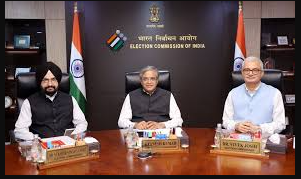
With the announcement of the schedule, the Model Code of Conduct has come into immediate effect in the poll-bound States and the Union Territory. Chief Election Commissioner Gyanesh Kumar and Election Commissioners Sukhbir Singh Sandhu and Vivek Joshi addressed the press conference. Mr Kumar said the process of Special Intensive Revision (SIR) of electoral rolls was carried out according to the Article 326 of the Constitution to ensure that no eligible voters were left from the electoral rolls and no ineligible voter was included in the electoral rolls. He said “pure electoral rolls” were the “bedrock of democracy.”
He said over 17.4 crore voters would be eligible to participate in the upcoming assembly elections across Tamil Nadu, Bengal, Assam, Kerala, and Puducherry. CEC Gyanesh Kumar said it would not be right for him to comment on litigations regarding the voters list in West Bengal. He said elections would be held according to the laws and the MCC has just come into effect.
To a question on “misinformation and deepfakes”, he said State nodal officers would continue to monitor and take them down and file FIR against them. To a question regarding the statement by some political parties and leaders against the SIR process, CEC Gyanesh Kumar said the ECI was bound by the Article 326 of the Constitution to add eligible voters to the electoral roll and remove who are ineligible. “With regards to the political statements by certain political leaders or political parties, the Commission doesn’t wishes itself to engage in such dialogues.”
To another question regarding sops announced by certain State governments announcing schemes just before the Model Code of Conduct (MCC) comes into force, he said, “… in a democratic setup, the State and central governments, in their own wisdom, can take any policy or any other decision which they feel is appropriate, but once the Model Code of Conduct comes into operation, any decision which affects the outcome of the election or works in a way of inducement is not allowed and the Model Code of Conduct has come into force just now.”
About polling transparency, the CEC said there would be “100% webcasting to ensure transparency in each and every polling station. The Presiding Officers of every polling station shall input the number of votes cast after every two hours to ensure that voting percentages that are being relayed through the media to the public at large is by and large accurate,” the CEC said. He also said all services offered by the various applications of the ECI were now available under the ECINET app. “All the necessary information (from) across all the necessary stakeholders is available,” he said about the application.
He said SIR was the first among more than 30 measures taken by the ECI in the last 12 months to enhance transparency and enhancing electors’ experience. Depositing mobiles outside poll booths, coloured photograph of candidates on EVMs, maximum of 1,200 electors in any polling stations, candidate booths to be set up just outside 100m of the polling station, and a clear number mentioning the voter’s polling station, were among the other major initiatives, Mr Gyanesh Kumar said.