


Manas Dasgupta
NEW DELHI, Jan 20: As the governors in some of the non-BJP ruled states continued to be in loggerheads with the state governments, controversy erupted on Tuesday in two southern Indian states where the governors refused to read out the customary inaugural addresses in their respective state Assemblies.
While the Kerala governor Rajendra Vishwanath Arlekar introduced his own lines in the text of the inaugural address prepared by the state cabinet, in the neighbouring Tamil Nadu the governor RN Ravi walked out of the House without reading out the address and declaring that the Assembly was open for taking up the budget discussions for the next financial year.
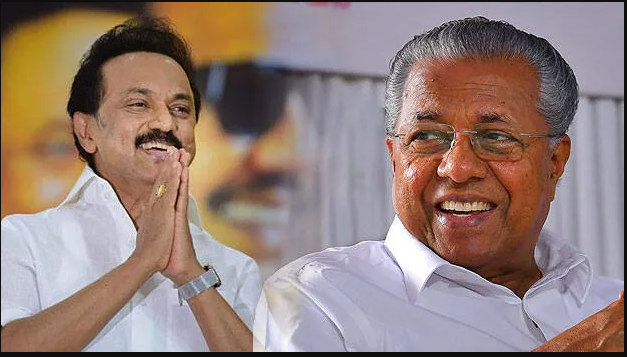
The Tamil Nadu chief minister and the ruling party DMK chief MK Stalin later announced that his party along with other like-minded political parties in the country would undertake efforts to advocate for a Constitutional amendment to do away with the practice of the first Assembly session of the year commencing with the customary Governor’s address to the House.
The move, if initiated, would be in keeping with similar views expressed by a former President R Venkataraman who had held that the customary president’s address and governor’s address at the beginning of the first session of the year of Parliament and state legislatures was a British legacy and India should do away with the colonial practices.
Earlier in the day, the Kerala Assembly witnessed extraordinary scenes when the chief minister Pinarayi Vijayan “corrected” the policy address made by Governor Arlekar after the latter had made his departure. After seeing off the Governor, Mr Vijayan returned to the Assembly and announced that Mr Arlekar had made changes to paragraphs 12, 15 and 16 in the policy speech. While certain sections in the policy address were omitted, Mr Arlekar made certain additions elsewhere, Mr Vijayan said.
According to the speech approved by the Cabinet, paragraph 12 began thus: “Despite these social and institutional achievements, Kerala continues to face severe fiscal stress arising from a series of adverse Union government actions that undermine the constitutional principles of fiscal federalism.” In Mr Arlekar’s speech, it was presented thus: “Despite these social and institutional achievements, Kerala continues to face severe fiscal stress arising from curtailment of advances.”
In paragraph 15, the Governor omitted the following section: “Bills passed by State legislatures have remained pending for prolonged periods. My government has approached the Supreme Court on these issues, which have been referred to a Constitution Bench.”
The Cabinet-approved section in paragraph 16 read thus: “Tax devolution and Finance Commission grants are constitutional entitlements of States and not acts of charity, and any pressure on constitutional bodies entrusted with this task undermines federal principles.” Mr Vijayan pointed out that the Governor had prefaced this section with “My government feels…”
Staying true to the spirit of the Indian Constitution and the precedents of the Kerala Assembly, the speech as approved by the State Cabinet would prevail, the Chief Minister said. “The Governor addresses the Legislative Assembly at the start of the first session of a year. Since the Governor presents the policy of the State government in the House, paragraphs 12, 15 and 16 as approved by the Cabinet will prevail,” Mr Vijayan said.
The English and Malayalam copies of the policy address that were distributed to the MLAs and the press remained the versions approved by the Cabinet.
The CPI(M)-led Left government’s relations with Lok Bhavan has not been cordial in recent years. In January 2024, the previous Governor, Arif Mohammed Khan, had created headlines when he wrapped up his policy address in less than a minute. The government’s relationship with Mr Arlekar had soured over a number of issues, including the delay in securing assent for Bills passed by the Kerala Assembly.
In Tamil Nadu, the state Assembly unanimously adopted a resolution moved by Mr Stalin disapproving the governor’s action in refusing to read out the address. The resolution also said the speech sent to the Governor (text of which was uploaded in the tablets given for members) would be considered as having been read out.
“The Governor has walked out of this House violating the rules and tradition of this House. As per Article 176 of the Constitution, the Governor should read out the Governor’s speech in entirety. There is no scope for the Governor to include his personal comments or to remove parts of the speech prepared by the State government,” Mr Stalin said.
Referring to queries from the Governor seeking clarifications on January 19, Mr Stalin said the reply was provided. “Despite that, the Governor has intentionally indulged in such an action violating the provisions of the Constitution. I consider his actions disrespected the customs and long traditions of this august House.”
Recalling his speech on April 10 in 2023, the Chief Minister said though late leaders and former Chief Ministers C.N. Annadurai and M. Karunanidhi were of the view that the Governor post was unnecessary, but they did not fail in according the respect to the post as long as it was there. Mr Stalin said he too followed that principle and issued instructions for steps towards the Governor’s address to the House.
“However, it is regrettable that the Governor has acted like before. The Tamil Nadu Legislative Assembly reflects the sentiments of the eight crore Tamil people. The Governor should be truly concerned about their welfare and development and should speak the truth. He should extend cooperation to the government elected by the people. The Constitution expects the same from the individual holding the post. But our Governor acted contrary to that,” Mr Stalin said.
It was the fourth consecutive year that Mr Ravi had either refused to read out in full the address prepared by the DMK government or walked out of the Assembly without formally inaugurating the budget session. Mr Stalin told the House later that since he had the principal responsibility in upholding the dignity of the House, he was moving the resolution.
Such events in various non-BJP states have yet again raised questions about the purpose behind the practice of having a Governor’s Address. The former president R Venkataraman (1987-1992), was a bitter critic of the practice of address by Presidents and Governors to the legislature at the commencement of the first session of the Houses every year.
In his memoirs, My Presidential Years, published in 1994, the former President described it as a “British anachronism” and a “meaningless formality.” He had recommended more than once to Prime Ministers — Rajiv Gandhi in March 1989 and Chandra Shekher in February 1991 — that the institution of the address to the legislature be deleted through a Constitutional amendment.
According to him, the address, prepared by the government, contained only views of the regime. The President and Governors were “mouthpieces.” It was for this reason that he also found fault with those who criticised the President or Governors for the contents of the address. He had also suggested to the government, before presenting his maiden Presidential address to the Parliament in February 1988, was to change the expression “My government” to “The government.” The original practice, he reasoned, was a part of the British legacy and not relevant in India which, according to Venkataraman, had a Constitution framed by people themselves through the Constituent Assembly and wherein “the powers of the President, Prime Minister, etc. are given by the people”. He pointed out that it was “incongruous” for the President of the country to call the government “My Government.”