


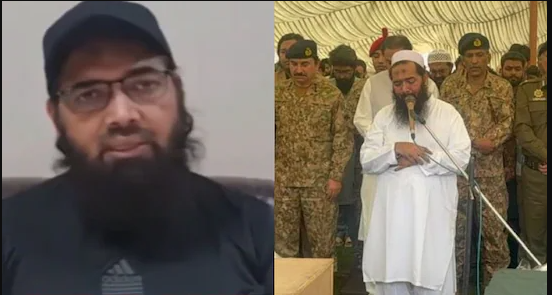
NEW DELHI, Jan 15: In a stunning public admission that cuts through years of denials and diplomatic doublespeak, the commander of Pakistan-based terror group Lashkar-e-Taiba (LeT), Hafiz Abdul Rauf, has acknowledged that India’s Operation Sindoor delivered a devastating blow to the terror group’s nerve centre in Muridke, razing what he described as its headquarters at Markaz-e-Taiba on the night of May 6-7, 2025.
Rauf, a US-designated global terrorist, told a gathering that the strike was “a very big attack” and conceded that the complex had been reduced to rubble. “What happened on May 6-7, that place is no longer a mosque. Today, we cannot even sit there. It is finished; it has collapsed,” he said, in remarks that amount to the most direct confirmation yet from within LeT that India’s operation hit its intended target.
Rauf has been the operational commander of Lashkar involved in training of terrorists and launching them from Pakistan Army-sponsored launchpads in Pakistan-Occupied Kashmir (PoK). The confession carries particular weight because Rauf is not a fringe figure. He had earlier led the funeral prayers of terrorists killed in the strikes, images of which had gone viral at the time. Now, months later, his words have torn away the last shreds of plausible deniability around what stood in Muridke and what was lost there.
Operation Sindoor was launched in the aftermath of the April 2025 Pahalgam terror attack, in which 26 civilians were killed in Jammu and Kashmir by LeT under the garb of the terror group, The Resistance Front (TRF). Investigators established that the attackers used Chinese-made weapons and equipment, pointing to a widening and more sophisticated supply chain feeding Pakistan-based terror groups.
Rauf has publicly admitted that Chinese weapons and equipment were indeed used by Pakistan and LeT during the confrontation that followed. But his remarks went far beyond acknowledging damage. In an extraordinary, almost boastful disclosure, Rauf claimed that Pakistan has given “open freedom for jihad” and that recruitment and training of terrorists was easier there than anywhere else in the world.
“The state has decided, that’s why we are able to do this,” he said, effectively confirming what New Delhi has long alleged that terror groups operate not just with tolerance, but with institutional backing.
Rauf also praised China, asserting that Beijing helped Pakistan during what he called “Bunyan-e-Marsous” in the period of heightened India-Pakistan tensions after Pahalgam. According to him, Chinese support provided Pakistan with near real-time intelligence on India. In a revealing aside, he said that “those whose aircraft used to sell have turned to scrap” and claimed there is now global demand for Chinese fighter jets and equipment – a statement that underscores the strategic messaging embedded in his speech.
The broader context makes the confession even more explosive. On Thursday, a passing-out ceremony for newly trained terrorists was held at the Markaz-e-Taiba complex – the same site Rauf now says has been destroyed. The event was attended by Rauf himself, Hafiz Saeed’s son Hafiz Talha Saeed, and Lashkar’s deputy chief Saifullah Kasuri, among other top commanders. The ceremony was a brazen display of continuity, suggesting that even after Operation Sindoor, the infrastructure of jihad was being rebuilt or relocated under official indulgence.
Rauf’s rhetoric mixed grievance, triumphalism and theology. “Allah saved us, Allah helped us,” he said, while acknowledging the scale of the Indian strike. He claimed Pakistan had intelligence “down to the last detail” and that the exchanges “echoed all the way to America and Europe,” projecting the confrontation as a global moment rather than a regional one.
(Manas Dasgupta)