


Manas Dasgupta
NEW DELHI, Sept 16: Months after India destroyed several terror establishments in Pakistan and Pakistan-occupied Kashmir (PoK) under “Operation Sindoor,” a Jaish-e-Mohamad (JeM) commander has admitted that the family of Masood Azhar, the terror group’s top commander, was “torn into pieces” in Indian army strikes on Bahawalpur and has also unmasked the Pakistan government and its army’s claims of having annihilated terrorism from its soil.
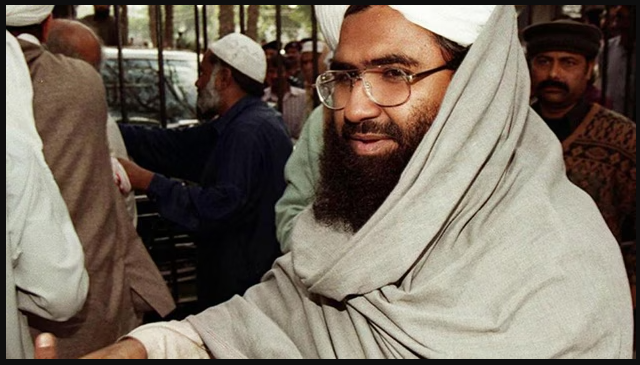
The commander has publicly acknowledged that the Pakistani army was thick and thin with the terror groups though he objected to the United Nations designated terrorists like Masood Azhar be branded a “terrorist,” and described him as ‘a global symbol of resistance… discussed by world powers from Washington to Moscow.’
In a video that has gone viral, a top Jaish commander, Masood Ilyas Kashmiri, flanked by security personnel, can be heard explaining how the Indian armed forces entered their hideout and attacked them and for the first time admitted that family members of Masood Azhar were killed during India’s strike in Bahawalpur as part of its Operation Sindoor. A statement attributed to Azhar himself then had claimed 10 members of the family had died.
“Embracing terrorism, we fought Delhi, Kabul and Kandahar for protecting the borders of this country. After sacrificing everything, on May 7, Maulana Masood Azhar’s family was torn apart by Indian forces in Bahawalpur,” Kashmiri said in Urdu, as several gun-wielding security personnel surround him in the background. At the same event, Kashmiri bragged about terror groups having the support of the Pakistan Army and its Chief Asim Munir and said, “Army sent generals to funerals” of those killed in Indian strikes.
Kashmiri was speaking at a religious event in Pakistan’s Balakot tehsil last week – ostensibly focusing on the life and teachings of Prophet Mohammed – has been red-flagged for anti-India and pro-jihad sentiments and slogans. The intelligence sources said the event – the 38th annual ‘Mission Mustafa’ conference – began at 10 am and drew a crowd of thousands from the town of Gadi Habibullah, where it was being held, and nearby areas. Prominent Islamic scholars, representing diverse schools of thoughts, spoke on the day. By and large the focus was on ‘Khatm-e-nubuwat’, i.e., the ‘finality’ of the Prophet, sources said.
The standout was the video of a speech by Kashmiri, a high-ranking member of the Jaish-e-Mohammed terrorist group that is accused of multiple terror attacks on India, including two in 2016 – on an Indian Air Force base in Punjab’s Pathankot and on an Army camp in Jammu and Kashmir’s Uri.
Intel sources said Kashmiri hit out at Azhar being labelled a terrorist and, in remarks that Delhi has seen as confirming, again, Pakistan’s involvement with cross-border terrorism – a topic that was raked up after the Pahalgam terror attack – he hailed ’25 years of struggle for ideological borders and sacrifices.’
India has expressed regret for civilian casualties but said efforts were made to minimise them, and that all targets had been carefully vetted and found to be directly linked to terrorist activity. Intel sources said Kashmiri also condemned the disavowal of terrorists, i.e., ‘mujahideen’, and called for the revival and expansion of jihad, to target even Israel Prime Minister Benjamin Netanyahu.
Masood Azhar is one of India’s most-wanted terrorists and has been involved, directly or otherwise, in the attack on the Parliament building in 2001 and the deadly 26/11 Mumbai strikes. Designated a global terrorist by the United Nations in 2019, Azhar was in India’s custody till he was released in exchange for the passengers of IC-814 after the Kandahar hijacking in 1999.
Since then, he has found shelter in Pakistan. India has repeatedly demanded Pak hand him and Hafiz Saeed, the chief of another banned terrorist group, the Lashkar-e-Taiba. Pak has feigned ignorance; in a July interview with Al Jazeera, Pak politician Bilawal Bhutto claimed Islamabad was unaware of his whereabouts and suggested that Azhar may be in Afghanistan. In a June interview, Bhutto Zardari had said his country would be “happy to” arrest him if India gives information that he is on Pakistani soil.
Reports have claimed that several top Pakistani military and civil officials attended the funerals of designated terrorists killed in the Indian air strikes under Operation Sindoor. Satellite images showed heavy damage to one of the domes of the mosque and extensive destruction inside. While Pakistan never acknowledged the fact, eyewitnesses and foreign media reports said state funerals were held in May for Azhar’s family members. Azhar, who has rarely been seen in public, also made a brief appearance and left the venue within minutes.
Weeks after 26 civilians were killed in a terror attack in Jammu and Kashmir’s Pahalgam, Indian armed forces, under ‘operation Sindoor,’ conducted coordinated overnight strikes on nine terrorist facilities inside Pakistan and PoK, targeting the deep infrastructure of Jaish-e-Mohammed (JeM) and Lashkar-e-Taiba (LeT). Pakistan later acknowledged that nine sites were hit in the strikes, including locations in Bahawalpur, Kotli and Muridke – all known hubs of extremist activity.
Bahawalpur, Pakistan’s 12th largest city, was targeted as it serves as the nerve centre of JeM. Located around 400 km from Lahore, it houses JeM’s operational headquarters at the Jamia Masjid Subhan Allah, also known as the Usman-o-Ali campus.
Formed in the early 2000s when UN proscribed terrorist Masood Azhar called for jihad in Kashmir, JeM is responsible for numerous attacks on Indian soil over the past two decades. After Operation Sindoor, Pakistani media reported that Masood Azhar released a statement admitting that 10 of his family members were killed in the Indian operation.