


Manas Dasgupta
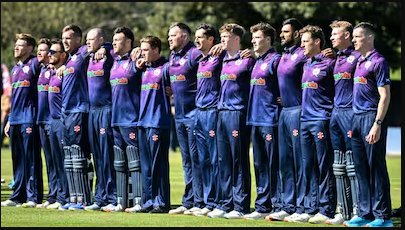
NEW DELHI, Jan 24: The International Cricket Council (ICC) on Saturday officially informed the Bangladesh Cricket Board that its team had been ejected out of the coming T20 World Cup for refusing to travel to India to play their matches and has named Scotland as its replacement for the tournament starting from February 7.
In a related development, the Pakistan Cricket Board (PCB) chairman Mohsin Naqvi said the Pakistan government would decide if its team would participate in the T20 World Cup after Bangladesh’s ouster. Addressing a press conference, Mr Naqvi said the matter would be placed before Prime Minister Shahbaz Sharif, who is currently out of the country, once he returned, for a final decision on Pakistan’s participation in the tournament.
Earlier this week, ICC had rejected Bangladesh’s request to shift their T20 World Cup matches from India to Sri Lanka, who are the co-hosts under the hybrid model. They also gave a 24-hour deadline to Bangladesh to either confirm their participation or get replaced.
The ICC has announced that Scotland will replace Bangladesh at the ICC Men’s T20 World Cup 2026. It was formally announced on Saturday that Bangladesh will no longer compete in the upcoming ICC Men’s T20 World Cup, after the Bangladesh Cricket Board (BCB) refused to participate in the tournament per the published match schedule,” ICC said in a statement on Saturday.
Sources said the ICC officials, including chairman Jay Shah, were in Dubai on Friday and an email was sent late in the evening to BCB chairman Aminul Islam Bulbul, conveying the global body’s decision. “An e-mail was sent last evening to Bangladesh Cricket Board chairman intimating him that his board didn’t get back to ICC officially after the 24 hour deadline that was given to them to decide if they wanted to come to India, so a decision has been taken,” an ICC source said.
“The BCB did a press conference in Dhaka before officially intimating the global body which is a violation of protocol. They have been categorically told that they are being replaced,” the source added. Bangladesh’s Sports Ministry advisor Asif Nazrul advised against travelling to India, citing security issues despite being given repeated assurances by the ICC.
Scotland will thus play their four group league games against West Indies (February 7), Italy (February 9) and England (February 14) in Kolkata followed by a game against Nepal in Mumbai on February 17.
Pakistan, which was the only nation to support Bangladesh demand for shifting their matches from India at the ICC Board of Directors meeting in which the decision to reject BCB’s demand was taken by 14 votes to 2, are scheduled to play all their matches in Sri Lanka as per an agreement with the BCCI. Mr Naqvi said Bangladesh, whom he described as a “big stakeholder” in world cricket, had been unfairly treated by the ICC. “Bangladesh is a big stakeholder and they have been unfairly treated in this case. This I maintained in Wednesday’s meeting as well and their stance has many factors which I will tell when the situation arrives,” he said.
The PCB chairman also questioned what he termed selective decision-making by the global body, alleging that “one member nation” was exerting undue influence. “One country is dictating. When the ICC changed venues for Pakistan and India in a favour, then why it was not done for Bangladesh?” asked Mr Naqvi.
“Our policy and position is clear when the time comes and the government takes a decision everyone will know about it. We are not under the ICC, we are subservient to our government. Once the PM returns he will decide. We will follow government directives.”
Even though as a last resort, the BCB has sought intervention of the Dispute Resolution Committee (DRC) of ICC requesting it to overturn the governing body’s decision to hold the national men’s team’s T20 World Cup games in India but its appeal won’t be heard as it is outside the remit of the sub-committee.
“Yes, BCB has approached the DRC of ICC as it wants to exhaust all its options. If DRC rules against BCB, then the only body that can be approached is Court of Arbitration of Sports (CAS) in Switzerland,” a BCB source said.
Under the ICC’s Constitution and ‘Terms of Reference’ for the DRC, it did not have any right to hear an appeal against a decision passed by the Board of Directors of the global body. As per clause 1.3 of Terms of Reference of DRC: “The Committee shall not operate as an appeal body against decisions of the ICC or any decision making body established under the ICC’s Memorandum and Articles of Association or under any rules or regulations of the ICC…”
An ICC board source said: “Bangladesh can approach the DRC but if one looks at the rules, the case can’t even be heard as the committee doesn’t have the remit to hear an appeal which is against the decision made by the Board of Directors.”
The ICC’s DRC acts according to the British law and one of its most recent verdicts under Beloff came in 2018 when it had summarily rejected Pakistan Cricket Board’s $70 million compensation claim against the BCCI for allegedly not honouring an agreement to play bilateral series in Pakistan. The DRC in its verdict had termed that what PCB back then had called a “Memorandum of Understanding” between two nations was merely a “letter of intent” which wasn’t binding on the BCCI.
The DRC normally checks if the ICC Board have followed all rules as per its law and accordingly gives its verdict. It is not an appeals body. Apart from Beloff, others include Mike Heron (Kings Counsel), Justice Winston Anderson, both of whom are Independent Code of Conduct Commission representative. The independent lawyers are Deon van Zyl (South Africa), Gary Roberts (Americas), Guo Cai (Asia), EAP Anabelle Bennett, Jean Paulsson (Europe), Peter Nicholson (Ethics Officer). Vijay Malhotra (Chair of Audit Committee) and Sally Clark (Management Support) are also part of the 11-member committee.