


Manas Dasgupta
NEW DELHI, July 16: At least two persons were killed and about 100 others hospitalised after a stampede-like situation broke out during the famous Jagannath Rath Yatra in Puri on Thursday triggering panic among the large chunk of devotees who had gathered on the roads for the annual chariot festival.
The emergency rescue teams evacuated several people on stretchers after a heavy surge of pilgrims gathered near the “Singhadwar” (Main entrance) of the Jagannath Temple. Security personnel and rescue teams rushed to assist devotees affected by the dense crowd, providing medical attention as the number of pilgrims continued to swell around the three sacred chariots.
With massive crowds gathered to witness the annual chariot procession of Lord Jagannath, Lord Balabhadra and Devi Subhadra, some devotees collapsed after allegedly experiencing suffocation while waiting on the Bada Danda (Grand Road) to watch the chariot pulling ceremony. One of the collapsed person was rushed to the Puri District Headquarters Hospital (DHH), where doctors declared him dead on arrival. The victim was identified as 35-year-old Anil Das, a resident of Cuttack district.
Several other devotees were also reported injured in the crowd, with emergency teams providing medical assistance and shifting the injured for treatment.
Police and disaster response personnel rushed to the spot and are assessing the situation as authorities monitor crowd management during the annual procession to the Gundicha Temple. The surge occurred amid heavy crowds on the Grand Road, known locally as Bada Danda, the route along which the massive chariots are pulled to the Gundicha Temple.
Inspector General of Fire Services Umashankar Dash said emergency teams had assisted nearly 100 people who were struggling in the crush. “So far, we have rescued almost 100 people who felt suffocated in the crowd. We have taken them to temporary hospitals and ambulances. That has given relief to devotees,” Dash said.
Naveen Patnaik, president of the Biju Janata Dal (BJD) and former chief minister of Odisha, expressed sorrow over the deaths. “I pray for the eternal peace of the souls of the devotees who have lost their lives and for the swift recovery of the more than a hundred injured devotees,” Patnaik wrote. During the same festival last year, three people were killed and several others were injured in stampede near Gundicha temple.
Despite the crowd pressure, the holy town of Puri remained immersed in religious fervour as lakhs of devotees lined the Grand Road (Bada danda) to witness the world-famous Rath Yatra.
The day’s ceremonies began with the traditional Pahandi, the grand procession in which the deities are ceremonially brought out from the sanctum sanctorum. Following centuries-old tradition, Lord Sudarshan, the divine weapon of Lord Jagannath, was taken out first. He was followed by Lord Balabhadra, Devi Subhadra, and finally Lord Jagannath.
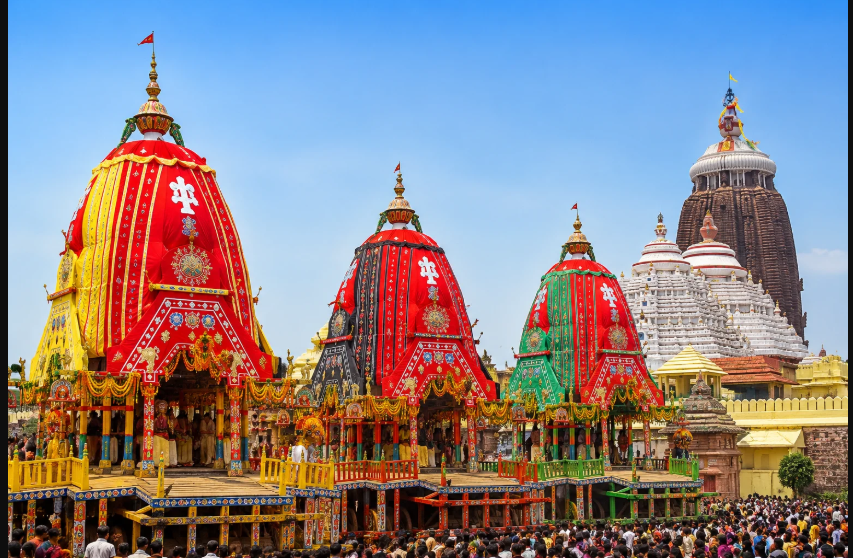
Before being seated on their respective wooden chariots, the deities performed the customary parikrama of the three newly built chariots — Nandighosha, Taladhwaja and Darpadalana. They were then placed on their thrones in the ritual known as Ratha Bije, marking the start of their annual journey. The Shankaracharya of Govardhan Peetha, Swami Nischalananda Saraswati, accompanied by his disciples, also visited the three chariots to offer prayers and perform special pujas.
Another key ritual of the festival, Chhera Pahanra, was performed by the titular King of Puri, Gajapati Maharaja Dibyasingha Deb. Arriving in a royal palanquin, he swept the platforms of all three chariots with a golden-handled broom and sprinkled fragrant holy water, a tradition that symbolises humility and equality before the Almighty.
After the completion of the royal rituals and the attachment of the wooden horses to the chariots, devotees began pulling the three chariots at around 2 pm, marking the next stage of the annual Rath Yatra.
Braving relentless rain, lakhs of devotees gathered in Puri to witness the sacred Pahandi ritual, marking the beginning of the nine-day annual Rath Yatra of Lord Jagannath, Lord Balabhadra and Devi Subhadra.
The ceremonial procession began with Chakraraj Sudarshan, the divine discus of Lord Vishnu, being carried out of the 12th-century Jagannath Temple and placed on Devi Subhadra’s Darpadalan chariot. Lord Balabhadra, the elder brother of Lord Jagannath, was then taken in a grand procession to his Taladwaja chariot, followed by Goddess Subhadra in the traditional Sunya Pahandi ritual performed by temple servitors.
As Lord Jagannath’s idol emerged from the sanctum, the Grand Road (Bada Danda) echoed with chants of “Jai Jagannath” as emotional devotees raised their hands in devotion. Odissi dancers, folk artistes and cultural troupes performed along the route in honour of the deities.
During the Pahandi ritual, the sibling deities are ceremonially carried to their respective chariots stationed outside the Lion’s Gate of the temple before embarking on their annual 2.6-km journey to the Shree Gundicha Temple, believed to be their birthplace.
Temple authorities said the rituals commenced around 9 am. Despite continuous rainfall, special arrangements were made to drain water from the Grand Road and ensure the smooth movement of the chariots, which are later pulled by thousands of devotees to the Gundicha Temple.