


Manas Dasgupta
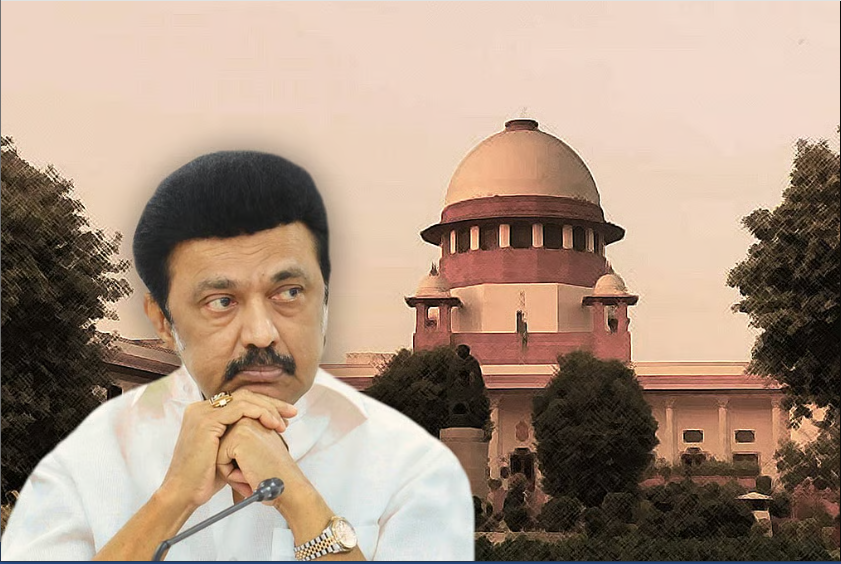
NEW DELHI, Nov 21: The Tamil Nadu chief minister and the ruling DMK president MK Stalin, whose running battle with the governor RN Ravi over indefinitely holding bills passed by the state legislative Assembly led to the Supreme Court on Thursday delivering its verdict on imposing timeline on the President and the governors, said on Friday that he would not rest till he forced the Centre to amend the Constitution to fix the timeline for the governors to clear bills.
A day after the Supreme Court pronounced its advisory opinion on the Presidential Reference on fixing timeline for clearing bills, Mr Stalin said the “fight for State rights and true federalism will continue.” He asserted there was “no rest until amending the Constitution to fix timelines for Governors to clear Bills.”
The Supreme Court on Thursday pronounced its advisory opinion on a Presidential Reference questioning the apex court’s authority to “impose” timelines and prescribe the manner of conduct of Governors and the President while dealing with State Bills sent to them for assent or reserved for consideration.
While the five-judge constitution bench headed by the Chief Justice of India GB Gavai giving an unanimous verdict said fixing a timeline for the President and the Governors to clear the bill would be against the Constitution, it also cautioned the governors against indefinitely holding on the bills to deny the wills of the people expressed through their representatives in the state Assemblies.
In a social media post, Mr Stalin said the Supreme Court’s opinion in its answer to the Presidential Reference “will have no impact on the April 8 judgement of the two-judge bench of the apex court in the case of State of Tamil Nadu v. Governor of Tamil Nadu.”
The Supreme Court Bench tendering the advisory opinion “has reaffirmed” that the elected “government should be in the driver’s seat, and there cannot be two executive power centres in the State,” he contended. “The Constitutional functionaries must act within the constitutional framework — never above it,” he added. It has reaffirmed that the “Governor has no fourth option to kill the Bill or exercise a pocket veto (as was done by the Tamil Nadu Governor). He has no option to withhold the Bill simpliciter.”
The opinion has also reaffirmed that the Governor cannot “indefinitely delay” acting on Bills. “In cases of prolonged, unexplained, and indefinite delay by the Governor in considering a Bill, States can approach the Constitutional Courts and hold Governors accountable for their deliberate inactions,” Mr Stalin said.
Citing a nine-judge Bench in Ahmedabad St. Xavier’s College Society v. State of Gujarat (1974) 1 SCC 717 (Para 109), which said “advisory opinion of the Court would have no more effect than the opinion of the law officers,” Mr Stalin said: “The Supreme Court’s opinion yesterday [November 20] has again rejected the Tamil Nadu Governor’s (a) theory of pocket veto, (b) assertion that Bills can be killed or buried by the Raj Bhavan.”
Mr Stalin further contended: “Through our legal battle, we have now compelled Governors, including the Tamil Nadu Governor, who are at odds with the elected government across the country, to work in line with the elected government and be accountable for their deliberate inaction in response to the people’s will through legislation. It has also empowered Constitutional courts to review their actions if they obstruct the passage of Bills indefinitely, and they cannot hide behind Article 361.”
The Chief Minister believed no Constitutional authority could claim to be above the Constitution. “When even a high Constitutional authority breaches the Constitution, the Constitutional courts are the only remedy, and the doors of the Court must not be closed. This would undermine the rule of law in our constitutional democracy and encourage breaches of the Constitution by Governors acting with political intent.” Mr Stalin said, “Until our people’s will in Tamil Nadu is fulfilled through legislation, we will ensure that every constitutional apparatus functions in this country in accordance with the Constitution.”
While the apex court’s advisory verdict has come as a mixed bag for Kerala, another non-BJP state witnessing a constant tussle between the elected government and the centre-appointed governors, divergent opinions were expressed by the legal experts and various opposition parties.
For Kerala, while the fate of the Bills that were rejected by the President without assigning any reasons has been sealed, Kerala may be able to take up the case of Bills that are pending either with the Governor or President beyond a “reasonable time” based on the Court’s decision on limited judicial review in such cases, legal experts pointed out. However, the Court’s finding that no timelines can be imposed on the President or Governors to decide on pending Bills has come as a setback for the State government.
Reacting to the Supreme Court’s judgment, West Bengal Assembly Speaker Biman Banerjee (Trinamool Congress) said a Bill loses significance when it remains stuck without clarity, adding that he “personally feels” that a fixed timeline should be laid down for Governors to clear Bills. He argued that keeping legislation pending indefinitely defeated the purpose of law-making and left elected governments in limbo.
The ruling Dravida Munnetra Kazhagam (DMK) in Tamil Nadu on Thursday termed the verdict of the Supreme Court on Governors a “good judgment” and that it would be useful in other cases involving powers of the gubernatorial post. Senior DMK leader T.K.S Elangovan said if the State Assembly elected by the people of Tamil Nadu had passed a resolution, the Governor has to accept it.
Communist Party of India (Marxist) general secretary M.A. Baby said the Supreme Court’s response to the Presidential Reference on timelines to grant assent to Bills was “deplorable and shocking.”
Reacting to the Supreme Court’s opinion, senior advocate Vikas Pahwa said the ruling effectively rolls back the “rigid timelines” of three months for the constitutional functionaries imposed in April by a two-judge Bench of the top court.
“While the Supreme Court continues to guard against prolonged, unexplained and indefinite delays in clearing the Bills, it duly respects the Governor’s and the President’s constitutional discretion — allowing more space for dialogue, rather than forcing every decision into a judicially mandated deadline,” he said.
Terming the opinion as a “corrective intervention,” Mr Pahwa said the April 8 verdict had sought to curb the “pocket veto” or permanent inaction by Governors “but, in doing so, arguably pushed the judiciary into micromanaging constitutional actors.” He said the opinion of the Constitution Bench restores a more balanced approach.
On the fate of the 10 Tamil Nadu legislations, which were granted deemed assent by the top court on April 8 by exercising its plenary power under Article 142, senior advocate Amit Anand Tiwari said all those Bills have become laws and have been already notified in the Gazette. “The opinion rendered in the Presidential Reference will have no impact on the Acts which have already been notified in pursuance of the judgment dated April 8, 2025,” he said. A Bench led by Justice J.B. Pardiwala had on April 8 granted deemed assent to 10 Tamil Nadu Bills.
The Bills, which have now become laws, included amendments to the Tamil Nadu Fisheries University Act, the Tamil Nadu Veterinary and Animal Sciences University Act, the Chennai University Act and the Tamil Nadu Dr Ambedkar Law University Act. Mr Tiwari said the April 8 verdict in the Tamil Nadu case has attained finality. He referred to a judgment to buttress his point that the subsequent advisory opinion of the Supreme Court on a Presidential Reference cannot overturn the earlier judgment.
However, the top court’s opinion referred to the views of Justice Y.V. Chandrachud in a 1978 Presidential Reference case in which he had held that all the courts are bound by the view expressed by the top court “even in the exercise of its advisory jurisdiction under Article 143(1) of the Constitution.”
Advocate Ashwani Dubey said the core finding of the April 8 judgment, which prescribed specific timelines, has been set aside by the opinion. “The ‘deemed assent’ granted by the apex court itself on the 10 Tamil Nadu Bills via its Article 142 powers is likely void or significantly affected by the Constitution Bench’s ruling that ‘deemed assent’ is impermissible,” Mr Dubey said.