


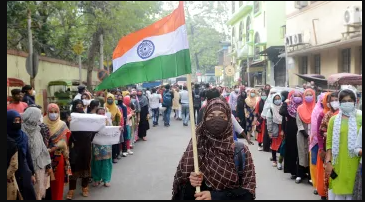
NEW DELHI, May 13: Even as the controversy surrounding wearing of hijab by students remained pending before the Supreme Court, the Karnataka government on Wednesday withdrew its 2022 uniform order and brought in new rules allowing students to wear some of the articles considered to be religious symbols across the state, Minister for Primary and Secondary Education, Madhu Bangarappa said.
The move comes weeks after three students at a college in Koramangala were asked to remove their janivara (sacred thread) by authorities before entering the exam hall on April 24 during the Common Entrance Test (CET).
The new order, issued on Wednesday, applies to government schools, aided institutions, private educational institutions and undergraduate colleges across Karnataka. It said these symbols can be allowed without disturbing order in institutions, as long as they do not create problems in identifying students, affect security arrangements or interfere with classes.
Under the fresh rules, students can wear turbans, sacred threads, rudraksha beads, Shiva beads, headscarves and similar traditional symbols along with the uniform. However, these should only be worn in a way that fits with the uniform and should not change its basic purpose, the minister said at a press conference.
“While institutions will continue to have uniforms, students will now be allowed to wear certain traditional and faith-based symbols as long as these do not affect discipline, safety, students’ identification or disturb the learning environment,” Mr Bangarappa added.
“After the janivara incident, the issue was raised by Health Minister Dinesh Gundu Rao with me. He flagged concerns and stressed the need to take up the matter with the Chief Minister. Hence, we decided to bring in the new order, revoking the previous one,” he said.
However, the larger legal position around the hijab issue remains unchanged. The matter is still pending before the Supreme Court of India. Since the two-judge bench hearing the Karnataka hijab case had delivered a split verdict and did not reach a common decision, the issue is yet to be finally settled by a larger bench. The legal uncertainty around the hijab ban continues.
Mr Bangarappa said schools and colleges are not just places for studies, but where students learn values such as equality, mutual respect and inclusion. He said after reviewing how the earlier order was being followed, it was found that some students wearing traditional symbols were facing issues.
The order states that no student can be stopped from entering classrooms, examination halls or other academic activities for wearing these permitted symbols along with the uniform. It also says no student can be forced either to wear or remove such symbols.
However, in examinations, any national or state-level dress code rules already in place will continue to apply.
(Manas Dasgupta)