


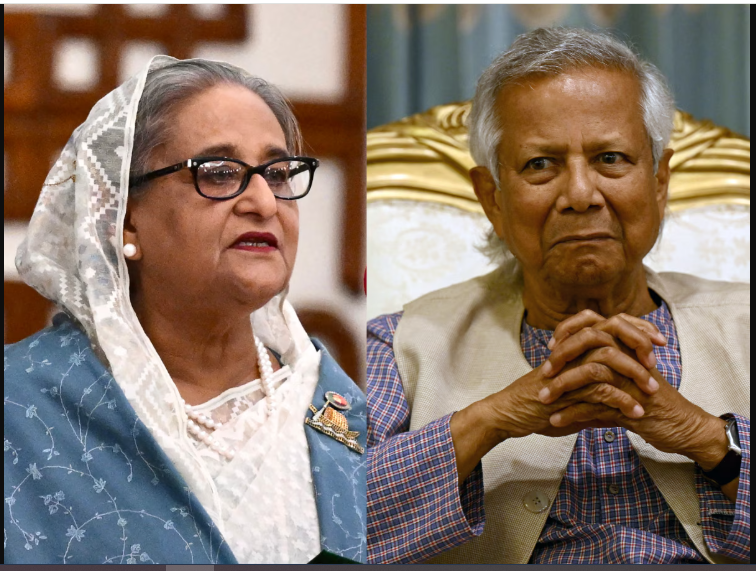
NEW DELHI, Jan 23: In her first address to a public gathering in India since leaving Bangladesh in 2024, former prime minister Sheikh Hasina launched a blistering attack on Nobel laureate Muhammad Yunus, accusing him of running an “illegal, violent” regime and plunging the country into what she described as an age of terror, lawlessness and democratic exile.
Speaking via audio message to an audience at the Foreign Correspondents’ Club in Delhi, Hasina framed the political crisis back home as an existential battle for Bangladesh’s sovereignty and constitution, and called on her supporters to rise up to “overthrow the foreign-serving puppet regime.”
The event, titled ‘Save Democracy in Bangladesh’, was attended by several former ministers from Hasina’s Awami League government and members of the Bangladeshi diaspora. Though Hasina did not appear in person, her speech – broadcast to a packed hall – was sweeping in its rhetoric and unsparing in its characterisation of Yunus, whom she repeatedly labelled a “murderous fascist,” “usurer,” “money launderer,” and “power-hungry traitor.”
“Bangladesh stands today at the edge of an abyss,” Hasina began, invoking the legacy of the Liberation War and her father, Sheikh Mujibur Rahman. She said “the country had been reduced to “a vast prison, an execution ground, a valley of death,” and accused extremist forces and foreign interests of ravaging the nation. The speech set the tone for an hour-long political indictment of the current dispensation in Dhaka, anchored in her claim that she was forcibly removed from office on August 5, 2024, in a “meticulously engineered conspiracy.”
From that day, she said, “the nation has been plunged into an age of terror. Democracy is now in exile.” Human rights, she added, had been “trampled into the dust,” press freedom extinguished, and violence against women and minorities allowed to flourish unchecked. “Life and property have no security. Law and order have collapsed,” she told the audience, painting a picture of a country gripped by mob violence, looting and extortion from the capital to the villages.
The sharpest barbs were reserved for Yunus personally. Hasina accused him of bleeding the nation dry and pushing Bangladesh towards the “furnace of a multinational conflict” by allegedly bartering away its territory and resources to foreign interests. “By betraying the nation, the murderous fascist Yunus is pushing our beloved motherland toward disaster,” she said, warning of a “treacherous plot” that threatens sovereignty itself.
Her speech was as much a rallying cry as it was a denunciation. Calling on “all democratic, progressive, and non-communal forces of the pro-Liberation camp,” Hasina urged unity to restore the constitution “written in the blood of martyrs.” The language echoed the slogans and symbolism of Bangladesh’s independence movement, culminating in chants of “Joy Bangla” and “Joy Bangabandhu” at the close.
Hasina also sought to position the Awami League as the only legitimate custodian of the country’s democratic and pluralist traditions. Describing the party as “independent Bangladesh’s oldest and most important political party,” she said it was “inexplicably interwoven with our country’s culture and democracy” and vowed that it would help the people “restore the thriving homeland that was snatched away.”
In a more structured political appeal, she laid out five demands that she said were essential to “heal” the country. The first was the removal of what she called the “illegal Yunus administration” to restore democracy and create conditions for free and fair elections. “Bangladesh will never experience free and fair elections until the shadow of the Yunus clique is lifted,” she said.
Her second demand was an end to what she described as daily street violence and lawlessness, arguing that stability was a prerequisite for economic recovery and functioning civic services. The third focused on an “ironclad guarantee” for the safety of religious minorities, women and the most vulnerable, saying that targeted attacks “must end” so that every citizen can feel safe in their own community.
Fourth, Hasina called for an end to what she termed politically motivated “lawfare” – the use of legal processes to intimidate, silence and jail journalists, Awami League members and other opposition figures. She urged the restoration of trust in the judiciary as an “impartial and noble institution.”
Her fifth and final demand was for the United Nations to conduct a “new and truly impartial investigation” into the events of the past year, arguing that only a “purification of truth” could allow the nation to reconcile and move forward. “The international community stands with you,” she told her supporters, asserting that the interim government had failed to listen to the people’s voices. “Together we are strong, and together we can make our demands heard.”
The tone of the address underscored how deeply polarised Bangladeshi politics remains, with Hasina presenting the current moment not as a routine political transition but as a civilisational struggle between the ideals of the Liberation War and what she called a regime of extremism, chaos and foreign manipulation.
Her repeated references to betrayal, occupation and resistance were clearly designed to mobilise her base and to frame the Awami League’s fight as a patriotic duty rather than a partisan contest. For the audience in Delhi, the speech also carried symbolic weight: it was Hasina’s first public address in India since she has been here, and a signal that she intends to continue to shape the political narrative in Bangladesh from abroad.
Whether her call for mass mobilisation and international intervention gains traction remains to be seen, but her message was unambiguous. “Do not give up now,” she told the people of Bangladesh. “Join us in the fight to take back our nation from those who seek to destroy it. Help us rebuild democracy in Bangladesh.”
(Manas Dasgupta)