


Manas Dasgupta
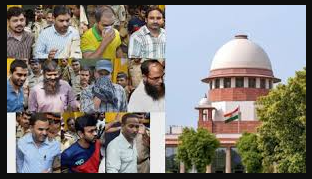
NEW DELHI, July 24: The Supreme Court on Thursday stayed the July 21 Bombay High Court judgment setting aside the conviction and sentence of the 12 men convicted by the lower court in the 2006 Mumbai train blasts case but the accused already released from jail are not to be re-arrested.
The Supreme Court on the Bombay High Court would only ensure that its July 21 order would not be treated as judicial precedent in any pending trials under the Maharashtra Control of Organised Crime Act (MCOCA).
A bench of Justices M M Sundresh and N. Kotiswar Singh accepted the Maharashtra government plea which sought a stay on the High Court order making it clear that it was not seeking to cancel their release but only that it should not be set as a precedence for other pending cases under the MCOCA.
Appearing before Bench, Solicitor General Tushar Mehta representing the Maharashtra government sought an interim stay of the judgment to the extent it would not be used as precedent before trial courts currently hearing other cases prosecuted under MCOCA. Seeking an urgent hearing in the matter, Mr Mehta said “It’s a serious matter from the government’s point of view.”
Mr Mehta clarified the State was not seeking a stay of the High Court judgement with an objective to put the acquitted men back in jail. “I am not seeking stay to bring them back to jail. That is not the intention… There are certain findings of law given by the court [HC] which affect all MCOCA trials going on,” the top law officer submitted.
The apex court, in its interim order, recorded the submission of the State that “all the respondents [acquitted men] have been released and there is no question of bringing them back to prison.” The Supreme Court made it clear that the High Court’s acquittal won’t be a precedent and the ruling in the Mumbai train blast case would not affect other MCOCA trials. Notice has been issued and the legal questions will be heard.
“Taking note of the submission made by the Solicitor General on the question of law, we are inclined to hold that the impugned judgment [of the HC] shall not be treated as a precedent in any other pending trials. Therefore, to that extent, we stay the impugned judgment,” the court ordered.
This would indicate the apex court has, in the interim order, not stayed the acquittal of the men, but only restrained the consideration of the High Court judgment as an authority to decide MCOCA cases on trial. The apex court issued notice to the former convicts on the State’s appeal against the acquittal.
The bench said they have been informed that all 7/11 Mumbai train blasts convicts have been released. “Therefore, there is no question of bringing them back to the prison. However, taking note of the submissions made by the SG on the question of law, we are entitled to hold that the impugned judgment shall not be treated as a precedent in any other case. To that extent, it is stayed.”
The development came after the Maharashtra government approached the Supreme Court challenging the Bombay High Court’s judgment, which acquitted all 12 accused in the 7/11 Mumbai train blasts case of 2006.
The Bombay High Court had on July 21 overturned the 2009 trial court verdict, which had sentenced five accused (one of whom has since died) to death and seven others to life imprisonment for their alleged involvement in the coordinated bombings on Mumbai’s Western Railway local line on July 11, 2006. Responding to the High Court’s order, Maharashtra Chief Minister Devendra Fadnavis described the verdict as “shocking” and stated that the state would move the Supreme Court against it.
The division bench of Justices Anil Kilor and Shyam Chandak of the Bombay High Court had ruled that the prosecution had “utterly failed” to prove the charges and observed it was “hard to believe the accused committed the crime.”
Before the hearing was wrapped up, Justice Sundresh pointed out that some of the persons involved seemed to be Pakistan nationals. The State said they had committed the deed and left India. “They were not arrested,” a State counsel informed.
In a brief mentioning of the case by Maharashtra on June 23 regarding a technical hitch in the case records, Chief Justice of India BR Gavai had remarked that a stay of a judgment of acquittal was “rarest of rare.”
The Bombay High Court had concluded that the prosecution “utterly failed” to establish guilt beyond reasonable doubt. It had set aside the 2025 judgment of the Special Maharashtra Control of Organised Crime Act (MCOCA) court, which had awarded death penalty to five and life imprisonment to seven others.
On July 11, 2006, a series of seven bomb blasts occurred in the first-class compartments of seven suburban local trains of Mumbai between 6:23 p.m. and 6:29 p.m. The coordinated explosions led to the tragic loss of 187 lives and left approximately 824 people injured.