


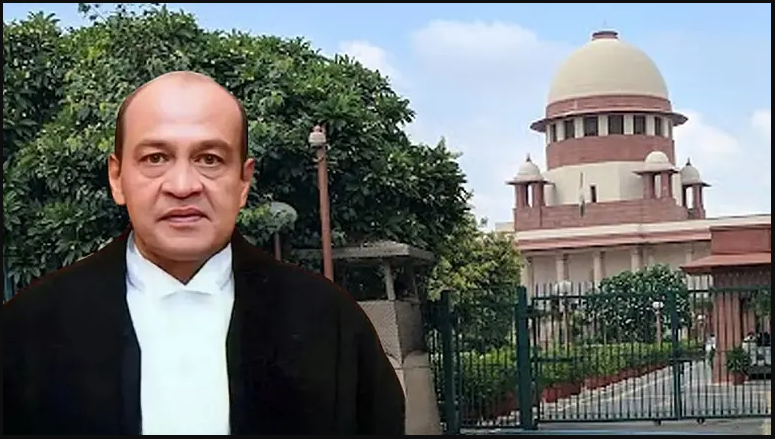
Manas Dasgupta
NEW DELHI, July 30: The Supreme Court on Wednesday reserved decision on Allahabad High Court judge Justice Yashwant Varma’s plea challenging the in-house inquiry ordered by the Chief Justice of India over allegations of cash discovery from his official residence in Delhi.
Justice Varma has challenged the findings of a three-member top court panel that probed the allegations against him and recommended his removal as a judge. This was during the tenure of former Chief Justice of India Sanjiv Khanna.
Appearing for the judge before a bench of Justice Dipankar Datta and Justice Augustine George Masih, Senior Advocate Kapil Sibal said the top court’s in-house committee was not empowered to recommend a judge’s removal and its ambit was limited to advising the Chief Justice. Mr Sibal cited Article 124 of the Constitution and the Judges (Inquiry) Act and said bypassing the rules laid down would create an extra-constitutional mechanism.
But the court while remarking orally that The Judges (Protection) Act, 1985, “empowers” the top court to order such a probe “for maintaining institutional integrity” and said the Chief Justice of India’s office was “not a post office” and the person occupying it has a duty to the nation. The court asked tough questions to Justice Yashwant Varma, who hit headlines for the massive cash recovery during a fire at his Delhi home when he was a judge in the Delhi High Court.
Justice Datta presiding over the two-judge bench pointed to Section 3(2) of the Act. “Nothing in sub-section (1) shall debar or affect in any manner the power of the Central Government or the State Government or the Supreme Court of India or any High Court or any other authority under any law for the time being in force to take such action (whether by way of civil, criminal, or departmental proceedings or otherwise) against any person who is or was a Judge.”
The bench made it clear that the remit of the in-house inquiry panel was not to find out who the cash discovered at Justice Varma’s house during an accidental fire belonged to. “Why do you want to invite us to the report, whether it’s your money or not? That was not the remit of the committee,” Justice Datta told Mr Sibal.
Justice Datta said the term “otherwise” appearing in the 1985 Act “has to be given some meaning.” “It means a non-punitive proceeding which is contemplated by the in-house procedure for maintaining the institutional integrity. And, therefore, this ‘otherwise’, other than the judgements, empowers the Supreme Court of India to direct this in-house inquiry.”
As Sibal sought to oppose such a conclusion, Justice Datta said, “In-house procedure has been put into place by judgments. That is the law of the land.” Illustrating, the judge said, “Let us take the case that there is an allegation against an additional judge who is not made permanent… In-house procedure kicks in, and there is some material against him… And the committee says that the evidence is such that it may not require a removal. So, this can be put into use. Today, how does the Supreme Court get the power to transfer, to direct the Chief Justice of the High Court to withdraw judicial work? It can also be supported by this ‘otherwise’. Such action is quite right…”
Justice Datta added, “When the judges are being given this protection on the one hand that nobody can take you or drag you to court at the drop of a hat, this power is entrusted with the High Court, with the Supreme Court, not to take disciplinary action so far as the judge is concerned, that is beyond the power, but to take such action as deemed fit and proper, which would include in-house procedure.”
Sibal said the question has to go “to a Constitution Bench to decide that issue.” But the bench did not seem to agree. “If some provision of law is not considered by a Constitution Bench, does that mean that we should put it to a Constitution Bench?” asked Justice Datta, adding that the provision in The Judges (Protection) Act is “a very relevant provision.”
However, Sibal said it is a provision which has “not been considered by anybody so far.” Justice Datta said, “Does not mean that we cannot?… The law is there… Section 3(2) is a complete answer prima facie to your submissions that the Chief Justice doesn’t have the power. Chief Justice of India is not just a post office. He has certain duties to the nation as the leader of the judiciary. If materials come to him regarding misconduct, CJI has the duty to forward them to the President and the Prime Minister.”
Justice Varma’s petition has called the SC’s in-house inquiry mechanism that indicted him as “a parallel, extra-constitutional mechanism.” It said, “Primarily, the In-House Procedure, adopted via a 1999 Full Court Resolution to handle complaints against judges and preserve judicial independence while maintaining public faith, unjustifiably extends beyond the intended scope of self-regulation and fact-finding.”
“By culminating in recommendations for removal from constitutional office, it creates a parallel, extra-constitutional mechanism that derogates from the mandatory framework under Articles 124 and 218 of the Constitution, which exclusively vest powers for removal of Judges of the High Courts in Parliament through an address supported by a special majority, following an inquiry under the Judges (Inquiry) Act, 1968.”
On Wednesday, the bench also questioned Sibal as to why Justice Varma had not taken legal recourse before participating in the in-house inquiry process. Responding, Sibal said, “What happened was that the tape was released… My reputation (was) already damaged. What would I come to court for?”
Justice Datta, however, said Justice Varma should have questioned it beforehand if he was convinced that it involved a constitutional question. “That, according to you, the in-house procedure empowering the committee to make a recommendation for initiation of removal is beyond the jurisdiction. That challenge was available at that point in time,” the judge said.
“That right would occur to me when that recommendation is made, (when) the cause of action arises… Supposing I came to court (then), your Lordship would have said ‘How do you know that you are going to be removed, or there is going to be a recommendation?’” Sibal said.
Mr Sibal argued that the Chief Justice could not have said the misconduct against Justice Varma was proven. When Mr Sibal said the bench has “already made up your mind”, Justice Datta responded, “If we had made up our mind, we would have kept mum and allowed you to argue. Then declared the judgment. But that is not fair justice. That is why we are speaking… Article 141 is law laid down, it has to be followed.”
Article 141 of the Constitution states that the law declared by the Supreme Court was binding on all courts in India. Arguing against the three-judge panel report, Mr Sibal said Justice Varma’s case is no longer just a Parliamentary process, but has become “political.” The court, however, said the three-judge panel’s report was preliminary and won’t impact future proceedings.
The bench then told the judge that his conduct “does not inspire confidence.” “Your conduct says a lot. You were waiting for a favourable finding and once you found it to be palpable, you came here.”
The court also asked the judge why he appeared before the panel. Mr Sibal said, “If the committee finds the money belongs to me (Justice Varma), I am fine.” To this, the court replied, “Let’s not spill something. That is not the remit of the committee to find out whose money it is.”
Justice Datta said the Chief Justice’s recommendation was not binding on Parliament. “Parliament has the power to take a call.” Mr Sibal replied, “Once a recommendation is given by CJI, which Member of Parliament will not believe?” Mr Sibal also pointed out that Justice Varma was not heard during the in-house probe.