


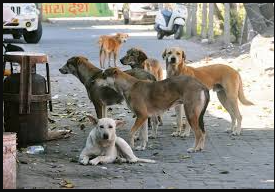
NEW DELHI, Oct 27: The Supreme Court on Monday took strong exception to the failure of several States and Union Territories to comply with its August 22 directives mandating the sterilisation, deworming, and immunisation of stray dogs in accordance with the Animal Birth Control (ABC) Rules, 2023, framed under the Prevention of Cruelty to Animals Act, 1960.
A three-judge Bench led by Justice Vikram Nath directed the Chief Secretaries of all States and Union Territories to personally appear before the court on November 3 and explain why compliance affidavits had not been filed despite adequate time having been granted.
Noting that repeated incidents of stray dog attacks were tarnishing the country’s image, the Bench rebuked the authorities for their continued non-compliance. “Nothing has come on record. Continuous incidents are happening. Your country is being shown down in foreign countries,” the Bench, also comprising Justices Sandeep Mehta and N.V. Anjaria, observed.
The court pointed out that only Telangana, West Bengal, and the Municipal Corporation of Delhi (MCD) had submitted compliance reports so far, and accordingly exempted the Chief Secretaries of the two States from personal appearance.
“Pursuant to the order dated August 22, 2025, only three compliance affidavits have been filed. These are West Bengal, Telangana, and the MCD. Notices have been issued to all States and Union Territories. As they have not responded, let the Chief Secretaries remain present before this Court on next Monday at 10.30 a.m. along with their respective explanations as to why compliance affidavits have not been filed,” the Bench directed.
The court further clarified that the Chief Secretary of Delhi must also appear in person on November 3, observing that the MCD’s report alone would not suffice. Justice Nath specifically asked Additional Solicitor-General Archana Pathak Dave, appearing for the Delhi government, to explain why the Government of the National Capital Territory (NCT) of Delhi had failed to file its affidavit.
“Ask your Chief Secretary to remain present on November 3, along with an explanation as to why no compliance affidavit has been filed till today. You are in Delhi, the order was passed in Delhi, in your presence it was passed, and nothing has happened,” Justice Nath told Ms Dave.
Expressing displeasure over the inaction, the court recalled that the States had been given nearly eight weeks in August to report on the implementation of the ABC Rules, which require local authorities to conduct sterilisation and anti-rabies drives under the catch–neuter–vaccinate–release model.
“Our order was widely reported by all newspapers and other media outlets. Do the State officers not read newspapers or use social media?” the Bench remarked, summoning all Chief Secretaries to appear before it in person on November 3. The Bench also indicated that a detailed order would be passed when the matter is taken up next week.
On August 22, the apex court had expanded the scope of the proceedings beyond the Delhi–National Capital Region (NCR), directing that the matter be treated as a pan-India issue to enable the formulation of a uniform national policy. It had accordingly ordered the impleadment of the Secretaries of the concerned departments of all States and Union Territories in the proceedings.
During Monday’s hearing, senior advocate Sidharth Luthra, representing an animal rights activist, informed the Bench that his client had submitted a compilation outlining best practices adopted in other jurisdictions to aid the court’s deliberations.
When another counsel referred to incidents of cruelty towards animals, the Bench retorted, “What about cruelty to humans?” It further underscored that its objective was to strike a balance between animal welfare and public safety. “We are solely monitoring it so that we can achieve the objective. There has to be a balance,” it said.
In its August 22 order, the Bench led by Justice Nath had modified an earlier directive issued by a two-judge Bench on August 11, which had called for the mass capture of stray dogs across Delhi and neighbouring districts without release. Terming the direction “too harsh,” the Bench had clarified that stray dogs must be sterilised, vaccinated, and released back into their respective localities, except in cases where they are rabid or exhibit aggressive behaviour.
The court had further directed municipal authorities to designate feeding zones in every ward to ensure that the feeding of strays does not cause public inconvenience. It had also instructed civic bodies to establish a dedicated helpline for citizens to report violations, stating that upon receipt of such complaints, “appropriate measures shall be taken against the individuals/NGOs concerned.” Additionally, it had warned that any person obstructing a public servant acting in compliance with these directions would invite punitive action.
The August order had also directed individual petitioners and NGOs to deposit ₹25,000 and ₹2 lakh, respectively, with the Supreme Court registry, to be utilised by municipal authorities for developing facilities for the care and management of stray dogs.
The court’s suo motu intervention came amid mounting public concern over a series of dog-bite incidents, including the death of a six-year-old girl, which had led to the earlier order passed by a Bench of Justices J.B. Pardiwala and R. Mahadevan. The Division Bench had noted that Delhi recorded 25,201 dog-bite cases in 2024 and said its directions were being issued in the larger public interest.
However, the sweeping directive drew sharp criticism from animal welfare groups, activists, and several public figures, who contended that the region lacked the capacity to accommodate an estimated eight lakh stray dogs. Subsequently, Chief Justice of India B.R. Gavai, in a rare administrative step, withdrew the matter from Justice Pardiwala’s Bench and reassigned it to a three-judge Bench headed by Justice Nath.
(Manas Dasgupta)