


Manas Dasgupta
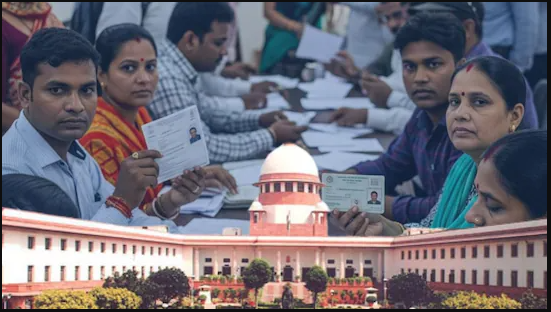
NEW DELHI, Sept 8: The Supreme Court on Monday directed the Election Commission of India (ECI) to accept Aadhaar as the twelfth valid document for the Special Intensive Revision (SIR) exercise of electoral rolls in poll-bound Bihar but made it clear that the ECI is entitled to verify if the documents are genuine since Aadhaar was not a proof of citizenship.
A bench of Justices Surya Kant and Joymalya Bagchi passed the interim order after complaints that election officials were refusing to recognise it despite earlier directions by the apex court. The complaints were made by the petitioners while the bench was considering the response of political parties like the Rashtriya Janata Dal (RJD), AIMIM and other petitioners on the poll panel’s note where it has submitted that 99.5% of the 7.24 crore electors in the draft electoral roll had filed their eligibility documents in the SIR exercise.
The case has been posted for next hearing on September 15. The bench of turned down the ECI reservations against formally adding Aadhaar to its list of approved identity proofs, stressing that while the document cannot establish citizenship, it remains a valid indicator of identity and residence.
“The Aadhaar card shall be treated as the 12th document by the ECI. However, it is open for the authorities to examine the validity and genuineness of the Aadhaar card itself. It is clarified that Aadhaar will not be treated as a proof of citizenship,” directed the bench, adding that the poll panel must issue instructions to its field officials “during the course of the day.”
The court overruled a plea by senior advocate Rakesh Dwivedi, appearing for the Election Commission, that said 99.6 per cent of the 7.24 crore voters in the draft roll had already submitted documents, and seeking inclusion of Aadhaar now would not serve any purpose.
However, in a nod to the poll panel’s earlier objection – that the Aadhaar could be forged and was, therefore, an unsuitable option to establish identity – the court said election officials could “verify the genuineness of the card” and that it could not be used to establish citizenship. The order this morning echoes a July observation; the court said the risk of forgery – which the EC said led it to rule out two other ID cards too – could happen for any of the 11 it had allowed.
In connection with that observation, the court also sought the poll panel’s explanation on notices that had been issued to poll officials for not accepting voters’ Aadhaar cards. The top court was hearing a clutch of petitions challenging the SIR exercise of the voter list in Bihar just months before the state election.
The order followed heated exchanges in court, where senior advocate Kapil Sibal, appearing for the RJD accused the ECI of deliberately excluding Aadhaar. “What they are doing is shocking…Booth-level officers (BLOs) are being hauled up for accepting Aadhaar. We can show notices being issued by electoral registration officers which say no other document except the 11 notified ones would be accepted. “Where is the inclusive exercise if a universal document like Aadhaar is being rejected?”
When the bench asked if the petitioners wanted the status of a voter to be determined solely on the basis of Aadhaar, Sibal replied: “I am already there in the electoral roll of 2025. Where is the question of proving anything? BLOs cannot determine my citizenship.”
The bench then turned to ECI’s counsel, senior advocate Rakesh Dwivedi, who maintained that Aadhaar was already being accepted but “cannot be a proof of citizenship.” He argued that the Commission has the constitutional mandate to look into citizenship questions when preparing electoral rolls: “There are provisions in the Constitution where an MP ceases to be a citizen and the President acts on the advice of the ECI. Similarly, for preparing rolls, the ECI can look into citizenship.”
But the bench expressed concern over the gap between the Commission’s position in court and the instructions given to officials on the ground. “Why does this copy mention just 11 documents and not Aadhaar despite our repeated orders? We want you to clarify this,” the court asked. Dwivedi said he would look into if “someone has erred” but insisted that the Commission had “publicised” the previous court order that Aadhaar would be accepted.
The bench also reminded both sides that the statutory framework was clear: Aadhaar cannot be elevated to proof of citizenship but does carry value under the Representation of the People Act. “Statute says and judicial dictum also says that Aadhaar is not proof of citizenship. But it is indeed a proof of identity and has some value. You should take it and examine it,” Justice Bagchi observed.
When senior counsel Abhishek Manu Singhvi and Gopal Sankaranarayanan supported Sibal’s plea that Aadhaar to be expressly added, the bench asked Dwivedi: “Why cannot you accept it as the 12th document? But for two — birth certificate and passport, all other documents among the 11 are also not proofs of citizenship. You have already gone beyond the requirement of citizenship for the inclusivity this exercise needs.”
Dwivedi, however, cautioned against “over-inclusivity.” “The whole idea is that Aadhaar is being pressed to be used as a proof of citizenship. We cannot allow that misuse. Already 99.6% have submitted one of the 11 documents. For the 65 lakh excluded, Aadhaar is being permitted. Now there are some 200 odd instances being flagged. We must look at the whole picture,” he said
Sibal retorted that the issue was not of numbers but of principle: “Let there be a direction to include Aadhaar as the 12th document, subject to an inquiry by the ECI. BLOs cannot be left to decide citizenship on their own.”
The controversy arises from the special intensive revision of electoral rolls in Bihar, where nearly 6.5 million names were excluded from the draft rolls published last month. Opposition parties, led by RJD, allege that genuine voters are being disenfranchised by technical barriers and inconsistent instructions, while the ECI maintains the revision is necessary after nearly two decades without such an exercise.
The opposition, including the Congress and the RJD who form the Mahagathbandhan alliance in the state, has argued the revision is subterfuge to disenfranchise lakhs of men and women from communities that traditionally vote for them. The Congress has also accused the ruling BJP and Election Commission of ‘collusion to commit voter fraud’.
The Election Commission, however, has insisted its SIR is within legal and constitutional mandates, and that the voter re-verification process was carried out in a transparent manner. The EC has also argued the re-verification process allowed it to identify lakhs of illegal voters, including those who are Nepali or Bangladeshi citizens and, therefore, have no right to vote in India. The court acknowledged that point in today’s hearing, saying, ‘nobody wants including of illegal immigrants in the electoral roll… only genuine citizens must be allowed to vote’.
The court said people claiming to be Indian citizens – on the basis of forged documents – must be excluded from the electoral roll. The question then was about documents that those excluded could present – the Aadhaar was not included then – to challenge their removal. In its August 22 hearing, the top court had made 12 political parties part of the hearing on the SIR and asked them to file a status report as to what they have done to help deleted voters.
On September 1, the court, while hearing some applications filed by parties for extension of deadlines, was told by the poll panel that claims, objections, and corrections in the draft roll can be filed beyond September 1 but these would be considered once it is finalised. The court termed confusion over the Bihar SIR ‘largely a trust issue’ and directed the state legal service authority to deploy paralegal volunteers to assist individual voters and political parties in filing claims and objections to the draft roll, which was published on August 1.
SIR has become a major political flashpoint ahead of the Bihar assembly elections scheduled for later this year. Opposition parties in the INDIA bloc have staged protests in Parliament and written to Lok Sabha Speaker Om Birla seeking a special discussion on what they call an “unprecedented” revision so close to state polls. Eight parties, including Congress, RJD, Samajwadi Party, DMK, Trinamool Congress and Shiv Sena (UBT), have warned that the exercise could be replicated nationwide.
The SIR’s findings reduced the total number of registered voters in Bihar, from 7.9 crore before the exercise to 7.24 crore after conducting it.