


Manas Dasgupta
NEW DELHI, Oct 10: The Supreme Court on Friday granted the Centre four weeks’ time to respond to the plea by a series of petitioners pressing the union government to honour its solemn pledge of restoring statehood of Jammu and Kashmir.
A bench led by Chief Justice B R Gavai and Justice K Vinod Chandran was hearing multiple petitions, including those filed by academician Zahoor Ahmad Bhat, socio-political activist Ahmad Malik and MLA Irfan Hafiz Lone seeking the restoration of Statehood within a specified time frame, preferably two months.
The union home minister Amit Shah has repeatedly given the assurance that the Centre’s “solemn pledge” to restore J and K’s statehood would be honoured at the earliest possible time. The Bench asked the Solicitor General Tushar Mehta, appearing for the Union Government, to respond to the submissions within four weeks, even as it acknowledged that “various considerations” had to be factored in while making such a decision, including the April 22 Pahalgam terror attack in which 26 tourists were killed.
The petitioners contended that the continued Union Territory status “violates the idea of federalism”, an essential feature of the Constitution’s basic structure. They further pointed out that the smooth conduct of both the Assembly and Lok Sabha elections showed there were no longer any security concerns hindering the restoration of Statehood.
Senior advocate Menaka Guruswamy, appearing for MLA Irfan Hafiz Lone, argued that the assurance of restoring Statehood was not a mere political declaration but an “institutional promise” made by the Centre before a constitutional court. “At an institutional level, the Union government had given an assurance to the constitutional court that it would restore Statehood. On that basis, the court refrained from adjudicating the issue. It sets a bad precedent,” she said.
She urged the court to consider the “larger question” of what it would signify for Indian federalism if a State could be reduced to a Union Territory “in this fashion.” She also drew the court’s attention to the October 18, 2024, resolution passed by the Jammu and Kashmir Cabinet, headed by Chief Minister Omar Abdullah, which had expressly called upon the Union government to restore Statehood to the Union Territory.
Senior advocate Gopal Sankaranarayanan, appearing for petitioners Zahoor Ahmad Bhat and Khurshaid Ahmad Malik, read from the Supreme Court’s December, 2023 judgement on the abrogation of Article 370 to emphasise that the court had refrained from deciding the Statehood issue only because the Solicitor General had assured it would be restored after elections.
“Elections have been held. Statehood was taken away in August 2019. We are in 2025 now…If an individual gave the assurance to the court and the court was then invited to withhold its verdict on a constitutional question, I am sure that individual would be held to the same measure of responsibility that we expect from the statement of the Solicitor General,” he said.
He also referred to the concurring opinion authored by former CJI Sanjiv Khanna in the Article 370 judgment, which had warned of the “grave consequences” of converting a State into a Union Territory as it denies citizens an elected government and impinges upon federalism. Justice Khanna had observed that such a conversion must be justified on “strong and cogent grounds.”
Senior advocate Dinesh Dwivedi, also appearing for the petitioners, pointed out that the court was not being asked to examine whether the circumstances warranted the declaration of President’s Rule under Article 356 of the Constitution, which might require factoring in developments such as border issues. Instead, he said, the Union Government was simply being asked to honour a clear assurance. “What if tomorrow, Uttar Pradesh or Tamil Nadu—their Statehood is revoked if the Centre finds it convenient?” he asked.
However, the Chief Justice interjected and remarked that States like Uttar Pradesh or Tamil Nadu could not be equated with Jammu and Kashmir. The petitioners further argued that at least “an attempt should be made” to introduce a Bill to restore Statehood, remarking that border conflicts would continue to arise and that such an assurance ought not to have been made if the Centre could not fulfil it.
Mr Mehta informed the bench that discussions were ongoing with the Jammu and Kashmir administration regarding the matter. He described the issue as “sui generis,” a unique situation involving broader considerations. “There was a solemn undertaking, yes, but various factors must be weighed,” Mehta said, while also alleging that certain individuals were attempting to portray a distorted and negative image of the region.
In its December 11, 2023 ruling, the Supreme Court unanimously upheld the Centre’s decision to revoke Article 370, which had granted special status to Jammu and Kashmir. The Court also directed that assembly elections be conducted in the Union Territory by September 2024 and that statehood be restored at the earliest possible date.
Mr Mehta submitted that “several considerations” were involved in decisions of this nature. He sought additional time to file a detailed response and informed the court that the Union government was in consultation with the State administration. He assured the Bench that he would address “each and every” submission within four weeks.
Responding to the concerns raised by the petitioners, Mr Mehta asserted that Jammu and Kashmir had “immensely progressed” since the abrogation of Article 370 and that the people were “happy.” “The problems they (petitioners) are trying to project may not be for this forum. Therefore, your Lordships may not treat them as gospel truth. Your Lordships may treat them with a pinch of salt,” he remarked.
Meanwhile, Mr Sankaranarayanan urged the court to consider referring the matter to a five-judge Constitution Bench in the interest of “judicial propriety.” He pointed out that the petitioners were seeking a specific timeframe for the restoration of Statehood, an issue not addressed in the earlier Constitution Bench judgment upholding the abrogation of Article 370. However, this was vehemently opposed by the Solicitor General.
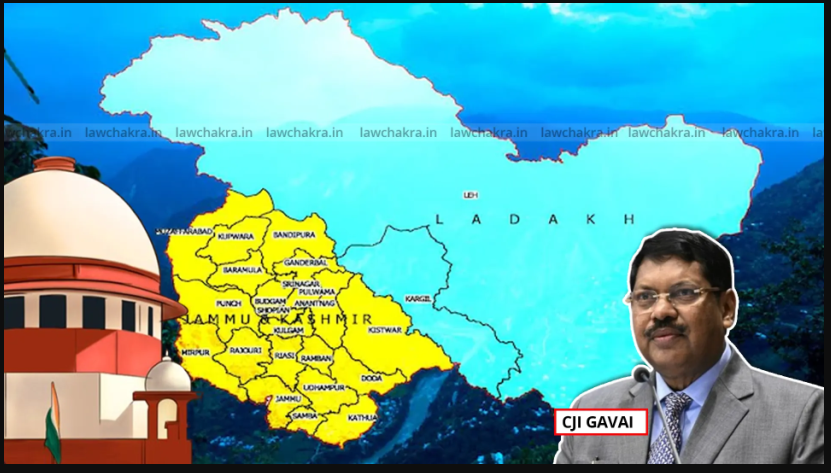
On August 5, 2019, Parliament revoked Article 370, the constitutional provision that had accorded special status to Jammu and Kashmir, and divided the former State into two Union Territories, Jammu and Kashmir and Ladakh. In a judgment delivered on December 11, 2023, a five-judge Constitution Bench upheld the abrogation, finding it to be a legitimate exercise of presidential power. The court observed that Article 370 was always intended as a transitional provision and described its repeal as “the culmination of the process of integration” of the region with India.
While the Bench chose not to rule on the legality of converting the State into Union Territories, it took note of the Centre’s assurance that Statehood would be restored “at the earliest” and directed that Assembly elections be conducted by September 2024. The polls were subsequently held in three phases between September 18 and October 1, 2024, resulting in a National Conference–Congress coalition government led by Omar Abdullah, who was sworn in as Chief Minister.