


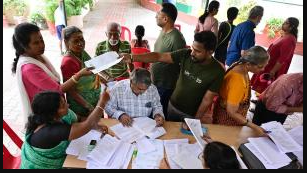
NEW DELHI, Jan 29: The Supreme Court on Thursday directed the Election Commission of India (ECI) to follow in Tamil Nadu the West Bengal pattern and display the names of the persons figuring in the “logical discrepancies” with the reason at public places in every ward.
The Bench also allowed affected persons to submit their documents or objections through their authorised representative, such as Booth Level Agent (BLA).
The court directed the State Government to provide adequate manpower to the E.C.I and the State Election Commission to handle documents/objections and hear persons likely to be affected.
The bench gave the direction while hearing an application filed by DMK leader R.S. Bharathi for the State’s ruling party said Electoral Registration Officers (EROs) had issued “logical discrepancy forms” to 1.7 crore voters.
These ‘logical discrepancies’ cited involved a mismatch of the father’s name, a mismatch of parents’ ages, a difference in parents’ ages of more than 50 years, a difference in grandparents’ ages of less than 40 years, and those having more than six progeny.
Earlier, the senior advocate Kapil Sibal had asked the Supreme Court if the ECI had placed any data on record to demonstrate that a nationwide Special Intensive Revision (SIR) was necessary and imminent despite annual updates to the electoral roll.
Mr Sibal opened the rejoinder submissions for the petitioners, which include non-BJP ruling parties from Kerala, Tamil Nadu and West Bengal, after the poll body completed its marathon arguments, spread over multiple days, in favour of the SIR.
Another senior advocate Gopal Sankaranarayanan, for NGO Association for Democratic Reforms, pointed out that ordinary people, especially the marginalised sections, use their position in the electoral roll to exercise core civil rights.
“Rights which they cannot exercise unless they are citizens. The problem is on the ground when evidentiary documentation is sought for. If you cannot show one of the two documents, you have to live in dread of being thrown out as a foreigner… God knows when that axe would fall. We have seen ICE do that in the U.S. It may happen here. It may not be this dispensation or this EC or this government we have to be worried about. We are worried about the fact that this small piece of paper holds protection for us, our civil rights and our right to be a part of this country,” Mr Sankaranarayanan submitted.
Mr Sibal submitted that the Commission, being a constitutional authority, should have been able to provide data based on a detailed study that it was necessary to conduct SIR.
Chief Justice of India Surya Kant pointed out that the poll body was only asking for documents in cases of electors unable to link their names to that of themselves or their parents in the 2002 electoral rolls. Mr Sibal asked how many people would have their parents’ birth certificates or, for that matter, their own. He said the citizenships of 1.82 crore people have been questioned.
“How many illegal immigrants were found in Bihar when all the exercise was completed,” Mr Sibal asked. He asked whether there was any transparency or data about the number of people added to the electoral roll. “A process of this nature should have an application of mind giving reasons as to why this has become necessary today… Why was this necessary, not for just a part or a constituency as a whole, but for the entire nation,” Mr Sibal submitted.
The Chief Justice pointed out that a lot may have changed on the electoral roll since the previous intensive revision over two decades ago. “There would have been deaths and outward migration,” Justice Joymalya Bagchi pointed out.
“But those updates were already being made on a yearly basis. The 2025 electoral roll had all that. I am saying that despite the 2025 electoral roll, they need a wholesale SIR. How did the EC come to this decision? They must produce data to show that despite yearly updations till 2025, they still needed the SIR done in the midst of elections, and for what,” Mr Sibal submitted.
He said the verification of citizenship by the poll body should be germane to the reasons given in the Citizenship Act. “The exercise of executive or administrative powers must be backed by reasons germane to that power,” Mr Sibal said.
(Manas Dasgupta)