


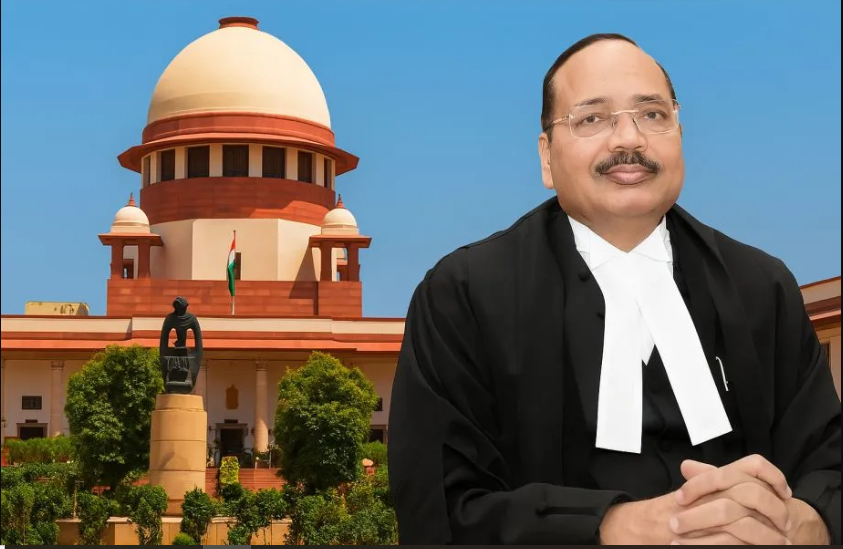
NEW DELHI, Dec 10: As many as 44 former judges of the Supreme Court and various High Courts have condemned what they described as a “motivated campaign” against the Chief Justice of India (CJI) Surya Kant following his recent remarks on the Rohingya migrants during the hearing of a petition.
In an open letter, the judges said the “disparagement” of the Supreme Court was unacceptable. “We the undersigned retired judges express our strong objection to the motivated campaign targeting the Hon’ble Chief Justice of India in the wake of his remarks in proceedings concerning Rohingya migrants,” the letter said.
The signatories said judicial proceedings can and should be subject to fair, reasoned criticism. However, they said, the campaign was not about principled disagreement, but an attempt to undermine the judiciary by portraying routine courtroom questions as prejudice.
The letter added: “The Chief Justice is being attacked for asking the most basic legal question: who, in law, has granted the status that is being claimed before the Court?” They said no adjudication on rights or entitlements can proceed until this basic threshold is addressed.
The judges noted that the Bench had also clearly affirmed that “no human being on Indian soil, citizen or foreigner, can be subjected to torture, disappearance or inhuman treatment, and that every person’s dignity must be respected.” The letter said to suppress this affirmation and then accuse the Court of “dehumanisation” constituted a serious distortion of what was actually said.
On legal status, the former judges pointed out that the Rohingyas have not entered the country under any statutory refugee-protection framework; in most cases their entry is “irregular or illegal.” The letter said they cannot convert that position into a legally recognised “refugee” status merely by assertion. India, they noted, is neither a signatory to the 1951 UN Refugee Convention nor its 1967 Protocol. The country’s obligations arise from its Constitution, domestic immigration laws, and general human-rights norms, not from any treaty it consciously chose not to join, they said.
The letter raised a “serious and legitimate concern” over reports that Rohingyas have obtained Indian identities and welfare documentations, such as Aadhaar cards and ration cards. Such misuse, the judges warned, undermines the integrity of India’s identification and welfare systems.
They advocated that a court-monitored Special Investigation Team (SIT) could be considered to investigate the lapses, identify those responsible, and expose any organised trafficking operations. While acknowledging the complex situation of the Rohingyas in Myanmar, where they have often been treated as illegal migrants with disputed citizenship, the retired judges stressed the need for Indian courts to proceed on clear legal categories, not slogans or political labels.
Against this backdrop, they said, the judiciary’s intervention was within constitutional bounds and balanced national security with the obligation to uphold human dignity. The signatories cautioned that if every probing judicial question on nationality, migration, documentation, or border security is met with accusations of hate or prejudice, judicial independence itself would be at risk.
They expressed full confidence in the Supreme Court and the CJI to perform their constitutional duties without fear or favour. The letter concluded by supporting the idea of a court-monitored SIT “to inquire into the illegal procurement of Indian identity and welfare documents by foreigners lacking lawful status.” “Bharat’s constitutional order demands both humanity and vigilance,” said the letter. Among the signatories are former Supreme Court judges Anil Dave and Hemant Gupta, former Chief Justice of Rajasthan High Court Anil Deo Singh, and former Chief Justice of J&K and Delhi High Court B.C. Patel.
The letter was in response to an earlier open letter written by another group of retired High Court judges, senior advocates and legal scholars to CJI Kant a few days ago voicing exception to “unconscionable remarks” made from his Bench about Rohingyas while hearing a petition raising concern about the custodial disappearance of a group of them in India.
During the hearing on December 2 of a petition filed by activist Rita Manchanda, Chief Justice Kant was reported in the media as orally questioning the refugee status of Rohingyas and whether intruders ought to be welcomed with a red carpet.
“When those who flee violence and persecution are dismissed with rhetoric that is hostile to their very dignity, it threatens the foundational values of our Constitution and undermines public faith in the courts as a refuge for the vulnerable… We therefore call upon you to reaffirm, in public statements, remarks in court and judicial verdicts, a commitment to constitutional morality based on human dignity and justice for all, regardless of origin.
“The majesty of the Supreme Court and your office is measured not merely by the number of verdicts or administrative measures but more by the humanity with which those verdicts are delivered and considered,” the open letter addressed to Chief Justice Kant had said.
The letter had recalled India’s track record of hosting refugees of different profiles and extending humanitarian protection while balancing national security interests and the concerns of its citizens. “The government has issued special documentation to Tibetans and Sri Lankans, recognizing their status as refugees, and allowing them to access basic socio-economic rights… The Citizenship Amendment Act, in fact grants exemption from the provisions of the Foreigners Act to religious minorities (other than Muslims), fleeing persecution, from Bangladesh, Pakistan or Afghanistan,” it read.
The letter was signed by former Delhi High Court Chief Justice A. P. Shah, Justices K. Chandru and Anjana Prakash, along with former Director of the National Judicial Academy Prof Mohan Gopal, senior advocates Rajeev Dhavan, Chander Uday Singh, Colin Gonzalves, Mihir Desai, Gopal Sankaranarayanan, advocates Kamini Jaiswal, Prashant Bhushan, Cheryl D’Souza, Alok Prasanna Kumar, RTI activists Nikhil Dey and Anjali Bhardwaj, among others.
The letter underscored the role of the Supreme Court as the custodian and final arbiter of the rights of the poor, the dispossessed and the marginalised. “Your words carry weight not simply in the courtroom but in the conscience of the nation and have a cascading effect on the High Courts, the lower judiciary and other government authorities.
“A remark that equates vulnerable persons (who in the case of the Rohingya include thousands of women and children) seeking shelter with ‘intruders’ who ‘dig tunnels,’ further dehumanises those fleeing genocidal persecution and weakens the moral authority of the judiciary,” the letter emphasised. It said invoking the plight of the poor in India to justify denying protections to refugees sets a dangerous precedent and was contrary to the principles of constitutional justice.
(Manas Dasgupta)