


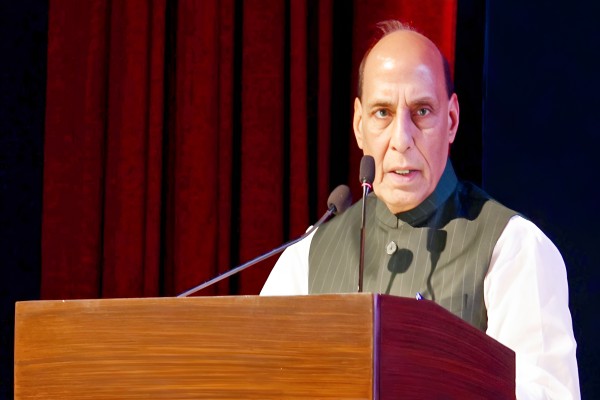
New Delhi: Defence Minister Rajnath Singh on Monday stressed that sustained research and the ability to create a “surprise element” will be decisive in future warfare, as he addressed the inaugural session of the North Tech Symposium in Prayagraj. He said countries that adapt fastest to rapid technological change will hold a clear advantage on the battlefield.
Highlighting the evolving nature of modern conflicts, Singh pointed to how warfare has shifted dramatically in recent years, citing the rapid transition from conventional weapons like tanks and missiles to drones, sensors and hybrid technologies. He also noted that everyday technologies are increasingly being repurposed for military use, making preparedness and innovation more critical than ever.
The Defence Minister underscored that research and development are central to India’s defence strategy, adding that the future of warfare is being shaped in laboratories today. He said the government has placed defence research at the forefront, with organisations like Defence Research and Development Organisation working closely with industry, start-ups and academia.
As part of this push, Singh revealed that over 2,200 technologies have already been transferred to industries, while 25 per cent of the defence R&D budget has been allocated to private players and academic institutions. He also highlighted policy reforms such as waiving technology transfer fees and granting industry access to DRDO patents and testing facilities to boost innovation and global competitiveness.
Calling for accelerated progress in emerging domains, Singh urged stakeholders to focus on areas such as artificial intelligence, machine learning, quantum technologies, hypersonic weapons, directed energy systems, and space and underwater capabilities. He emphasized that these technologies will define the next generation of warfare.
Referring to recent military operations, Singh cited Operation Sindoor as evidence of India’s growing technological prowess, noting the successful deployment of indigenous systems like the BrahMos and Akash missile system. He said the operation demonstrated India’s confidence in using advanced, homegrown defence technologies.
The Defence Minister also highlighted the rapid growth of India’s defence manufacturing sector. He said domestic defence production reached a record ₹1.54 lakh crore in FY 2025–26, while exports hit an all-time high of ₹38,424 crore, reflecting the success of self-reliance initiatives under the government’s broader vision.
The three-day symposium, themed “Raksha Triveni Sangam – Where Technology, Industry & Soldiering Converge,” brings together defence personnel, industry leaders, start-ups and academia to develop indigenous solutions for operational challenges. It also features participation from over 280 companies showcasing advanced technologies and innovations.
Senior military officials, including Chief of the Army Staff (COAS) General Upendra Dwivedi, and representatives from industry and academia attended the event, which aims to strengthen collaboration and chart a roadmap for future-ready defence capabilities.
Singh concluded by calling for a collective effort to build India into a technologically advanced and formidable military power, suggesting the creation of a “knowledge corridor” to foster collaboration and innovation across sectors.
(DD News)